Equipment basics guide
Best Loader Attachments for Farms and Acreages
Quick answer
The best loader attachments for a farm or acreage are a bucket, pallet forks, a bale spear, a manure fork, a grapple, an auger and a brush cutter. They cover feed, bedding, brush, fence and gravel work. Choose by the jobs you repeat, and size every tool to your skid steer or tractor loader's capacity and hydraulics.
Shopping for this now? Get a fit-checked, delivered quote.
Key takeaways
- Start with a bucket, pallet forks and a bale spear or grapple.
- Add a manure fork, auger and brush cutter as your jobs demand.
- Tractor loaders and skid steers use different mounting systems and limits.
- Hydraulic tools need the right flow; many farm tools need little or none.
- Rent specialty tools you use once or twice a year.
A farm or acreage runs on repeat jobs: feed, bedding, manure, bales, fence lines, brush, gravel lanes, snow. A loader with the right tools handles most of them. The trick is to buy the few attachments you will use weekly, and rent or skip the rest. Here is a practical list, organized by job.
What machine are you putting the attachments on?
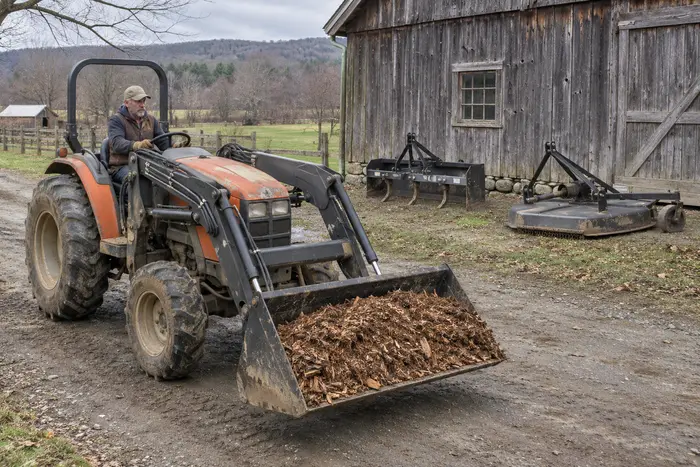
Farm attachments are used on two kinds of loader: skid steers and compact tractor loaders. Compact front-end loaders go on compact utility tractors, which are usually in the 20 to 50 hp range, while full-size tractor front loaders go on larger farm tractors. Skid loaders use four hydraulically driven wheels and track loaders use continuous tracks. Compact tractor loaders usually have lower capacities than commercial loaders, so size every tool to your machine's rated capacity. Our guide on a skid steer vs a tractor helps if you are still choosing a machine, and compact tractor attachments covers three-point tools.
Must-have farm attachments
| Attachment | Farm jobs | Hydraulics needed |
|---|---|---|
| General-purpose bucket | Gravel, soil, feed, grain, snow, cleanup | Cylinders only |
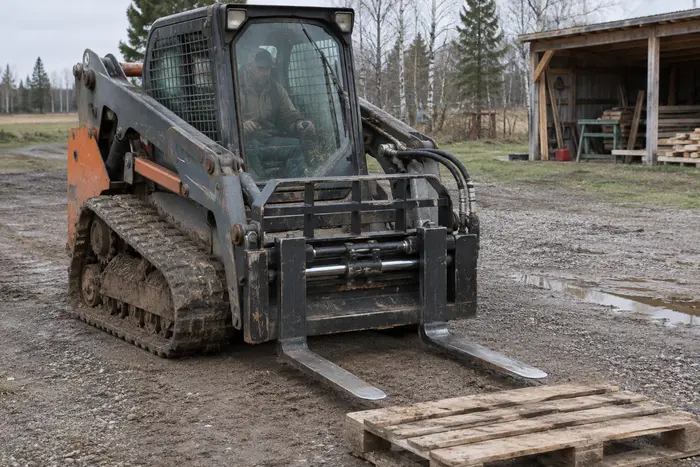
| Pallet forks | Feed bags, fence supplies, pallets, hay in small bundles | Cylinders only |
| Bale spear | Round bales: loading, moving, feeding | Cylinders only |
| Manure fork | Bedding, manure, silage, brush | Cylinders only |
| Grapple | Brush, logs, rocks, fence debris | Auxiliary circuit |
| Auger | Post holes, tree planting | Auxiliary circuit |
| Brush cutter | Fence lines, field edges, overgrowth | Auxiliary circuit; check flow |
Moving bales
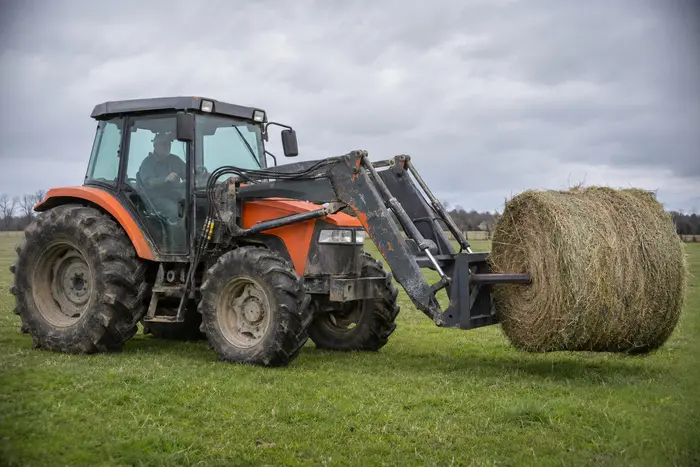
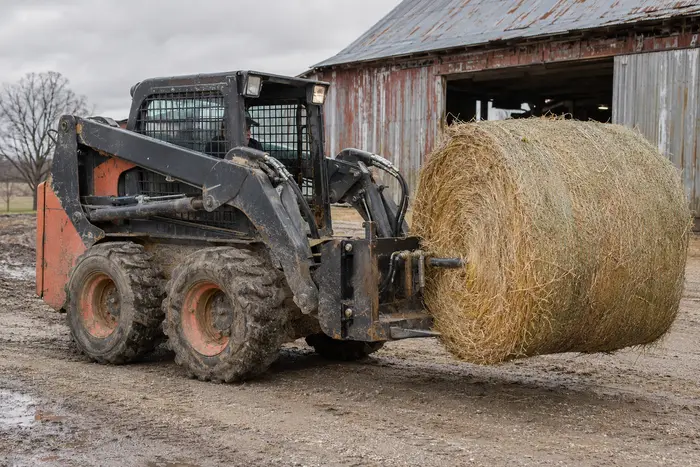
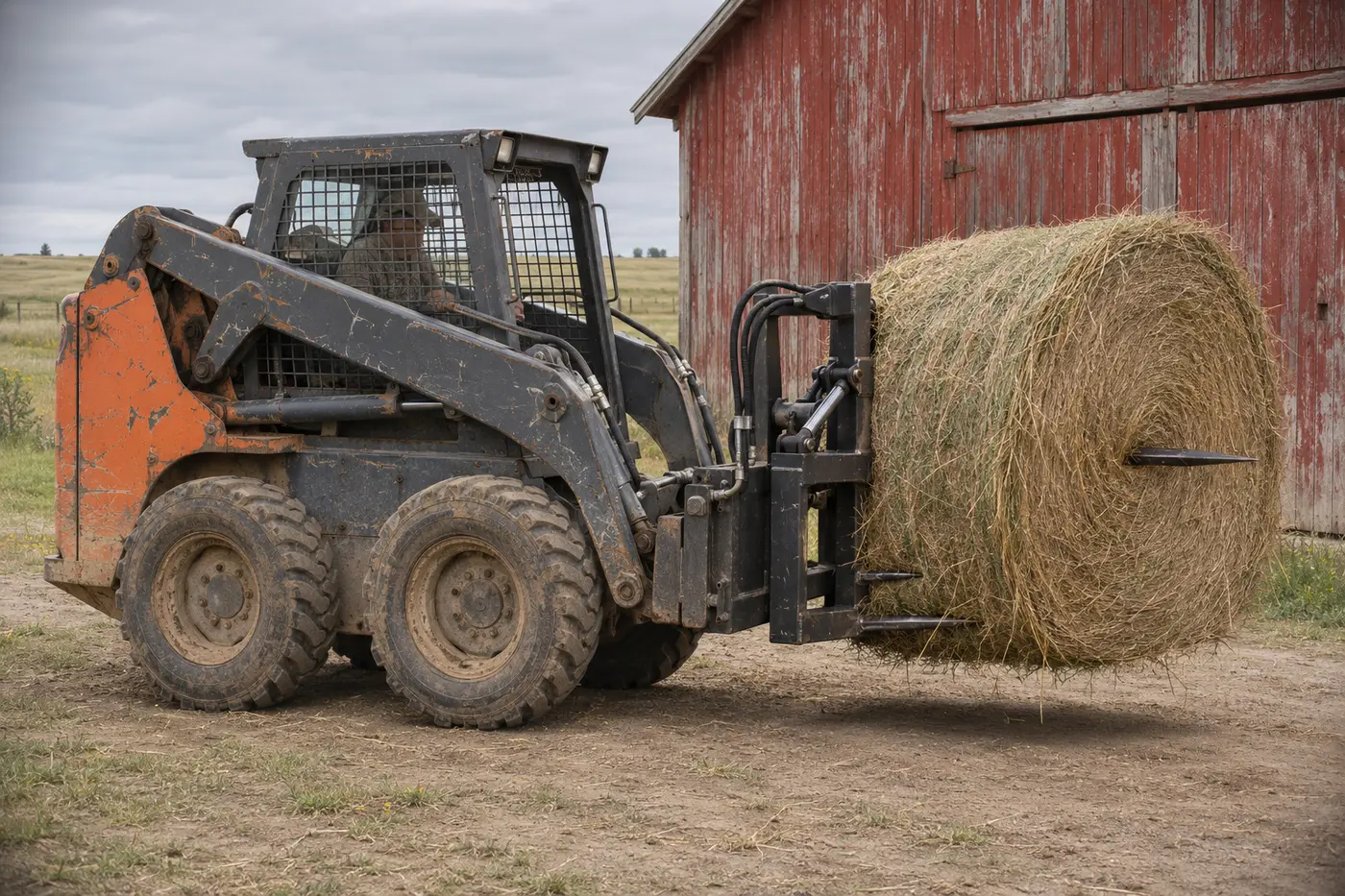
A bale spear is the simplest bale tool. It pushes into the center of a round bale and lifts it, and a stabilizer spear or a pair of spears keeps the bale from spinning. Reference sources list bale grapplers and bale spears among the standard loader attachments for hay and straw. Take care with weight and tip load: wet bales can be much heavier than dry ones, and a high bale makes a loader less stable. Our guides on how to move round bales and the skid steer bale spear guide go deeper, and you can browse bale spears and bale handlers.
Manure, bedding and feed
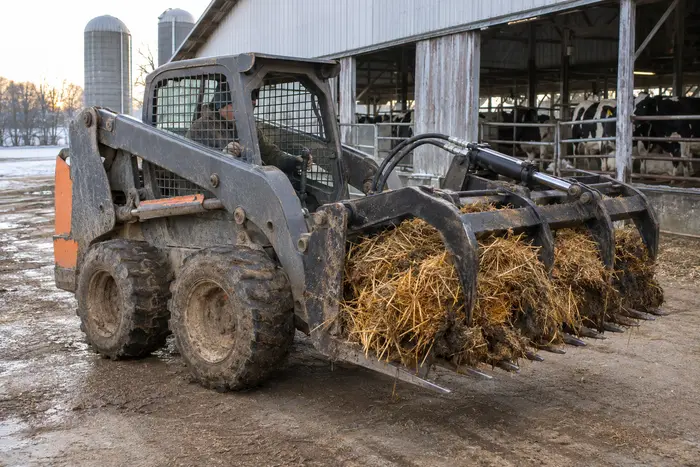
A manure fork, a heavy-duty tined fork bucket, lifts manure and bedding while letting fine material fall through. It also works on silage and brush. A solid bucket handles grain and loose feed. See the manure fork guide and browse manure forks.
Fence lines and brush
For fence work, an auger drills post holes and a hydraulic post driver pushes posts in. See our fence installation guide and how deep a fence post should be. For overgrowth, a brush cutter clears pasture edges and fence rows. Lighter cutters work on standard flow, as our low-flow brush cutter guide explains. A grapple helps pile and move what you cut. Browse grapples and brush cutters.
Lanes, yards and drainage
A box grader, land plane or landscape rake keeps gravel lanes and yards smooth. See box graders and landscape rakes, plus our guide to building a gravel driveway. A rock bucket or skeleton bucket separates stones from soil in pasture renovation and field edges.
Winter on the farm
Snow is a loader job too. A snow pusher or blade clears yards and lanes, and a spreader handles ice at barn doors. A general reference lists snow removal among the typical loader jobs, including sidewalks and parking lots. See attachments for snow in Canada.
How to decide what to buy first
- List the five jobs you do most each season.
- Pick tools that handle at least three of them. A bucket, forks and a bale spear usually do.
- Check your loader's rated operating capacity and lift height against bales and pallets.
- Add hydraulic tools only if you have the auxiliary flow they need.
- Rent anything you will use less than a few times a year.
Skid steer or tractor loader for farm attachments?
A skid steer turns in place and is quick in barns and pens, but it can be hard on turf. A tractor loader is gentler on ground and can do tillage, mowing and hauling with three-point tools. Many farms have both. Attachments made for one do not always fit the other, though adapters exist. Check mounting and capacity before you buy, and read are skid steer attachments universal.
Safety on the farm
Keep bales and loads low while traveling, and never carry a raised load across a slope. Use a machine with a rollover and falling-object protective cab or frame (ROPS and FOPS) when lifting bales overhead. Keep bystanders and livestock clear of the work area. Follow the operator manual and the rated capacity on the machine.
A sample setup by farm type
Hay and cattle
Bale spear for round bales, a bucket for feed and gravel, pallet forks for supplies and a manure fork for pens. A grapple helps with fence repair debris. Watch bale weight against your loader's rated capacity and lift height.
Horse property
A manure fork and a bucket for bedding, forks for shavings and feed, an auger for fence and arena posts, and a landscape rake for footing and lane maintenance. Smooth, level footing matters for animals, so a rake or box grader earns its place.
Hobby acreage
A bucket, forks and a brush cutter cover most of the year. Add an auger for plantings and fence, and a snow pusher for winter. Many hobby owners use a compact tractor loader plus three-point tools instead of a skid steer.
Market garden or orchard
A bucket for compost and soil, forks for crates and bins, and a tiller or rake for bed preparation. A tree spade or auger helps with orchard planting. Choose tools sized to your machine, since small machines limit weight and width.
What do skid steer attachments cost to run?
We do not quote prices on this page, and the running cost depends on how often you use each tool. A useful way to think about it: tools with no hydraulics, like buckets and forks, have almost no running cost. Hydraulic tools add wear parts such as blades, teeth, hoses and couplers. Brush cutters and mulchers have the highest wear. Plan for replacement parts in your budget, and ask for the expected wear-part life in your conditions when you get a quote.
Maintenance that saves money on a farm
- Grease pivot points and quick-attach pins on a schedule.
- Check hoses and couplers for wear and cracking before every season.
- Wash salt and manure off steel to slow corrosion.
- Keep cutting edges sharp or replace them when worn.
- Store attachments off the ground, on a rack or pallet, to protect them from rust and make hookup easier. Browse attachment racks if you are running out of floor space.
Our guide on skid steer attachment maintenance covers a seasonal routine in more detail.
Get the right fit the first time
Send us your machine's make, model and year, and a person will check fit against the maker's specs. Your quote shows one delivered price, freight to your address included, and the order ships direct from the supplier. Start a fit-checked quote.
Questions buyers ask
What are the best skid steer attachments for farming?
A bucket, pallet forks, a bale spear, a manure fork and a grapple cover most farm jobs. Add an auger and a brush cutter for fence lines and overgrowth. Choose by the jobs you repeat and size each tool to your machine's capacity.
What are must-have skid steer attachments?
For most owners the must-haves are a general-purpose bucket and pallet forks. On a farm, add a bale spear and a manure fork. Add specialty tools only when a recurring job justifies them, and rent the ones you use rarely.
What are the best attachments for a compact tractor?
A front-end loader with a bucket and forks covers most work. Three-point tools such as a box blade, a rotary cutter or flail mower, a tiller and a post-hole digger add field and fence capability. Match each tool to your tractor's horsepower and lift capacity.
Can a skid steer do farm work as well as a tractor?
For loading, feeding, manure and material handling, a skid steer is quick and maneuverable. A tractor is better for tillage, mowing and pulling implements, and it is gentler on turf. Many farms use both, and attachments are not always interchangeable between them.
Which farm attachments need hydraulic flow?
Buckets, forks, bale spears and manure forks run on cylinders and need little or no auxiliary flow. Grapples, augers and brush cutters use the auxiliary circuit. Large brush cutters and mulchers need the most flow, so check your loader's rating first.