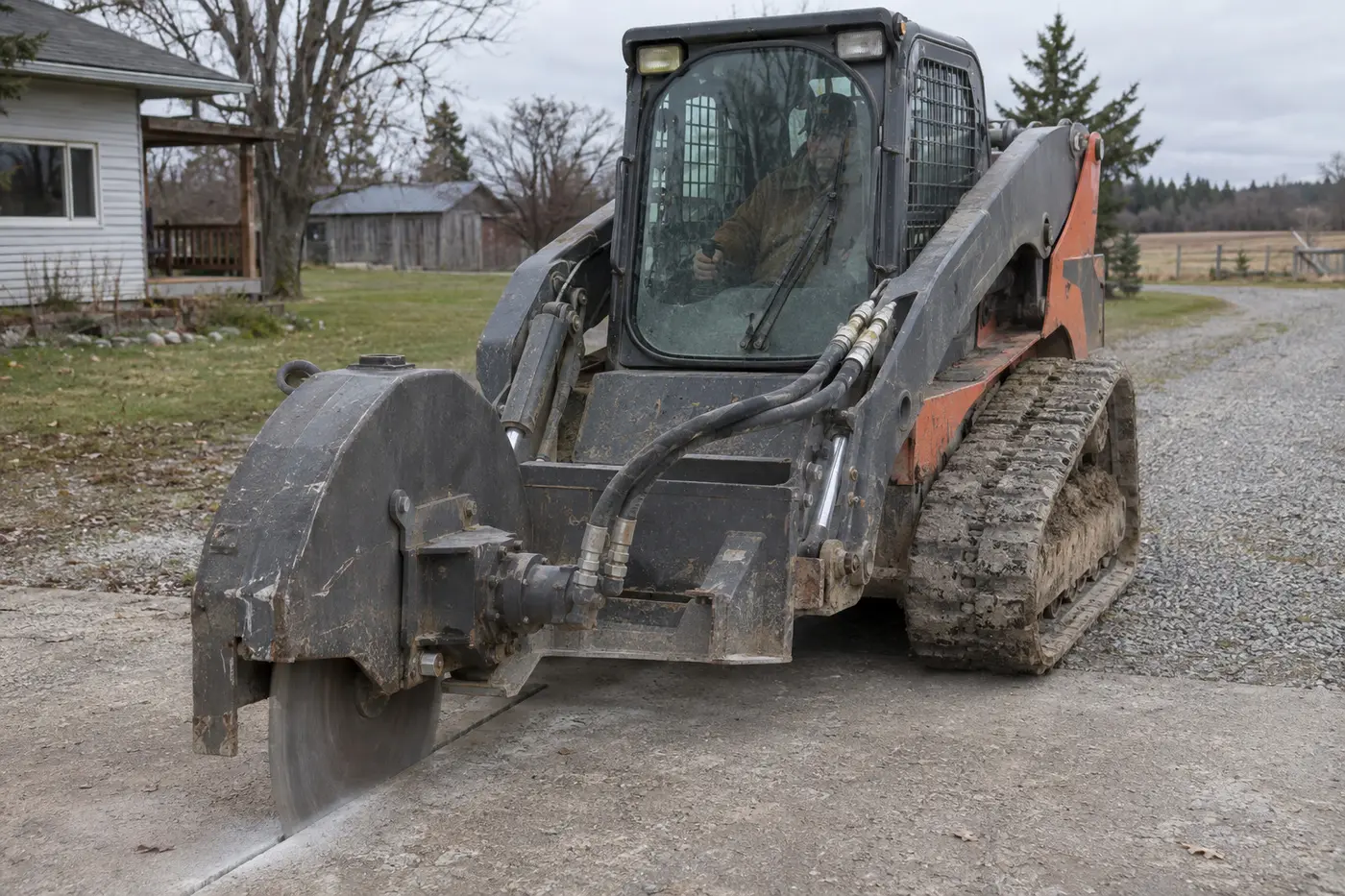
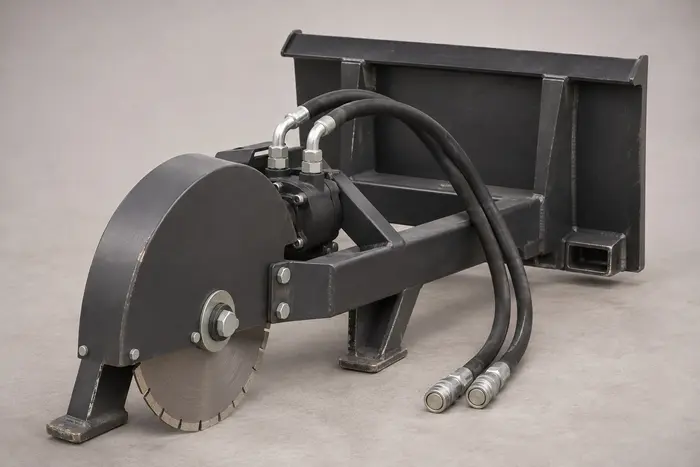
A skid steer concrete saw is a hydraulic saw attachment that cuts through concrete and asphalt slabs. It mounts on the quick attach of a skid steer or compact track loader and uses a large diamond blade driven by the loader's auxiliary hydraulics to make straight cuts at a set depth.
Attachment type. Maker, model, photos and availability for your machine are confirmed on your quote.
Heavy-Duty Concrete Saw AttachmentPhotos confirmed on your quote
Heavy-Duty Concrete Saw Attachment
Larger-frame skid steers and track loaders
A larger-blade saw built for deeper cuts through thick slabs and pavement. Suited to crews who cut daily and want a stronger frame and steady blade speed.
Attachment type. Maker, model, photos and availability for your machine are confirmed on your quote.
Fit check
What a person checks before you get a price
Fit is the first thing that goes wrong when you buy attachments online. Before we send a delivered price, a person checks your setup against the maker's specs. If we can't confirm fit, we tell you before you pay.
Make, model and year of your machine
Coupler: universal quick attach or another plate
Auxiliary hydraulic flow and pressure, standard or high flow
Hose coupler type (flat-face or poppet) and any electrical connector
Rated operating capacity against the attachment's weight
Width against your machine and the job
How hard you'll run it: acreage use or daily contractor work
How buying here works
Tell us your machine and the job.
A person checks fit and sends one delivered price, freight included.
Approve it and the supplier ships to your door.
We're a new dealer adding manufacturers now. If we can't source a fit-checked option for your machine and job, we'll tell you on the first call, with no obligation.
How to choose skid steer concrete saw
Look at the cut you need to make first. Blade size sets the maximum depth, and the loader's hydraulic output sets how well the blade holds speed under load. Pick a saw that matches both.
Blade size and depth: a larger blade cuts deeper but needs more power and a heavier carrier.
Hydraulic flow and pressure: check your loader's auxiliary output against the saw's requirement.
Water or dust control: wet cutting keeps the blade cool and limits silica dust. Plan for a water supply.
Mount and alignment: confirm universal quick attach and how the saw is guided along a line.
Blade type: concrete, green concrete and asphalt each call for a different diamond blade.
Blade care is part of the cost of cutting. Diamond blades wear faster in abrasive aggregate and can glaze if you push them too hard, so ask about blade types for your material and how to swap them. Keep spare blades on hand if the saw is on a deadline job, and keep guards in place at all times.
Common jobs for skid steer concrete saw
Road and utility crews use a loader-mounted saw to open up pavement fast.
Trench cuts: cut clean edges for utility trenches in slab or asphalt.
Joint and relief cuts: cut joints or relief cuts in existing slabs.
Demolition prep: score slabs so they break in manageable sections.
Road repair: square off failed pavement before a patch.
A saw pairs well with other demolition tools. See our skid steer attachment guide for how the options compare.
What we check before we quote
We confirm the quick attach style, auxiliary flow and pressure, coupler type and rated operating capacity for your skid steer, then compare them with the maker's specs for the skid steer concrete saw. A person reviews every match before a delivered price is sent to you.
Get the right fit the first time
Send us your machine make, model and year. A person checks the attachment against the maker's specs, you approve a delivered price before you pay, and it ships direct from the supplier, with the ship-from location on your quote. Get a fit-checked quote.
It is a hydraulic saw attachment that cuts concrete and asphalt using a diamond blade. It mounts on a skid steer's quick attach and runs on auxiliary hydraulics, so one loader can cut pavement, trench lines and joints without a separate road saw.
Do skid steer concrete saws need water?
Wet cutting is standard practice. Water cools the blade and keeps silica dust down, which protects the operator and nearby workers. Follow dust-control rules for your jurisdiction and the saw maker's manual, and plan for a water supply on the job.
How deep can a skid steer concrete saw cut?
Depth depends on the blade diameter and the saw's design. Larger blades cut deeper but need more hydraulic power and a heavier loader. Tell us the slab thickness you cut most, and we match a saw that handles it with your loader's flow.