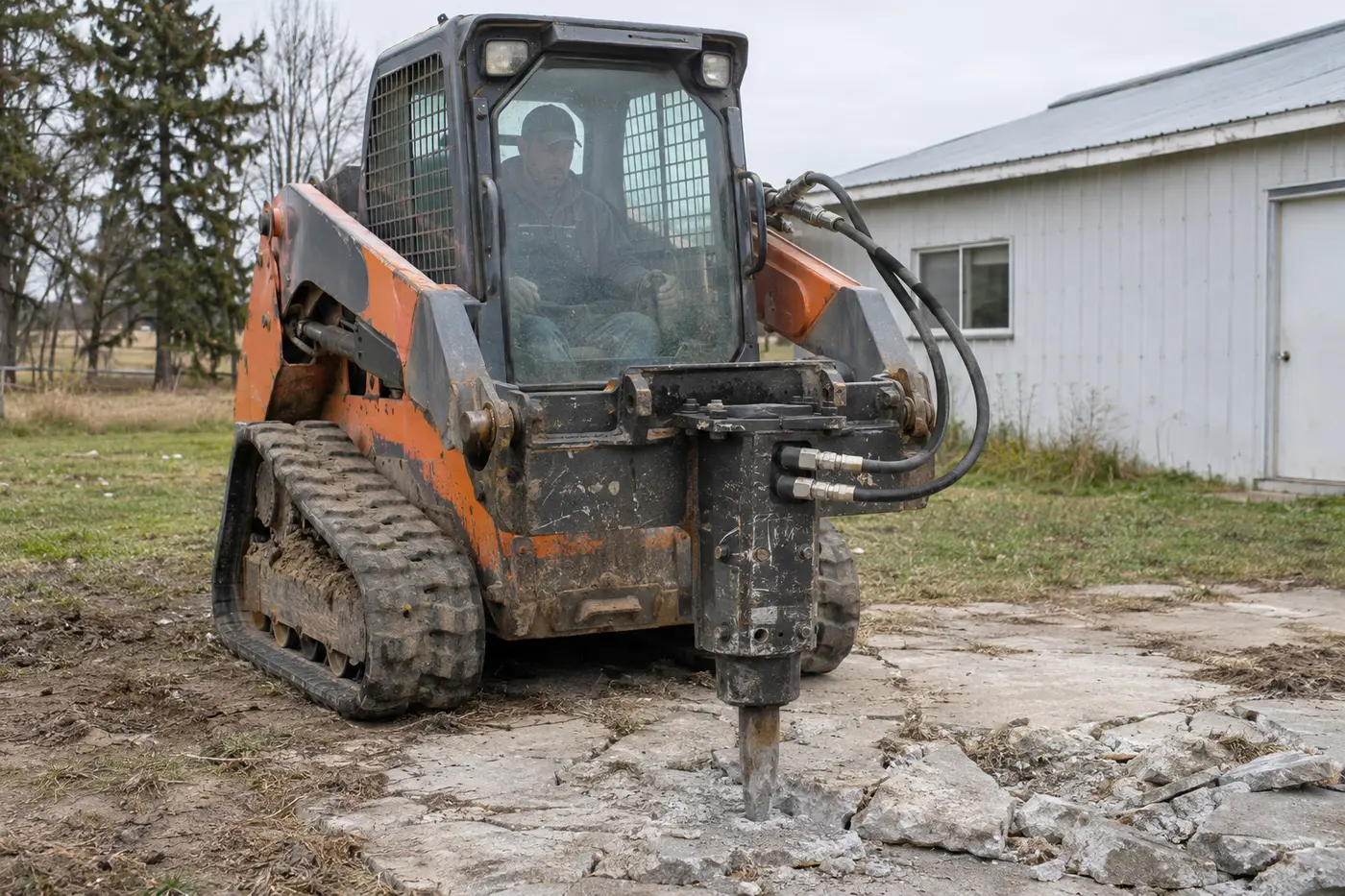
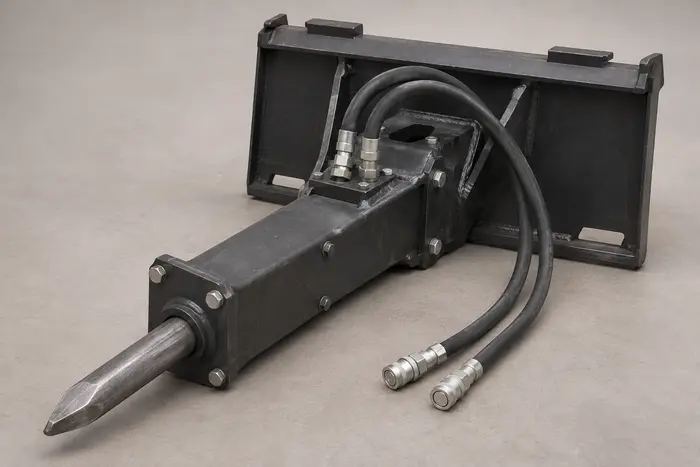
A skid steer breaker attachment is a hydraulic hammer that mounts on the loader's quick attach plate. It breaks concrete, asphalt, rock and frozen ground by delivering repeated blows through a tool bit powered by the loader's auxiliary hydraulics. Choosing the right class for your loader protects both the carrier and the tool, and keeps demolition moving without constant stops.
Every option is quoted for your exact machine. Sizes, flow and couplers are confirmed on the quote.
Illustration
Light-Duty Hydraulic Breaker
Smaller skid steers with standard flow
A compact breaker for light demolition such as thin slabs, sidewalks and patch work. A fit for contractors working in tight spaces on smaller loaders with standard hydraulic flow.
Compact body
Standard flow operation
Quick attach mount
Good for small jobs
Get my delivered priceTypical listed price at other online dealers$7,500 – $9,750USD · shipping terms vary by seller · a guide, not our price
Attachment type. Maker, model, photos and availability for your machine are confirmed on your quote.
Heavy-Duty Hydraulic BreakerPhotos confirmed on your quote
Heavy-Duty Hydraulic Breaker
Larger-frame skid steers and track loaders
A higher-energy breaker for thick concrete and footings. Designed for steady work on larger loaders with strong hydraulics, where cycle time and impact power matter more than a compact body.
Higher impact energy
Reinforced housing
Suits larger frames
Flow matched on quote
Get my delivered priceTypical listed price at other online dealers$9,750 – $10,650USD · shipping terms vary by seller · a guide, not our price
Attachment type. Maker, model, photos and availability for your machine are confirmed on your quote.
Rock and Ice Breaker Tool KitPhotos confirmed on your quote
Rock and Ice Breaker Tool Kit
Skid steers with standard or high flow
A breaker with interchangeable tool bits for rock, frozen ground and ice. Built for seasonal work where the material changes and the operator needs to swap bits quickly in the field.
Attachment type. Maker, model, photos and availability for your machine are confirmed on your quote.
Price ranges show what two other North American online dealers listed comparable attachments for, checked November 2026. Shipping terms vary by seller. They are a guide, not our price: your delivered price, with freight to your address, is confirmed on your quote.
Fit check
What a person checks before you get a price
Fit is the first thing that goes wrong when you buy attachments online. Before we send a delivered price, a person checks your setup against the maker's specs. If we can't confirm fit, we tell you before you pay.
Make, model and year of your machine
Coupler: universal quick attach or another plate
Auxiliary hydraulic flow and pressure, standard or high flow
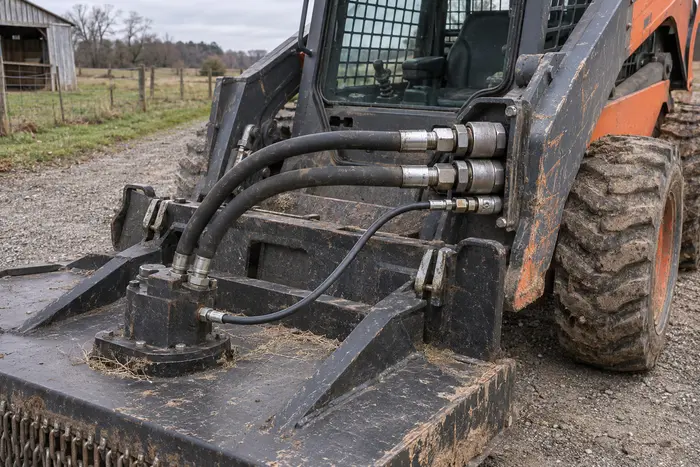
Hose coupler type (flat-face or poppet) and any electrical connector
Rated operating capacity against the attachment's weight
Width against your machine and the job
How hard you'll run it: acreage use or daily contractor work
How buying here works
Tell us your machine and the job.
A person checks fit and sends one delivered price, freight included.
Approve it and the supplier ships to your door.
We're a new dealer adding manufacturers now. If we can't source a fit-checked option for your machine and job, we'll tell you on the first call, with no obligation.
How to choose skid steer breaker attachment
Breakers are sized to the carrier. Too small and you waste time. Too large and you risk the loader and the tool. The loader's hydraulic flow and operating weight drive the choice.
Hydraulic flow and pressure: the breaker must match the loader's auxiliary output. Too much flow can damage the tool.
Carrier size: match the breaker class to the loader's frame and operating weight.
Mount: confirm universal quick attach or a plate that fits your loader.
Tool bit: point, chisel or moil. Choose by material: concrete, rock or asphalt.
Case drain and returns: some breakers need a dedicated return line. Check your loader's setup.
Matching the breaker to your loader
A breaker is only as good as the hydraulics behind it. Find your loader's auxiliary flow and relief pressure in the operator manual, then compare them with the breaker's operating range. Check whether the breaker needs a separate return line or a case drain, and make sure the hoses and couplers are rated for the pressure. Keep the tool bit lubricated, never fire the breaker without pressure on the bit, and keep the front door or guard your loader maker specifies for breaker work in place. Follow the operator manual for the loader and the breaker.
Common jobs for skid steer breaker attachment
Breakers do the heavy demolition work when a bucket will not.
Concrete demolition: slabs, footings and curbs.
Rock work: breaking oversized boulders and light rock.
Asphalt removal: trenches and patch repairs.
Frozen ground: breaking a frost layer before digging.
A fit check covers the mount, the hydraulics and the load limits of your skid steer. We read the specs for the skid steer breaker attachment against your machine, so you know it fits before you approve a price.
Get the right fit the first time
Send us your machine make, model and year. A person checks the attachment against the maker's specs, you approve a delivered price before you pay, and it ships direct from the supplier, with the ship-from location on your quote. Send us your machine for a fit check.
It depends on the loader's operating weight and hydraulic flow. A breaker class that is too heavy overloads the frame. One that is too small works slowly. Send your make and model and we confirm a breaker that matches flow and mount.
What is a skid steer breaker used for?
It breaks concrete, asphalt, rock and frozen ground. Common jobs include removing slabs, footings, curbs and boulders, plus patching asphalt. Use the tool bit that matches the material, and follow the operator manual for the loader.
Do skid steer breakers need high flow?
Many run on standard auxiliary flow, but the correct breaker must match your loader's output. Over-supplying flow can damage the tool, and under-supplying cuts power. We verify flow and pressure against the breaker's specs before quoting.