Tractor guide
Best Attachments for a Compact Tractor: A Practical Guide
Quick answer
The best attachments for a compact tractor are a front loader bucket, a box blade, a rotary cutter, a rotary tiller and a post-hole digger. Start with the loader and the one tool that does your most common job. Check the hitch category, PTO power and lift capacity before buying any implement.
Shopping for this now? Get a fit-checked, delivered quote.
Key takeaways
- Start with the front-end loader bucket, then add the tool for your most frequent job.
- Check the hitch category (usually 1 on a compact tractor), PTO speed and lift capacity first.
- Rear implements ride the three-point hitch; front tools use the loader or quick-attach.
- Buy a smaller set of well-matched tools rather than a long list of marginal ones.
A compact tractor earns its keep through its attachments. The tractor itself is a power unit with a hitch, a PTO and a loader. What you hang on it decides what it can do. This guide lists the best attachments for a compact tractor, in rough order of usefulness, and shows what to check before you buy.
Check these three things before you buy any attachment
- Hitch category. Most compact tractors use a Category 1 three-point hitch, which is common on tractors in the roughly 20 to 45 hp range. Very small machines may use Category 0, and larger ones Category 2. See three-point hitch categories to confirm yours.
- PTO power and speed. Powered tools like tillers, mowers and chippers need enough PTO horsepower and the right shaft speed. Match the implement's requirement to the tractor's PTO rating.
- Lift capacity. The tractor's rear lift capacity limits the weight of a three-point implement. A heavy implement that the hitch cannot lift is a safety problem.
Also check the front loader: its lift capacity, quick-attach type and hydraulic circuit determine which loader tools fit.
Top compact tractor attachments
| Attachment | Mounts on | What it does |
|---|---|---|
| Loader bucket | Front loader | Digs, carries, loads and levels |
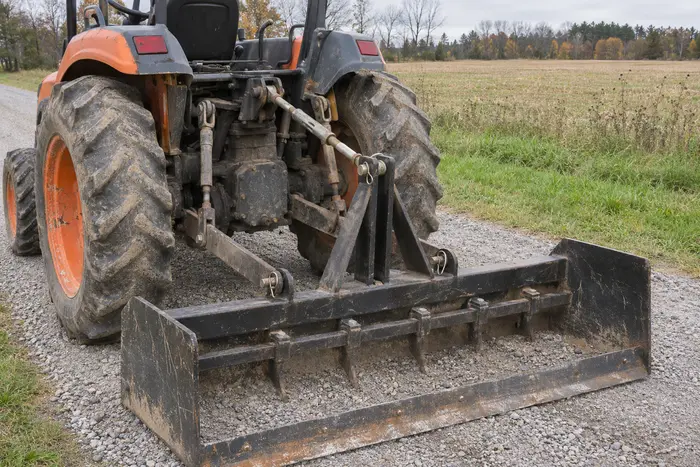
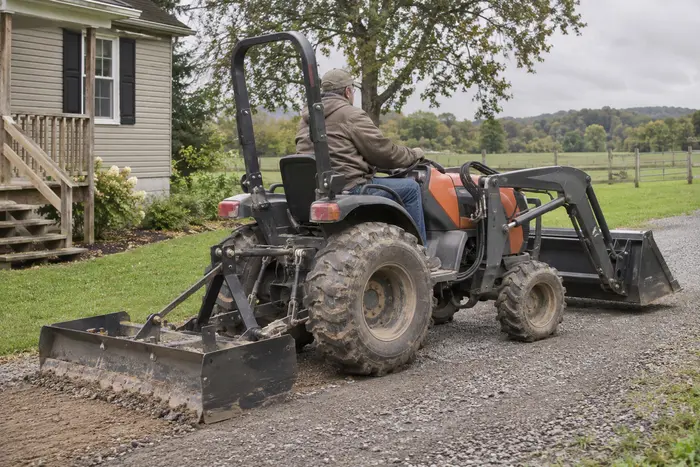
| Box blade | Three-point hitch | Grades driveways, levels and spreads gravel |
| Rotary cutter | Three-point hitch, PTO | Cuts brush, tall grass and pasture |
| Rotary tiller | Three-point hitch, PTO | Breaks soil for gardens and seedbeds |
| Post-hole digger | Three-point hitch, PTO | Drills fence and post holes |
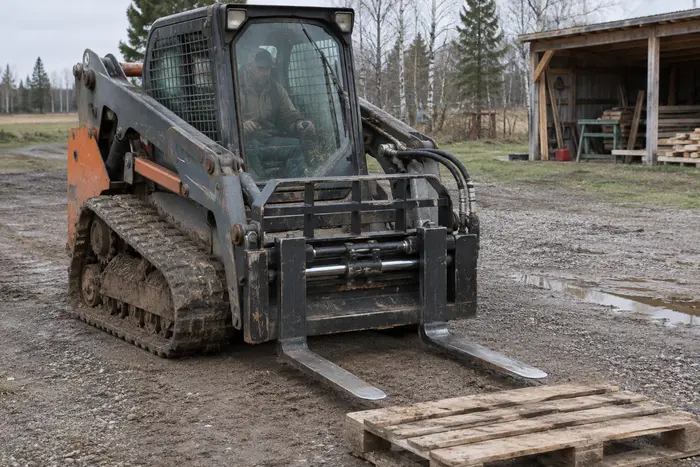
| Pallet forks | Loader | Moves pallets and bulky items |
| Grapple | Loader | Holds brush, logs, rocks and debris |
| Rear blade | Three-point hitch | Pushes snow and shapes ground |
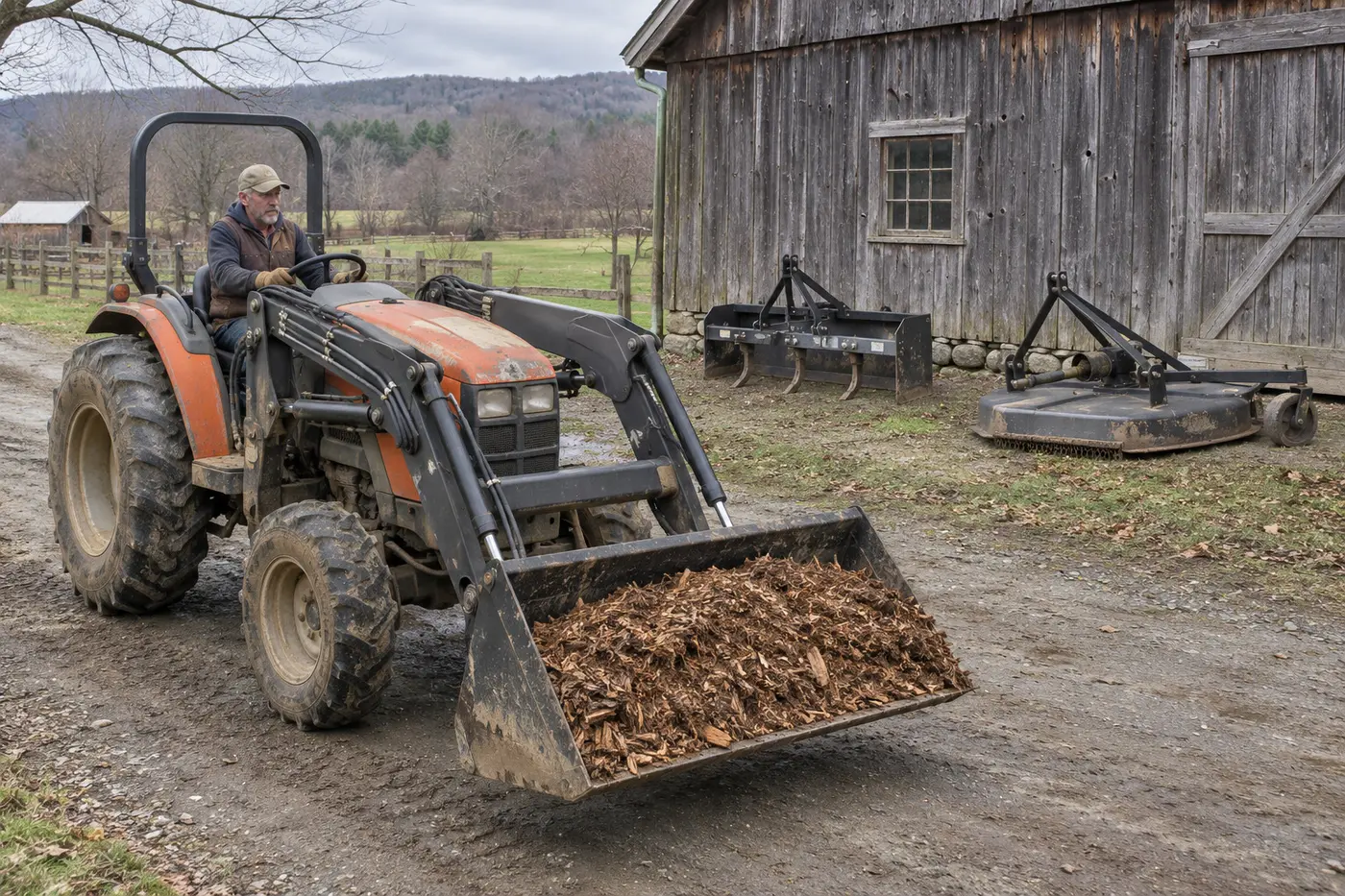
1. Front loader bucket
If your tractor has a loader, the bucket is the most-used tool you will own. It moves soil, gravel, mulch and snow. A general-purpose bucket is the starting point. Specialty buckets and bucket forks for a tractor loader extend its use. Check the bucket width against the tractor and how much material it can carry within the loader's rated lift capacity.
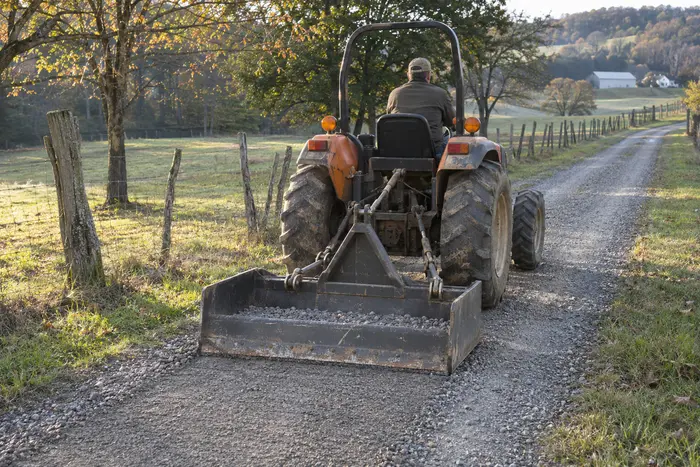
2. Box blade
A box blade is the standard tool for driveway and road upkeep. It cuts, carries and spreads gravel and shapes ground. It needs a hitch rating and weight that match the tractor. See how to use a box blade on a gravel driveway for technique.
3. Rotary cutter (brush mower)
A rotary cutter mows pasture, tall weeds and light brush. It runs from the PTO. Look at the cutting width, the gearbox rating and the deck strength. Cutters are rated for a maximum cutting diameter, so check that before tackling saplings. For finer cutting on lawns, a finish mower is a different tool. See also flail mower vs rotary cutter.
4. Rotary tiller
A tiller turns hard ground into a seedbed for a garden, food plot or lawn. It also needs PTO power, and tiller width must suit the tractor. A tiller that is too wide for the tractor will bog down. Read our best rotary tiller for a compact tractor guide.
5. Post-hole digger
A PTO auger drills holes for fence posts, signs and trees. The auger diameter and the gearbox rating matter. Soil conditions limit it. Rocky ground may need a rock bit or a different tool. See our auger category for options on the loader side.
6. Grapple and pallet forks
A loader grapple holds brush, logs and rocks, and cleans up storm debris. Pallet forks move bags, bales and pallets. Both depend on the loader's rating and the quick-attach on your tractor. Compare them with skid steer grapples and pallet forks if you run both machines.
7. Rear blade, snow tools and more
A rear blade handles light grading and plowing. In snow country, a blade, a blower or a pusher is often the most valuable tool of the year. Add-ons include a log splitter, a rear scraper, a chipper and a spreader. Add them one at a time as a real need appears.
Compact tractor or skid steer?
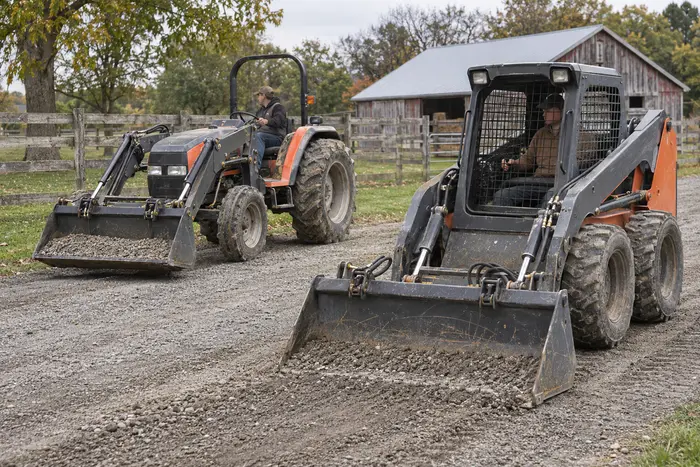
A compact tractor is a PTO and three-point machine with a loader. A skid steer is a loader that turns in place and takes a huge range of attachments. If your work is mowing, tilling and grading, a tractor suits. If your work is digging, carrying and clearing, a skid steer may be better. See skid steer vs tractor for a closer comparison. You can also add a 3 point adapter to run tractor tools on a skid steer.
A buying order that makes sense
- Loader bucket (usually comes with the tractor).
- The one rear tool for your most frequent job: box blade, cutter or tiller.
- Forks or grapple for the loader.
- Post-hole digger if you fence or plant.
- Seasonal tools: snow, mowing, spreading.
Start small, use each tool until you understand its limits, and then expand. For smaller tractors, see sub-compact tractor attachments.
Common mistakes when buying tractor attachments
- Buying on width alone. A wider tool is not always better. If the tractor lacks the weight or PTO power, a wide implement will stall or lift poorly.
- Ignoring the PTO shaft. Driveline length and shield condition matter. A shaft that is too long or short for your hitch can bind or separate.
- Overlooking the loader's limits. Loader tools hang forward of the tractor, so heavy ones reduce real lift capacity and can lighten the rear end. Add rear ballast if the manual calls for it.
- Skipping ballast. A rear implement balances a front loader, and the opposite is true too. Weight on the right end keeps the tractor steady.
- Buying used without checking wear. Check blades, gearboxes, pins and hoses before you pay. Worn parts add cost fast.
- Forgetting the quick hitch. A quick hitch speeds changes but can move the implement farther back, which affects lift and balance.
Seasonal attachment plan
Think about the year. In spring and summer you may mow, till and spread. In fall you clear leaves, drill post holes and prep for winter. In winter, snow tools matter. A small set of tools that covers each season is better than a large set that sits unused. Check our guide to attachments for farm and acreage for ideas matched to land use.
Before you spend money, test the tractor with the loaded implement in a safe area. Check that the front wheels stay planted, the hydraulics lift smoothly and the PTO engages without strain. A short trial tells you more than a spec sheet.
Get the right fit the first time
Tell us your tractor's make, model and year, plus its hitch category and loader type if you know them. A person checks the fit against the maker's specs, your quote shows one delivered price, freight to your address included, and the order ships direct from the supplier. Get a fit-checked quote.
Questions buyers ask
What are the best attachments for a compact tractor?
Start with a front loader bucket, then add a box blade, rotary cutter, rotary tiller or post-hole digger depending on your work. Pallet forks and a grapple add loader versatility. Match each to your hitch category, PTO and lift capacity.
What hitch category do compact tractors use?
Most use Category 1, which covers roughly 20 to 45 horsepower. Very small tractors may use Category 0, and larger compacts may use Category 2. Check your manual or measure the pins and lower-link spacing to confirm.
What is the most useful attachment for a compact tractor?
For most owners it is the front loader bucket, followed by a box blade for gravel and grading or a rotary cutter for mowing. The most useful tool is the one that matches your most common job.
Can I use a skid steer attachment on a compact tractor?
Sometimes, with a quick-attach adapter, but it depends on the tractor's loader and hydraulics. Many loader tools use different mounts and flow. Always check weight, mount type and hydraulic requirements with the maker before you buy.
Do compact tractor attachments need PTO power?
Some do. Tillers, rotary cutters, post-hole diggers and chippers use the PTO. Check the horsepower and speed the implement needs, and compare them to your tractor's PTO rating. Tools like box blades and loader buckets do not use the PTO.