Forklift guide
How to Drive a Forklift: Beginner's Guide
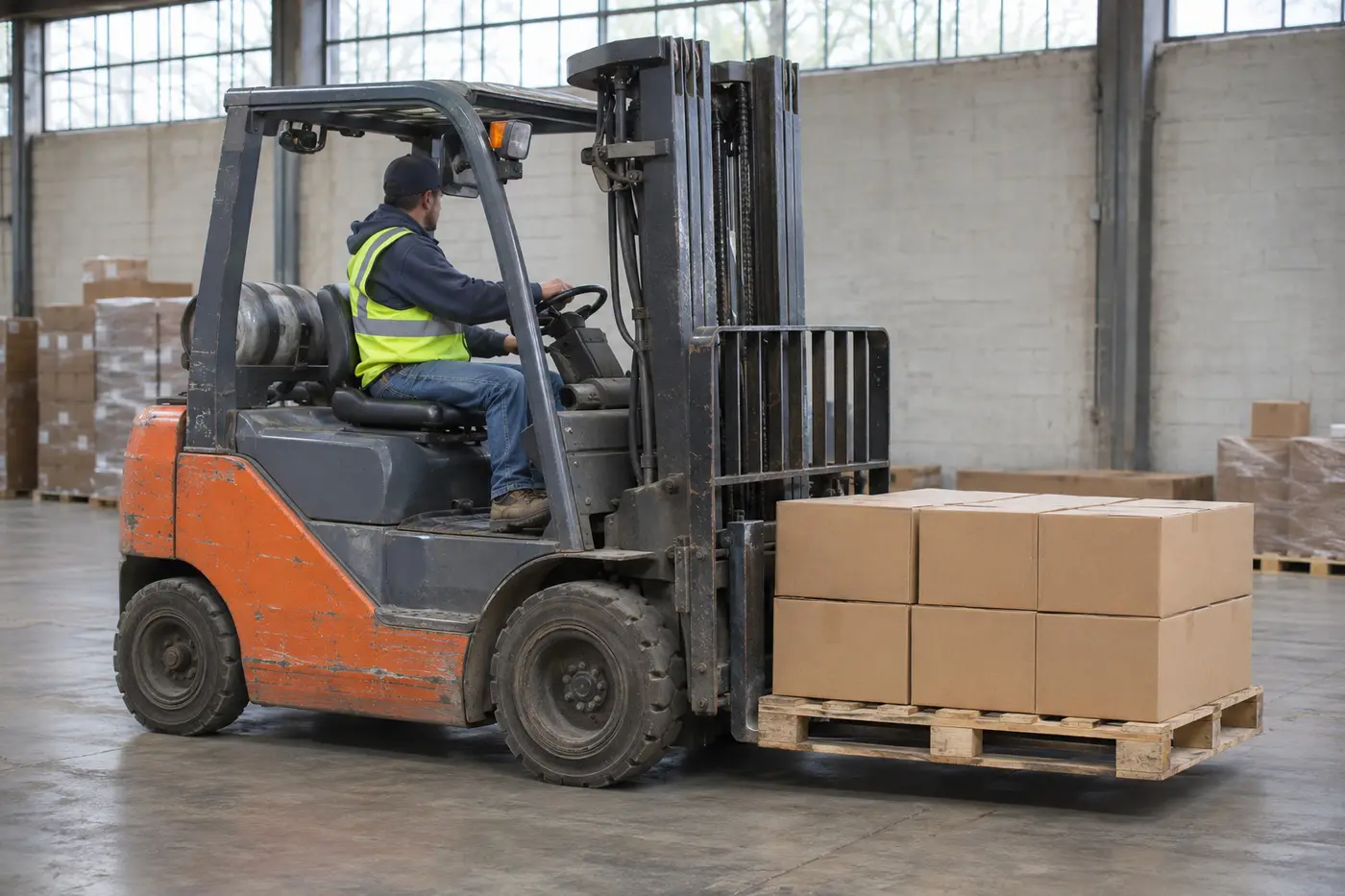
Quick answer
To drive a forklift, complete employer training, inspect the truck, buckle up, set the forks low and tilted back, then drive slowly with the load trailing uphill on ramps. Steering is by the rear wheels, so the back swings wide. Never carry riders or turn fast with a raised load.
Shopping for this now? Get a fit-checked, delivered quote.
Key takeaways
- Training and evaluation are required by OSHA before you operate a powered industrial truck.
- Inspect the truck before use, at least daily.
- Rear-wheel steering makes the back end swing wide.
- Keep forks low, load tilted back and travel slow.
Before anything else about how to drive a forklift: you need training and authorization first. This guide covers the basic steps and habits, but it does not replace your employer's training program or the operator manual for your truck.
Do you need training to drive a forklift?
Yes. Under OSHA rules in the United States, employers must make sure each operator is competent, shown by completing training and evaluation. Anyone under 18 may not operate a forklift in non-agricultural jobs. Each operator's performance must be evaluated at least once every three years. Refresher training is also required after unsafe operation, an accident or near miss, a poor evaluation, reassignment to a different type of truck or a change in the workplace that affects safe operation. Canadian provinces have their own rules, so check yours.
Know the controls
Forklift controls differ by model, so read the manual. Most share these basics:
- Lift control: raises and lowers the forks.
- Tilt control: tilts the mast forward or back. Tilting back keeps a load from sliding off.
- Direction control: selects forward or reverse.
- Accelerator and brake pedals: some trucks also have an inching pedal for precise movement.
- Steering wheel: turns the rear wheels.
- Horn and parking brake: use the horn at corners and blind spots.
Why does a forklift steer differently?
A forklift steers with its rear wheels. That makes tight turns easy but swings the back end wide. When you turn, the tail moves in the opposite direction of the front. Watch for people, racks and walls behind you. A forklift is also not like a car on turns. The steering does not straighten itself the way a car's does. Practice turning slowly in an open area before you work around racks.
Pre-use inspection checklist
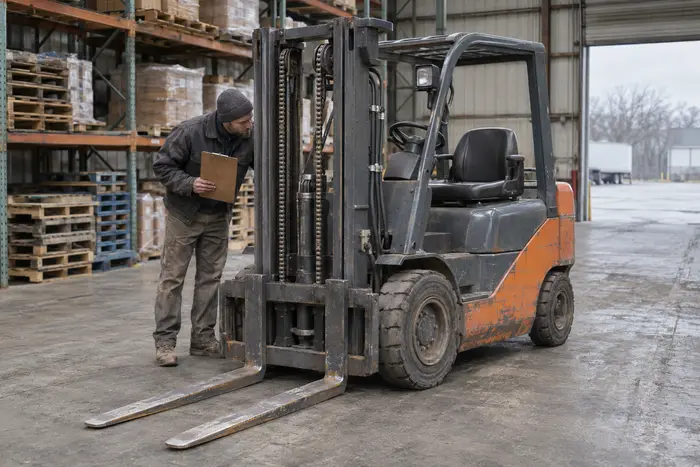
OSHA requires trucks to be examined before they are placed in service, and at least daily. Trucks used around the clock must be examined after each shift. Defects must be reported and corrected right away. A typical check includes:
- Look at tires and wheels for damage.
- Check forks for cracks, bends and wear. Make sure the heel is not worn.
- Check the mast and chains for damage and leaks.
- Check hydraulic hoses and fluid levels.
- Test horn, lights and backup alarm.
- Test brakes and parking brake.
- Check the seat belt and operator restraint.
- Confirm the capacity plate is in place and legible.
Our forklift inspection checklist goes into more detail.
How to drive a forklift step by step
- Mount and buckle up. Use the grab handles. Face the truck as you climb. Fasten the seat belt.
- Adjust. Set the seat so you reach the pedals and controls. Check mirrors if fitted.
- Start. Set the parking brake, put the direction control in neutral and start the truck.
- Set the forks. Lower them to about the height needed to clear the ground and tilt back slightly. Check overhead clearance.
- Check around you. Look all around, sound the horn and release the parking brake.
- Move off slowly. Select direction and press the accelerator gently.
- Look where you are going. If a load blocks your view, travel in reverse where it is safe to do so.
- Slow for turns. Turn smoothly with the load low.
- Stop smoothly. Ease off the accelerator and brake. Do not slam.
How to pick up and carry a load
- Approach the load straight on, with forks level.
- Set the fork spacing so they support the load.
- Drive the forks fully under the load.
- Lift a short distance and tilt back.
- Check that the load is stable and within the capacity plate rating.
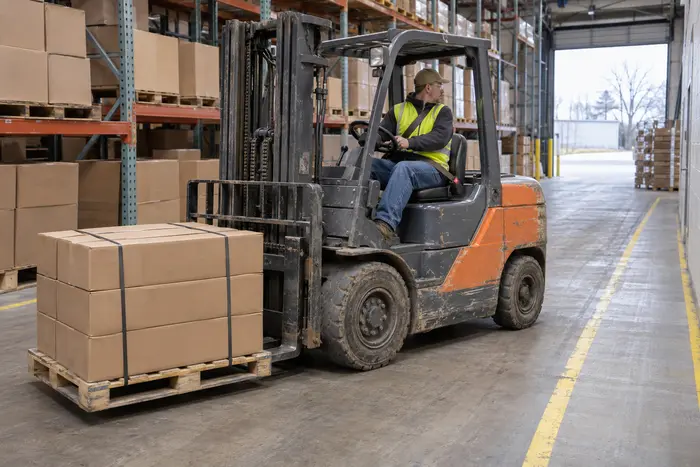
- Back away slowly, then lower the load to a travel height just above the floor.
Forklifts are rated for a maximum weight at a specified forward center of gravity. That information is on the nameplate. Load capacity drops as you raise the forks and when the load is not seated fully against the fork heel. Never exceed the rated capacity. See how to move pallets with a forklift and forklift weight.
How to drive a forklift down a ramp
Take grades slowly. Under OSHA rules, loaded trucks must be driven with the load upgrade on grades over 10 percent. On any grade, the load should be tilted back where applicable and raised only as high as needed to clear the road surface. That means that going down a ramp with a load, you travel in reverse so the load stays uphill. Going up a ramp with a load, you drive forward. Never turn on a ramp.
Safe habits that prevent accidents
- Never carry riders unless the truck is made for it and your employer authorizes it.
- No stunt driving or horseplay.
- Do not turn at speed with a raised load. The truck and load can tip over.
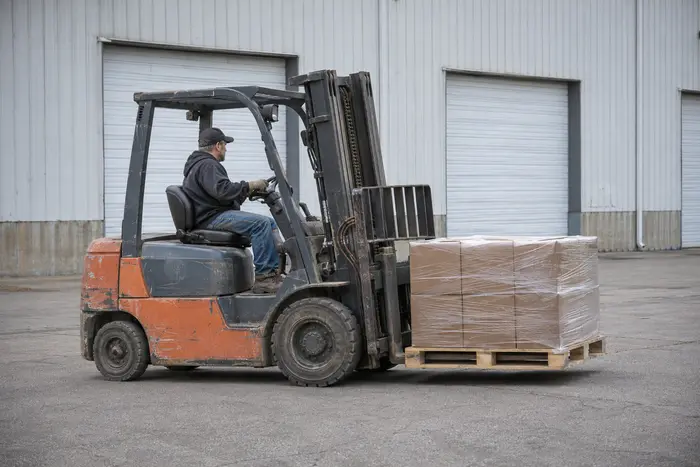
- Keep forks low while traveling.
- Sound the horn at corners and doorways.
- Do not lift people on forks. Use a rated platform where required. See man basket rules.
- Park with forks lowered, parking brake set and key removed.
Our full forklift safety guide goes deeper. For more on truck types, see types of forklifts.
What if you need a telehandler or skid steer instead?
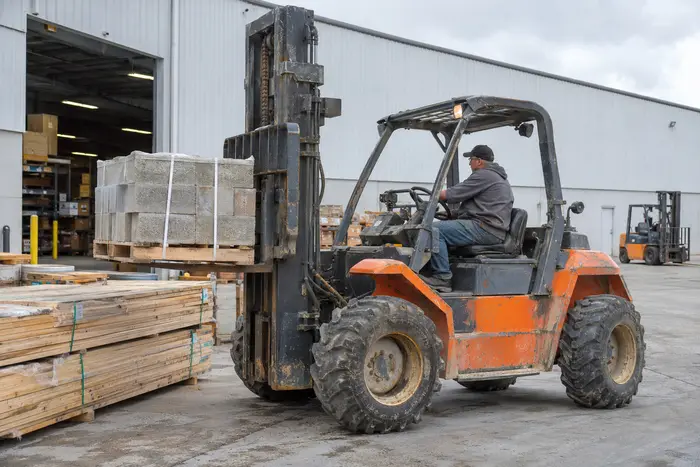
A warehouse forklift is built for smooth floors. If you work on rough ground, a telehandler or a skid steer with pallet forks is a better fit. Read telehandler vs forklift for the differences.
Common beginner mistakes
- Driving with forks raised. It raises the center of gravity and makes the truck unstable. Keep forks low.
- Taking turns too fast. The rear end swings and the load shifts. Slow before you turn.
- Not looking behind. The tail swings wide. Check before you turn or back up.
- Forgetting overhead clearance. Mast tops, sprinklers and door frames get hit by operators who forget the height.
- Guessing the weight. Read the load, check the capacity plate and ask if you are unsure.
Parking and shutdown
- Stop in a designated area, not in an aisle or exit.
- Lower the forks fully to the floor and tilt the mast slightly forward so the tips rest on the ground.
- Put the direction control in neutral and set the parking brake.
- Turn off the engine or power and remove the key.
- Report any defects you found during the shift.
Practice before you work
Practice in an open area with no one around. Drive forward and reverse, make turns, lift an empty pallet and set it down. Practice stopping smoothly. Under a trainer, practice picking up and placing a load on a rack. Skill builds with slow, repeated practice, not with speed.
Get the right fit the first time
Fit problems are the expensive mistakes, and they are easy to avoid. Send us your machine make, model and year and what you plan to do with it. A person checks the fit against the maker specs, and you see the delivered price before you pay. When you are ready, get a fit-checked quote.
Questions buyers ask
How do you drive a forklift for beginners?
Get trained and authorized first. Then inspect the truck, buckle up, lower the forks and tilt them back, look around and sound the horn, and move off slowly. Remember the rear wheels steer, so the back swings wide in turns.
Do I need a license to drive a forklift?
In the US there is no federal license, but OSHA requires employers to train, evaluate and certify each operator, and operators in non-agricultural jobs must be at least 18. Evaluations repeat at least every three years. Canadian provinces set their own rules.
How do you drive a forklift down a ramp?
Go slowly and keep the load upgrade on steep grades. With a load, you drive forward up the ramp and in reverse down it. Tilt the load back, keep it low and never turn on the ramp.
Why does a forklift steer with the rear wheels?
Rear-wheel steering lets the truck make tight turns in narrow aisles. The tradeoff is that the back end swings wide, so watch for people and objects behind you, and keep your speed low in turns.
How fast should you drive a forklift?
Slowly enough to stop safely. Speed limits come from your site and the truck's manual. Slow down for turns, wet floors, corners and when carrying a load. Never turn at speed with a raised load.