Forklift guide
How to Move Pallets With a Forklift Safely
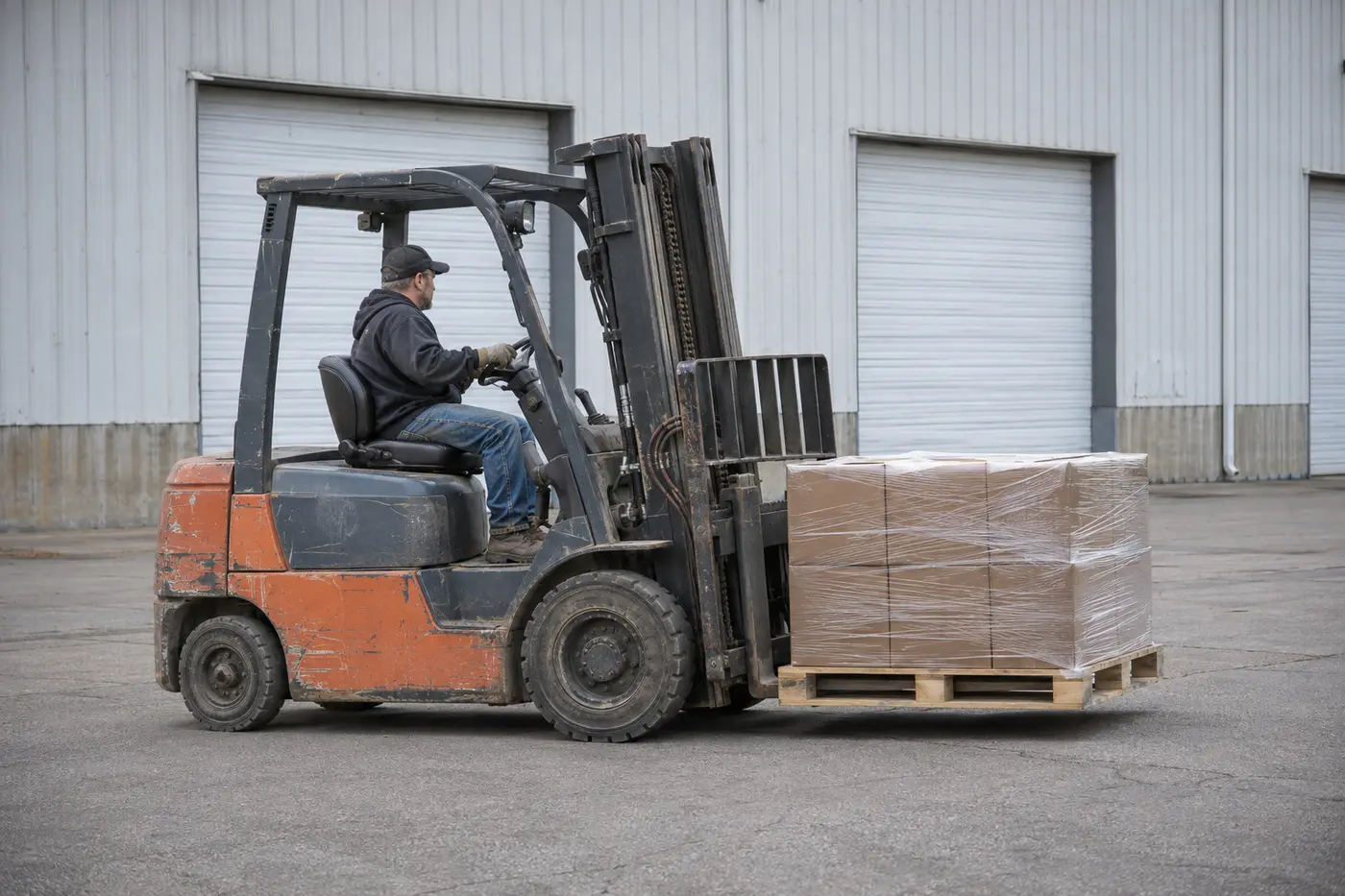
Quick answer
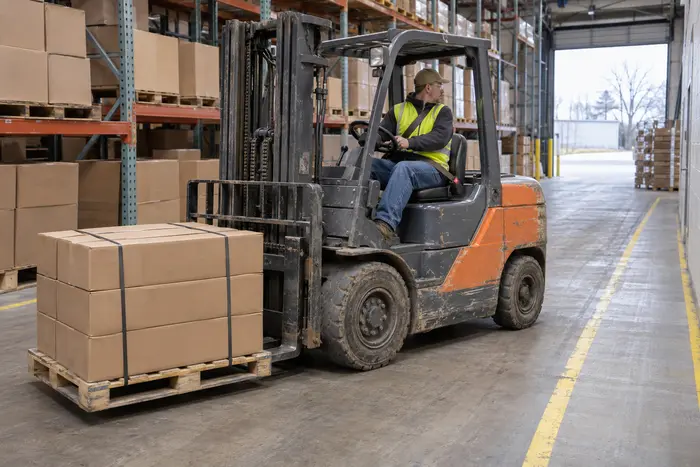
To move a pallet with a forklift, approach square, level the forks, slide them fully under the load, lift a few inches, tilt the mast back and travel with the load low. Stay within the rated capacity and keep people clear. Lower the load and level the forks before you set it down.
Shopping for this now? Get a fit-checked, delivered quote.
Key takeaways
- Square up to the pallet, level the forks and slide them fully under.
- Forks should be at least two-thirds the length of the load.
- Lift only a few inches, tilt back and travel with the load low.
- Never exceed the data plate capacity, and keep everyone out from under the load.
- Take the same care with pallet forks on a skid steer or tractor.
Moving a pallet looks simple. Many tip-overs and dropped loads start with small mistakes at the pickup or the set-down. This guide walks through the steps, based on OSHA and CCOHS guidance, and explains how the same steps apply when you use pallet forks on a skid steer or tractor. It isn't a substitute for operator training or your machine's manual.
What should you check before you lift a pallet?
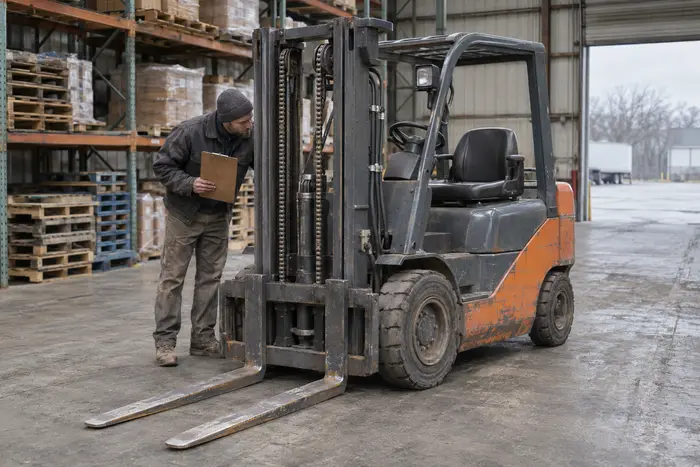
Start with the machine. Do a pre-use inspection of tires, forks, mast, chains, hydraulic hoses, brakes and steering. Penn State Extension notes that this check typically takes about 5 to 10 minutes. Don't operate a machine with a problem until it is repaired. Then check the load: look for a damaged pallet, loose items, wrap that has failed and an uneven stack. Know the machine's rated capacity from its data plate and never exceed it. CCOHS gives the same advice: know the recommended load limit and stay inside it.
Wear the right gear. CCOHS recommends leather gloves when moving loads or checking skids and fully laced safety boots for impact protection.
How do you pick up a pallet step by step?
- Approach the pallet square. Stop about 8 to 12 inches in front of the load.
- Set the direction control to neutral, and make sure the forks are at the right height for the pallet openings.
- Level the forks before you insert them.
- Check overhead clearance, then creep forward, using the inching pedal if you have one.
- Slide the forks fully under the load. They should be at least two-thirds the length of the load.
- Center the load's weight between the forks.
- Raise the load about 4 inches above the pallet below, then lift it clear.
- Tilt the mast back slightly to rest the load against the backrest.
Those figures come from OSHA's load handling guidance. Use them as a baseline, then follow your machine's manual and your site rules.
How should you travel with the load?
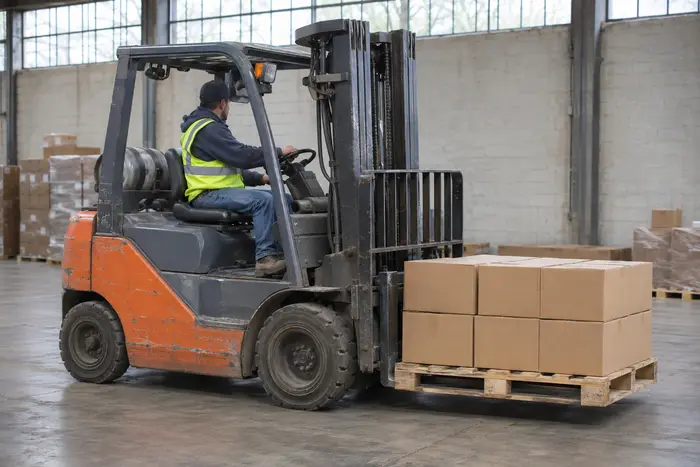
Keep the mast tilted back and carry the load low. OSHA says to keep a safe travel height but doesn't give a single number, and it refers to the maneuvering section of its guide. A common practice is to carry the load just high enough to clear the ground and obstacles. Never travel with the load tilted forward. Drive in reverse when a load blocks your view, slow down at intersections and blind corners, and use a spotter when visibility is limited. Avoid sudden turns and stops, because they shift the machine's center of gravity.
Penn State Extension adds that the combined center of gravity of the machine and the load has to stay inside the machine's stability triangle. Keep loads low while traveling and go slowly on uneven ground or slopes.
How do you set a pallet down or stack it?
- Stop square to the stack or the floor spot.
- Raise the load to the right height, then tilt the mast forward cautiously only to place it.
- Lower the load onto the stack or floor and tilt back only enough to stabilize it.
- Back away 8 to 12 inches from the stack, stop and return the mast to vertical.
- Lower the forks so the lowest point is about 6 to 8 inches from the floor before you drive off.
When high-tiering, put heavier loads on the bottom and lighter on top. Reduce the load below the truck's capacity as the mast extends, because capacity drops with height.
Why does load center matter?
Forklifts are often rated at a 24-inch load center. That means the load's center of gravity should be 24 inches or less from the face of the forks. A long or uneven load can have its center farther out, which reduces what the truck can safely lift. If the load is long, move it as close to the backrest as you can and check the data plate. Attachments can reduce capacity too, so read the manufacturer's specifications.
What about pallet forks on a skid steer or tractor?
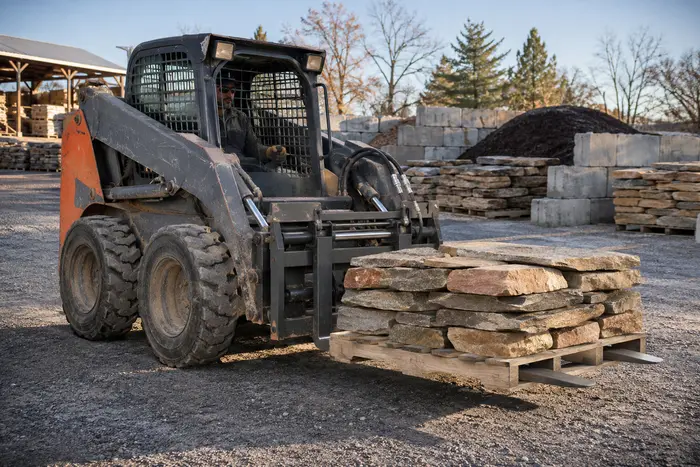
The same principles apply. Center the load on the forks, keep it close to the machine and carry it low. Confirm that the forks are locked on the carriage and that the machine's rated operating capacity covers the pallet. For uneven ground, slow down. See skid steer pallet forks or the skid steer pallet forks guide for fit and capacity details, and check fork extensions if your load is long.
A skid steer is not a forklift. It has no mast, so a raised load shifts the center of gravity in a different way. Follow the manual's limits for lift height and slope. Telehandlers handle reach and height but still follow load charts.
How can you move a pallet without a forklift?
People search for ways to move a heavy pallet without a forklift. A hand pallet truck or jack is the usual answer for flat floors. For rough ground, a pallet dolly or a loader with forks can do the job. Don't drag a heavy pallet by hand or use improvised levers on a heavy load. If you must break the load down, unstack it into smaller parts. Don't use a raised pallet as a work platform, which CCOHS warns against.
What mistakes cause pallet accidents?
- Not squaring up and driving in at an angle, which damages the pallet and the load.
- Skipping the fork length check and carrying a long load on short forks.
- Traveling with the load too high.
- Tilting forward while moving.
- Letting people stand or walk under the raised part of the forks.
- Overloading the machine or ignoring attachments that reduce capacity.
What training do you need?
Forklift operators need training before they drive. In the US, OSHA requires employers to train and evaluate each operator and certify that it was done. In Canada, the rules are set by each province or territory. Employers should refresh training as the rules and the machine require. Read the forklift safety guide and the forklift inspection checklist as a starting point, then follow your employer's program. Ask your regulator what applies in your state or province.
What about uneven ground and outdoor yards?
Yards, farms and job sites rarely have a smooth warehouse floor. Slow down and keep the load low and tilted back. Avoid turning on a slope, and travel straight up or down it with the load on the uphill side as the machine's manual directs. Soft or wet ground reduces stability, so test it first. Rough-terrain machines and telehandlers are built for this, while a standard warehouse forklift is not. If your pallets are long, such as lumber or pipe, fork extensions can help, provided the maker approves them and the capacity is derated as the manual states.
Watch for ice, loose gravel and overhead lines. In winter, snow packed on the forks changes how the load sits, so clear it first. Check that your pallet is in good shape in cold weather, because plastic and wood both behave differently when frozen. Any time you doubt a load, set it down and rethink it.
Get the right fit the first time
Pallet forks, fork extensions and carriages all depend on your machine and its rated capacity. Send us the make, model and year and a person will check fit against the maker's specs. You approve a delivered price before you pay, and the supplier ships direct. Get a fit-checked quote or call 1-888-245-1555.
Questions buyers ask
How do you pick up a pallet with a forklift?
Approach square and stop 8 to 12 inches away, level the forks and slide them fully under the load. The forks should reach at least two-thirds of the load length. Center the weight, lift a few inches, then tilt the mast back slightly.
How high should you carry a pallet on a forklift?
Carry it low, with the mast tilted back. OSHA's guide refers to a safe travel height but doesn't give a single number. Keep the load just high enough to clear the ground and obstacles, and never travel with it tilted forward.
How do you stack pallets with a forklift?
Square up, raise the load to the stack height, tilt forward carefully only to place it, then lower and tilt back to stabilize. Back away 8 to 12 inches before lowering the forks. Put heavier loads on the bottom tier.
How can I move a pallet without a forklift?
Use a hand pallet truck on flat floors, a pallet dolly or a loader with pallet forks on rougher ground. Avoid dragging heavy pallets by hand. If the load is too heavy for the equipment you have, break it into smaller loads.
What is the load center on a forklift?
Many forklifts are rated at a 24-inch load center, meaning the load's center of gravity should be within 24 inches of the fork face. Longer or uneven loads reduce safe capacity, so check the data plate and the maker's specifications.