Telehandler guide
What Is a Telehandler? Uses and How It Works
Quick answer
A telehandler is a lifting machine with a telescoping boom and a front carriage, so it works like a forklift that can reach out and up. It carries pallets, lumber and bulk material to places a standard forklift cannot reach, and takes many attachments. Capacity drops as the boom extends.
Shopping for this now? Get a fit-checked, delivered quote.
Key takeaways
- A telehandler is a telescopic boom on a wheeled chassis, also called a reach forklift or zoom boom.
- It reaches up and forward, which a standard forklift cannot do.
- Capacity falls quickly as the boom extends; the load chart in the cab is the rule.
- Attachments such as forks, buckets, grapples and work platforms make it a multi-tool.
What is a telehandler? It is a wheeled lifting machine with a telescoping boom on the front and a carriage that takes forks or other attachments. Think of a forklift whose mast has been replaced by a long arm that can extend forward and upward. The same machine is also called a telescopic handler, reach forklift, zoom boom or teleporter. It is used on farms, construction sites, yards and warehouses. This guide explains how it works and what it is used for.
How does a telehandler work?
A telehandler has a chassis with four large wheels, an operator cab, an engine, and a boom made of nested sections. Hydraulic cylinders extend and retract the sections and raise or lower the boom angle. A carriage at the end tilts and holds the attachment. Many machines offer two-wheel, four-wheel and crab steering modes, so they can maneuver in tight spaces. Many have stabilizers that you lower to widen the base and cut tipping risk.
The key difference from a forklift is reach. A forklift lifts straight up a mast with the load close to the wheels. A telehandler can place the load forward over a wall, into a trailer or onto a roof edge.
What is a telehandler used for?
- Moving pallets and materials. Unloading trailers, stacking lumber, brick and bagged products.
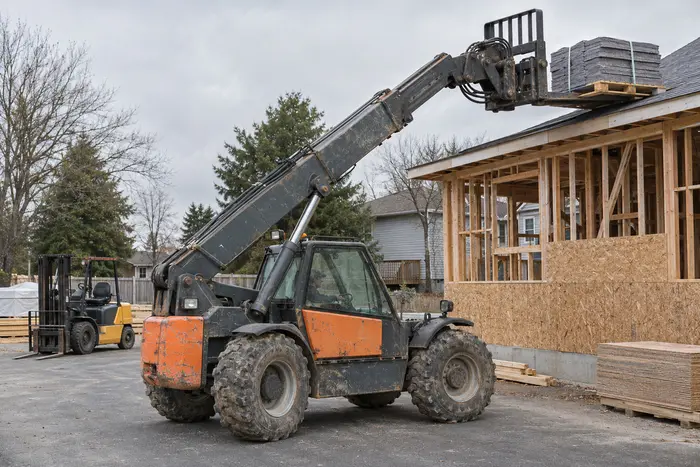
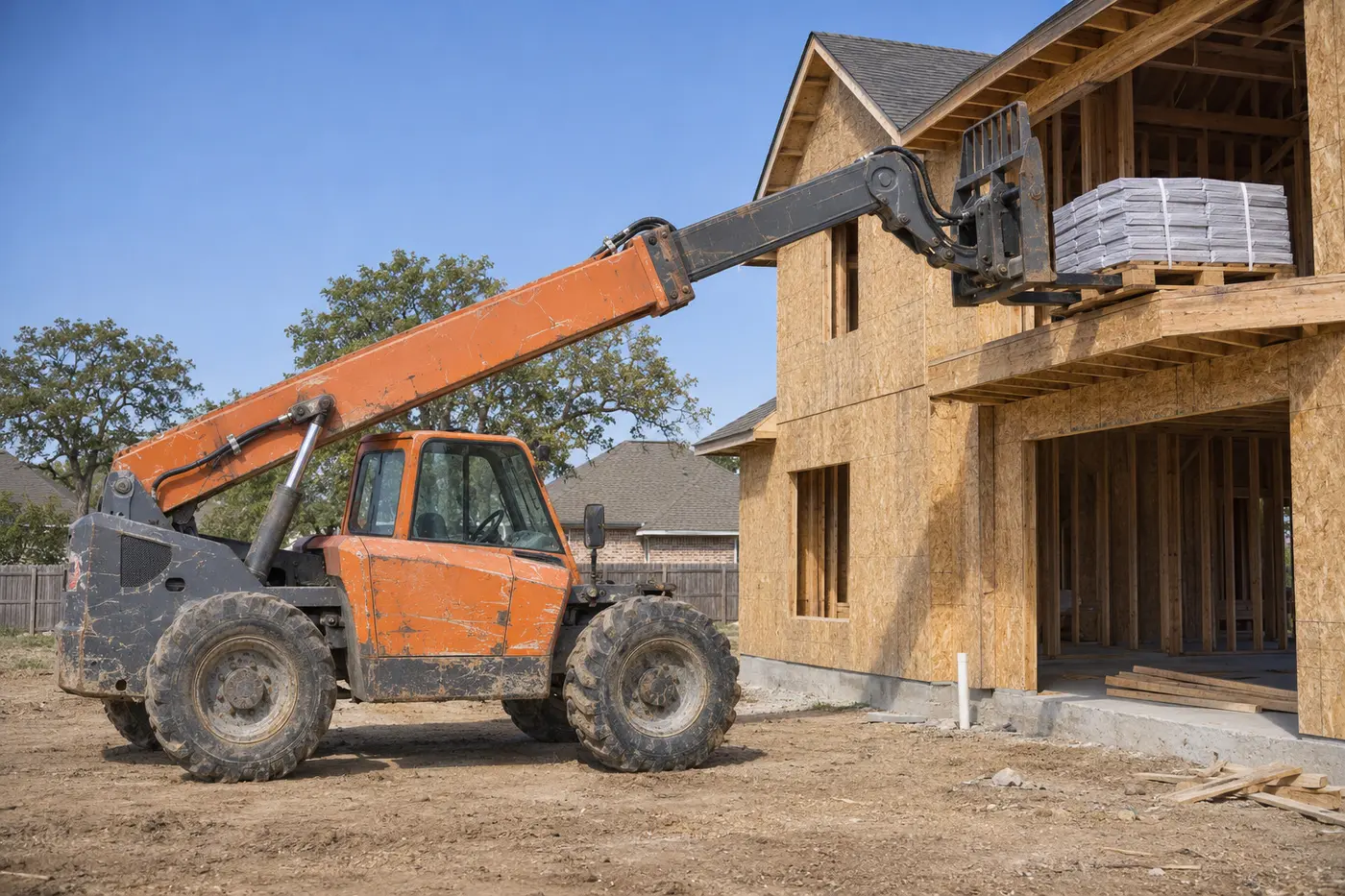
- Placing loads at height. Roof trusses, wall panels, drywall and shingles.
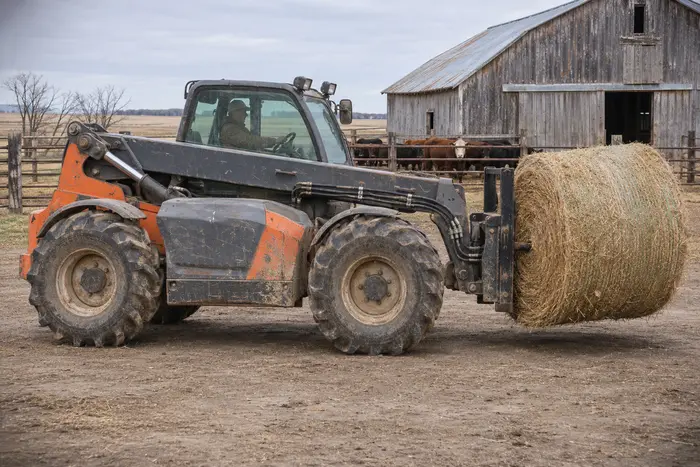
- Farm work. Bale handling, feed and grain.
- Digging and loading. With a bucket, it moves soil, gravel and snow.
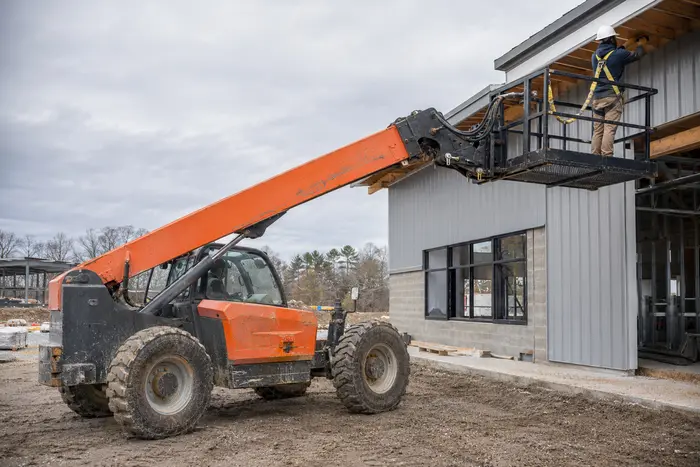
- Lifting people. With an approved work platform, under strict rules.
Published descriptions say its most common use is moving loads to and from places a conventional forklift cannot reach, such as taking palletized cargo from inside a trailer, or loading material up to a roof. See our guide to telehandler attachments for the full list.
Why capacity changes with reach
The telehandler's most important rule is that lift capacity drops as the boom extends. As the load moves forward of the front wheels, it acts like a longer lever, and the machine becomes less stable even with rear counterweight. One reference example describes a machine that can safely lift 5,000 pounds with the boom retracted but only a few hundred pounds at full extension. The numbers differ by model, but the pattern is universal.
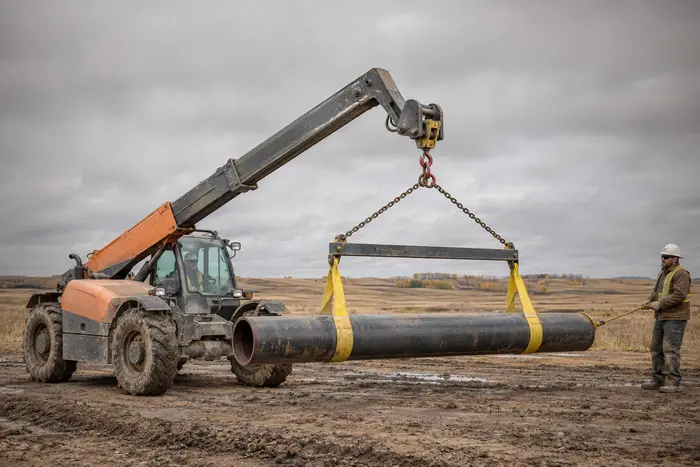
That is why each machine has a load chart. It shows rated capacity by boom angle and extension. The chart is usually posted in the cab, and the operator must stay inside it. Attachments change the numbers, so the chart must match the attachment on the machine. Never guess; read the chart before you lift. In US construction, OSHA's crane rules can apply when a telehandler is set up with a winch or hook to hoist suspended loads, and they require rated capacities and operating procedures to be readily available in the cab.
Telehandler vs forklift vs skid steer
| Machine | Strength | Limit |
|---|---|---|
| Telehandler | Reaches up and forward; many attachments | Capacity falls with reach; larger and costs more |
| Forklift | Efficient for pallets at close range | Little reach; needs flat, firm ground |
| Skid steer | Compact, fast, great for digging and carrying | Limited lift height and reach |
For more on how these compare, read our guide to telehandler vs forklift. If you are weighing a loader for job-site work, see our mini excavator vs skid steer guide for another useful comparison.
Common telehandler attachments
The front carriage accepts a range of tools. The most common are:
- Fork extensions for long pallets and loads.
- Buckets for bulk material.
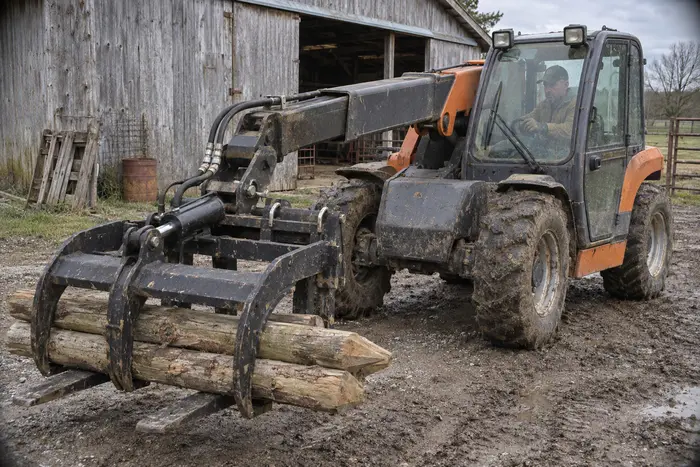
- Grapples for brush and loose loads.
- Work platforms for people, when approved.
- Truss booms and jibs and hooks for hanging loads.
- Bale spears for farm work.
Check that the attachment's weight, its mounting style and its center of load fit the machine. The attachment adds weight at the end of the boom and must be listed in the manual.
Do you need training or a certificate?
Operators should be trained. In the United States, OSHA requires that powered industrial truck operators be trained and evaluated. In Canada, rules depend on the province and the employer. Many job sites also require manufacturer or third-party operator training specific to telehandlers. Training covers load charts, stability, pre-use inspection and safe travel. Ask your employer or local regulator what applies to you, and keep the operator manual in the cab.
Safety basics
- Do a pre-use inspection each shift, and check tires, hoses, forks and controls.
- Travel with the boom low and the load tilted back.
- Keep the load chart visible and stay within it.
- Level the machine, use the stabilizers if fitted, and watch the frame level indicator.
- Check for power lines before raising the boom. Keep a safe distance.
- Do not lift a person without an approved platform and the maker's permission.
Parts of a telehandler
Knowing the parts helps you read a spec sheet and talk to a dealer.
- Chassis and axles. A heavy steel frame with front and rear axles. The rear axle often oscillates so all four wheels stay on uneven ground.
- Boom. Nested telescoping sections. More sections or a longer boom means more reach, but also more weight and a lower capacity at the end.
- Carriage. The plate at the boom tip that holds forks or an attachment. It can tilt and sometimes rotates or sideshifts.
- Stabilizers. Front outriggers, on some models, that widen the base for stationary lifts at height or reach. The load chart shows the capacity with them down.
- Cab and controls. A joystick controls the boom, with pedals or a selector for travel. A level indicator and a load moment indicator are common safety aids.
- Counterweight. Mass at the rear that balances the load at the front.
How to choose a telehandler size
Telehandlers are sized by rated lift capacity and by maximum lift height. A compact machine fits through gates and works well on farms and tight sites. A larger machine reaches higher and carries heavier loads but is wider, longer and needs firmer ground. To choose a size, write down the heaviest load you will lift, the height you need to place it, and how far forward the load has to sit. Then check the load chart for that spot, with the attachment weight included, not the headline capacity.
Ground conditions matter too. Soft ground and slopes cut stability. Four-wheel drive and tires with good grip help, but the load chart assumes a firm, level surface.
Get the right fit the first time
If you have a telehandler and need an attachment, send us the make, model and year. A person checks the carriage type and capacity against the maker's specs, you approve a delivered price before paying. Get a fit-checked quote.
Questions buyers ask
What is a telehandler used for?
It moves loads up and forward: unloading trailers, stacking lumber and pallets, placing trusses and panels, handling bales, and loading bulk material with a bucket. With an approved platform, it can also lift workers. The attachment decides the job.
Is a telehandler the same as a forklift?
Not quite. A forklift lifts straight up a mast. A telehandler has a telescoping boom that reaches forward and up. It can do forklift work, but it can also reach over obstacles, which a standard forklift cannot. It is also known as a reach forklift.
Why does a telehandler lose capacity when the boom extends?
As the load moves farther from the front wheels, it acts on a longer lever and tips the machine more easily. That is why the load chart shows lower capacity at full reach. Always check the chart for the boom angle, extension and attachment.
Do I need a certification to operate a telehandler?
Operators should be trained. In the United States, OSHA requires training and evaluation for powered industrial truck operators, and sites often add telehandler-specific training. Rules in Canada vary by province. Check with your employer or regulator.
What attachments fit a telehandler?
Common ones are forks and fork extensions, buckets, grapples, bale spears, truss booms and jibs, lifting hooks and work platforms. The attachment must match the carriage and be listed for your machine, and the load chart must reflect its weight.