Tractor guide
Sub-Compact Tractor Attachments: What Actually Fits
Quick answer
Sub compact tractor attachments must match four limits: hitch category, PTO power, rear lift capacity and tractor weight. Most owners start with a front loader bucket and a rear blade or box blade, then add a mower, tiller or post hole digger once they confirm PTO and lift ratings.
Shopping for this now? Get a fit-checked, delivered quote.
Key takeaways
- Hitch category, PTO power, lift and weight decide fit.
- Start with a loader bucket and a rear blade.
- Check PTO horsepower, not engine horsepower.
- Heavy tools can lift the front end or tip a small tractor.
- Ask for a fit check when specs are unclear.
Sub-compact tractor attachments are the implements that mount on the three-point hitch, the front loader or the PTO of a small tractor. What fits depends on your tractor's hitch category, PTO power, lift capacity and weight. A tool that looks right on paper can overload a small tractor, so check those four limits first.
What is a sub-compact tractor?
A subcompact utility tractor is a smaller variant of the compact utility tractor. These machines are often barely larger than a riding lawn mower, yet they share features with compact tractors, including a three-point hitch, power steering, four-wheel drive and a front-end loader. They are mainly marketed to homeowners who want to mow lawns and do occasional light landscaping. That small size is why attachment choice matters so much. The tractor has less weight, less hitch lift and less PTO power than a full compact.
What limits what a sub-compact tractor can run?
- Hitch category. Sub-compact tractors normally use a small three-point hitch size. Implements must match the hitch pins and link spacing. Read our guide on three-point hitch categories.
- PTO power. Powered implements like tillers, mowers and post hole diggers draw power from the PTO. Check the implement's required horsepower against what your tractor delivers at the PTO, not at the engine.
- Hitch lift capacity. The tractor's rear lift has a maximum weight it can raise. Heavy implements may not lift fully or can unbalance the machine.
- Tractor weight and ballast. A small tractor can lift its front end or tip if the implement is too heavy. Counterweights and the right tires help, but the limits in the manual still apply.
- Front loader rating. Buckets and forks need to fit the loader's quick attach system and capacity.
- Shaft and driveline details. PTO shaft length and rotation speed must match.
Which attachments make sense for a sub-compact tractor?
| Attachment | Mounts on | Best job |
|---|---|---|
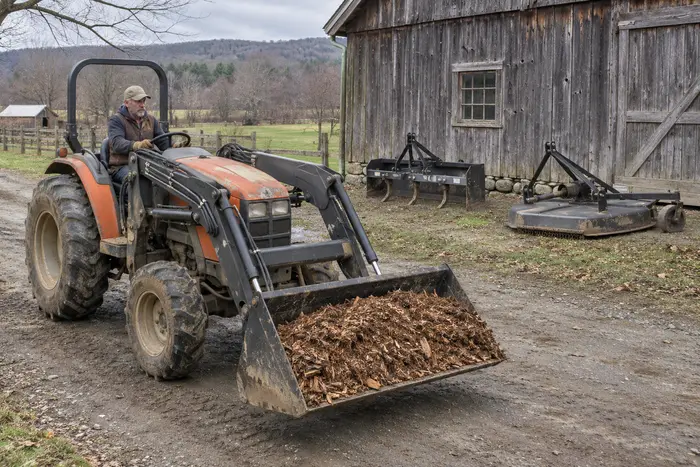
| Front loader bucket | Loader | Moving soil, gravel, mulch and snow |
| Pallet forks or bucket forks | Loader | Moving pallets, logs, bales (light) |
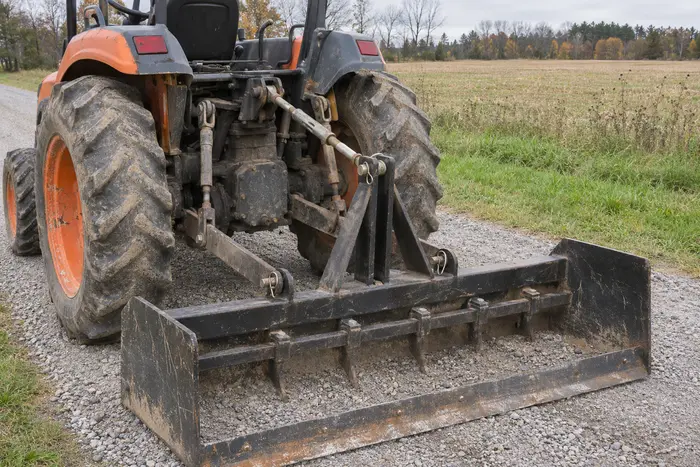
| Rear blade | 3-point hitch | Grading gravel, clearing snow, light dozing |
| Box blade | 3-point hitch | Leveling drives, spreading, small pads |
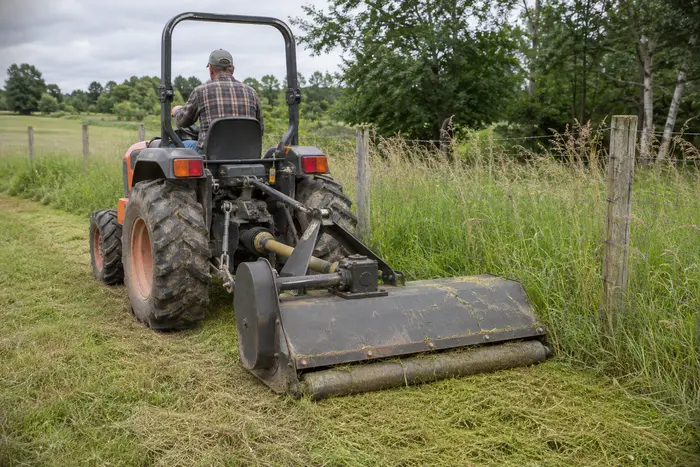
| Finish mower or flail mower | 3-point hitch, PTO | Lawn and rough areas |
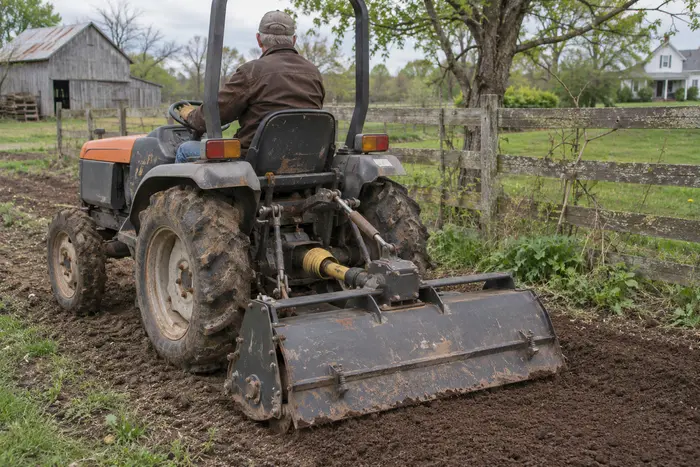
| Rotary tiller | 3-point hitch, PTO | Garden and food plot prep |
| Landscape rake | 3-point hitch | Seedbed prep, rock removal |
| Post hole digger | 3-point hitch, PTO | Fence posts, deck footings |
| Snow blower | 3-point hitch, PTO | Driveway snow clearing |
A flail mower is a PTO-driven implement that attaches to the three-point hitch on the rear of most tractors. A cultivator or rotary tiller stirs and pulverizes the soil, either before planting or after crops are growing. We cover both in our guides to flail mowers for compact tractors and rotary tillers for compact tractors.
Start with the loader and the rear blade
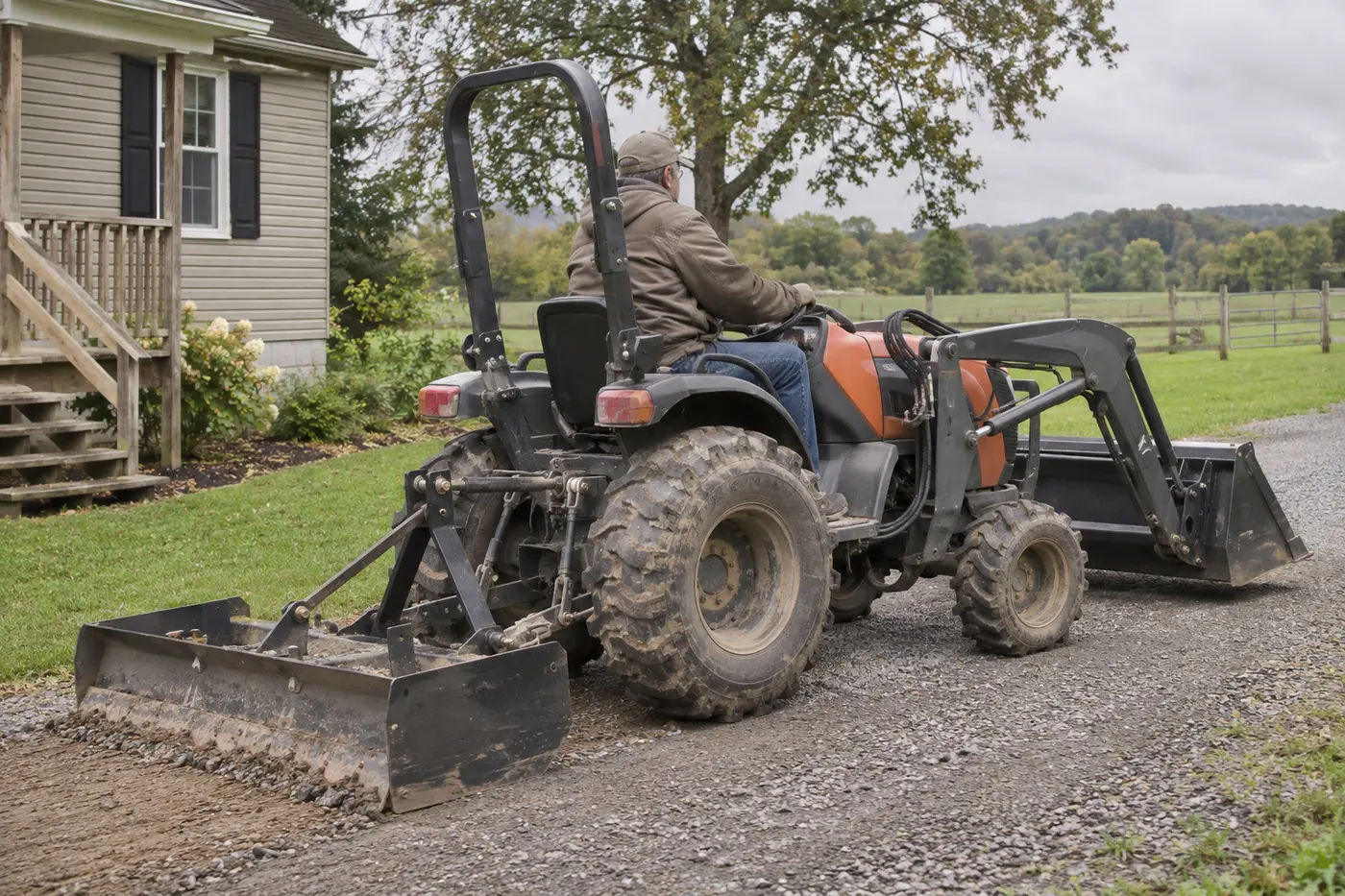
Most owners get the most use out of two tools: a front loader bucket and a rear blade or box blade. They need no PTO power, they work year-round and they handle gravel drives, small grading jobs and snow. Add a mower or tiller after those, because they depend on PTO power and tractor weight.
If you want to move up to bigger tools, look at what will fit your hitch and PTO. Our broader compact tractor attachments guide lists common options for the next size up. You can also see rotary tillers and landscape rakes for work that uses similar principles.
How to check fit before you buy
- Find your hitch category in the operator manual.
- Find the PTO horsepower and rotation speed. Do not use engine horsepower as a stand-in.
- Look up the rear lift capacity at the lift points.
- Weigh the implement or read the maker's listed weight.
- Check the working width against the tractor's wheel track. A wider implement can be hard to control.
- Look at the loader's rated capacity for buckets and forks.
- Ask for a fit check if you are unsure. A person comparing your tractor's specs with the implement's specs catches the common mismatches.
Skid steer tools that mount on a tractor with an adapter
Some attachments made for skid steers can mount on a tractor loader through a quick attach adapter, or on a three-point hitch through a 3-point adapter. That can widen your choices, but it adds weight and changes how the load sits on the tractor. Browse 3-point adapters for options. Always check hydraulics, capacity and weight before you try it.
Matching tool weight to a small tractor
Weight is the quiet problem with small tractors. A tool that is fine on a larger tractor can raise the front wheels when it is lifted, or overload the rear axle and hitch. If you see the front end go light when you raise an implement, the tool is too heavy or the tractor needs more ballast. Wheel weights, filled tires and a rear counterweight can help, but they do not change the hitch lift limit. If you need to lift or carry heavy loads often, a bigger tractor or a compact track loader may be the better tool for that job. For tools that sit behind the tractor, keep them close to the hitch and lift them only high enough to clear the ground when you travel.
Seasonal setup: what to own for each season
- Spring: rotary tiller or landscape rake for beds and seedbeds, plus a loader bucket for mulch and topsoil.
- Summer: finish mower or flail mower for grass and rough areas.
- Fall: box blade or rear blade to re-grade drives before the ground freezes.
- Winter: a rear blade, a loader bucket or a PTO snow blower for snow.
You do not need all of them. Pick the two that cover most of your work and add more as you need.
Safety rules for small tractors
- Keep the roll-over protective structure (ROPS) up and wear the seat belt. If the ROPS is folded down, the belt should not be worn; fold it only where the manual allows, such as under low branches or doorways.
- Keep the loader bucket low when you travel.
- Keep PTO shields and guards in place. Never step over a spinning shaft.
- Shut off the engine and take the PTO out of gear before you adjust or clear a jam.
- Do not exceed the lift and loader ratings.
- Avoid slopes where the tractor can roll. Drive straight up or down, not across, and stay inside the slope limits in your manual.
Buying new, used or renting first
Used implements can be a good deal if the frame, pins and bearings are sound. For PTO-driven tools, check the gearbox for leaks and the shaft for play. For rental, try a tool for a day before you commit. If the tractor struggles on a rented tool, you have learned something cheap.
Get the right fit the first time
Send us the make, model and year of your machine and what you plan to do with it. A person checks fit against the maker's specs and sends a delivered price for you to approve before you pay. Ready when you are: send your tractor details for a fit-checked quote.
Questions buyers ask
What attachments fit a sub-compact tractor?
Common choices are a front loader bucket, pallet forks, a rear blade or box blade, a finish or flail mower, a rotary tiller, a landscape rake, a post hole digger and a snow blower. Fit depends on hitch category, PTO power, lift capacity and tractor weight, so check each limit.
What are the best sub-compact tractor attachments to buy first?
Most owners start with a front loader bucket and a rear blade or box blade. They need no PTO power and handle gravel, grading and snow. Add a mower or tiller later, because those depend on PTO power and tractor weight. Confirm fit for your tractor before buying.
Can a sub-compact tractor run a rotary tiller?
Often yes, if the tiller is sized for your PTO power and hitch category. Check the tiller's horsepower requirement against your PTO output and look at the rear lift capacity. A narrow, light tiller made for small tractors is the safe choice.
What three-point hitch category do sub-compact tractors use?
Most small tractors use the smaller hitch sizes, but it varies by model. Check your operator manual for the category and the pin sizes. The implement must match the hitch category, so confirm before you order, or ask for a fit check.
Can I use skid steer attachments on a sub-compact tractor?
Sometimes, with an adapter for the loader or the three-point hitch. Weight, hydraulic needs and capacity limits still apply, and small tractors tip or lose lift more easily. Check the machine's ratings and ask for a fit check before trying it.