Tractor guide
Three-Point Hitch Categories Explained (0 to 4)
Quick answer
Three point hitch categories rank hitch size from Category 0 to Category 4. Higher numbers mean bigger pins, wider lower-arm spacing and more tractor power. Category 1 suits about 20 to 45 hp, Category 2 about 40 to 100 hp. Match the implement's category to the tractor's hitch.
Shopping for this now? Get a fit-checked, delivered quote.
Key takeaways
- There are five hitch categories, 0 to 4, set by pin diameter and lower-link spacing.
- Category 1 is the common size for compact and sub-compact tractors; Category 2 covers mid-size utility tractors.
- Pin sizes differ between categories, so a bushing or adapter is needed to mix them.
- Narrow (N) hitches use a bigger pin with smaller spacing for quick hitches.
Three point hitch categories are the size standard that decides whether an implement fits a tractor. The categories run from 0 to 4, and each step up means bigger pins, wider spacing between the lower arms and more tractor power. Pick the wrong category and the implement will not pin on, or it will be too weak for the load. This guide explains the system in plain terms.
What is a three point hitch?
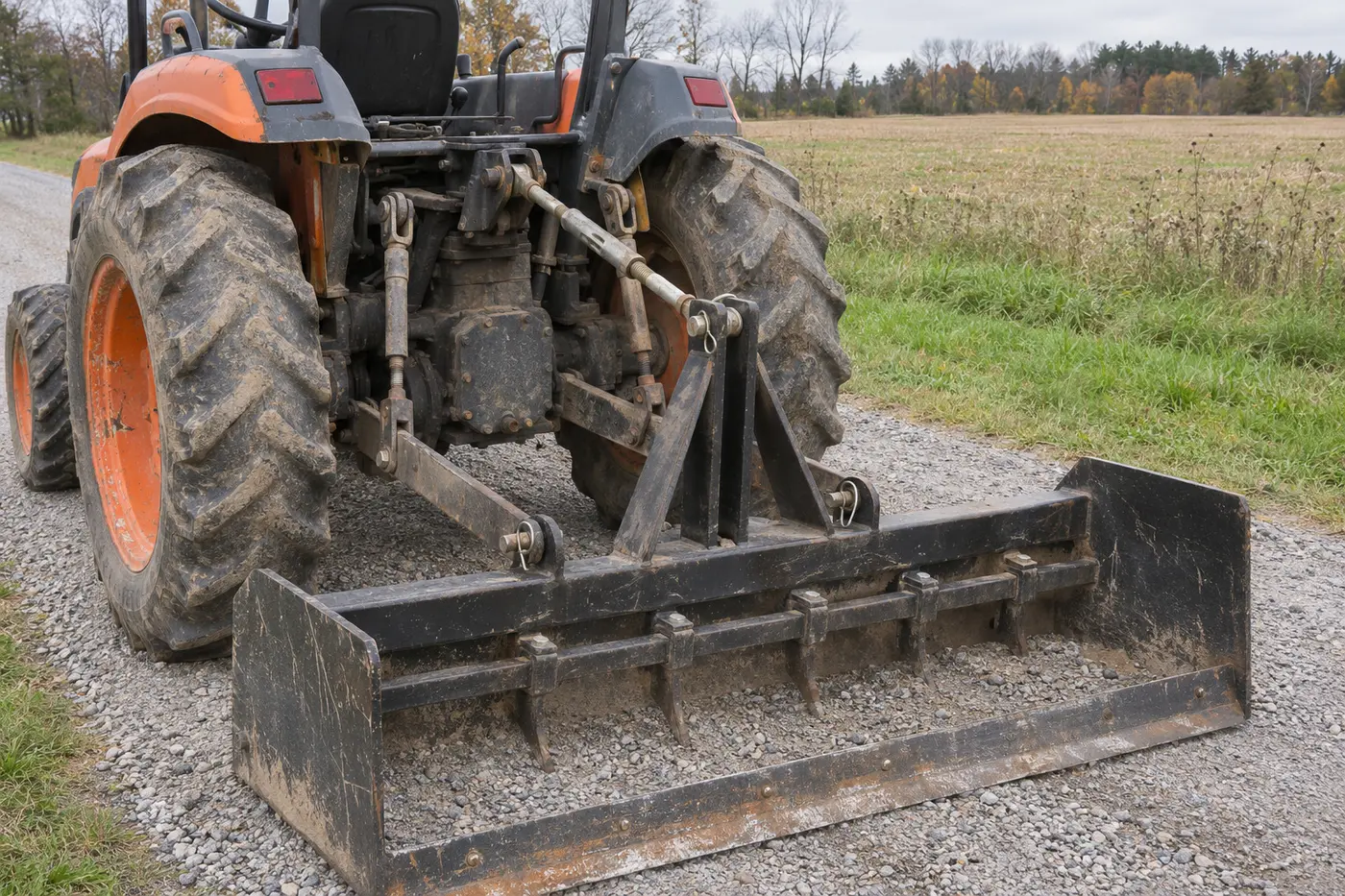
A three point hitch is the standard way to mount implements on the back of a tractor. Two lower lift arms and one top link form a triangle. A box blade, rotary tiller, mower, post-hole digger or landscape rake attaches at those three points. The hitch also lifts and lowers the implement, and a PTO shaft can drive powered tools. The design was patented in 1926 and became the common industry standard by the 1960s, which is why the same tool often fits many tractor makes.
Hitch categories: size and power
Categories 1 to 4 are defined in the ISO 730 standard. The table below shows the figures commonly published for them; spacing figures vary a little by source and by where they are measured, so confirm against your manual or the implement maker.
| Category | Typical tractor power | Top link pin | Lift arm pin | Lower hitch spacing |
|---|---|---|---|---|
| 0 | Up to about 20 hp | 5/8 in | 5/8 in | About 20 in |
| 1 | About 20 to 45 hp | 3/4 in | 7/8 in | About 28 in |
| 2 | About 40 to 100 hp | 1 in | 1-1/8 in | About 34 in |
| 3 | About 80 to 225 hp | 1-1/4 in | 1-7/16 in | About 40 in |
| 4 | Over about 180 hp | 1-3/4 in | 2 in | About 48 in |
Horsepower bands overlap, so a tractor of 40 to 45 hp can sit on either side. The pin sizes and the spacing between the lower links are what decide the fit, not the horsepower on its own.
Category 1: the compact tractor standard
Most compact and sub-compact tractors use Category 1. It covers the common 20 to 45 hp range and fits a long list of implements: box blades, rotary tillers, rear blades, finish mowers and post-hole diggers. If you own a compact tractor, shop for Category 1 first. See our guide to attachments for a compact tractor for what to buy next.
Very small machines at the bottom of the range may use Category 0, which has smaller pins and a narrower spread. That is typical for garden-size tractors and some sub-compacts.
Category 2: the step up
Category 2 fits larger utility tractors and is common in the 40 to 100 hp range. The pins are bigger and the published spacing is about six inches wider than Category 1. Implements built for Category 2 are heavier and usually have more cutting width. Some tractors have an adjustable ball or bushing on the lift arms so they can take either Category 1 or Category 2 implements. Check the arms: you can often see a stepped end or a sleeve.
What does N mean in a hitch category?
You may see "1N" or "2N" on a quick hitch. "N" means narrow. A narrow hitch uses the pin size of the listed category but the spacing of the category one step lower. It lets a larger tractor pick up a smaller implement. Quick hitches are common on utility tractors for this reason.
How to tell which category you have
- Check the manual. It will list the hitch category for the tractor.
- Measure the lower pin ends. Use a caliper or tape and compare to the table.
- Measure the lower-link spacing. Measure the spread between the lower hitch points and compare it to the table.
- Look at the top link. The pin diameter and the clevis opening tell you the category.
- Check the implement. Its decal, spec sheet or listing should state the category it needs.
Mixing categories: adapters and bushings
You can sometimes use a Category 1 implement on a Category 2 tractor with sleeves or a quick hitch. The reverse is harder because a Category 2 implement can overload a Category 1 tractor. Do not force it. Bushings that reduce pin size are common and legitimate, but check the load limits and the lift capacity first. If a tractor's hydraulic lift cannot raise the implement, the mismatch is a safety problem, not just a fit problem.
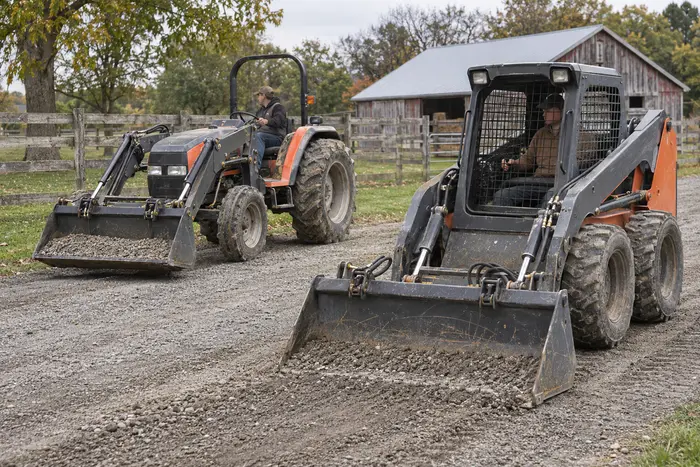
Skid steers have no three-point hitch, but you can mount tractor-style tools with an adapter. See our 3 point adapters for the options, and our skid steer vs tractor comparison if you are deciding between the two machines.
Buying checklist
- Confirm the tractor's hitch category in the manual.
- Match implement weight to the tractor's rear lift capacity.
- Check the PTO horsepower and speed for powered tools.
- Confirm the top link length and the sway chain or stabilizer setup.
- Check whether a quick hitch is on the tractor, and which category it uses.
Which implements work with each category?
If you run a skid steer rather than a tractor, our rotary tillers run off the loader's auxiliary hydraulics instead of a PTO and a hitch category.
Most implements are sold by category, and the category usually shows in the product name or spec table. Here is how the common choices line up in practice.
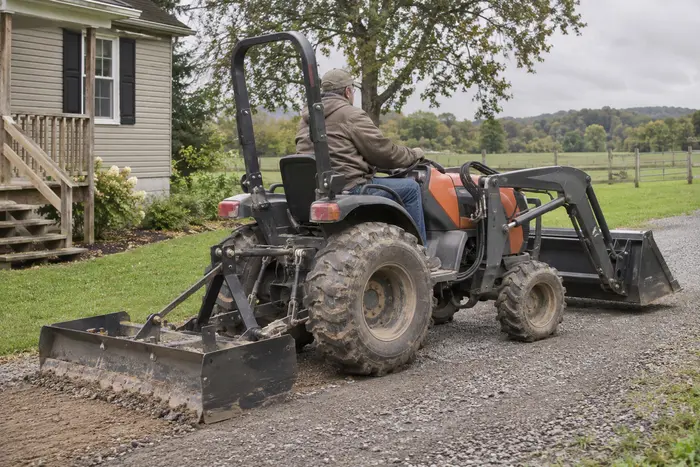
- Box blade or rear blade. A box blade moves and levels soil and gravel. Size it to your tractor's weight and lift. A box blade too heavy for a small tractor will not lift cleanly and will make the front end light.
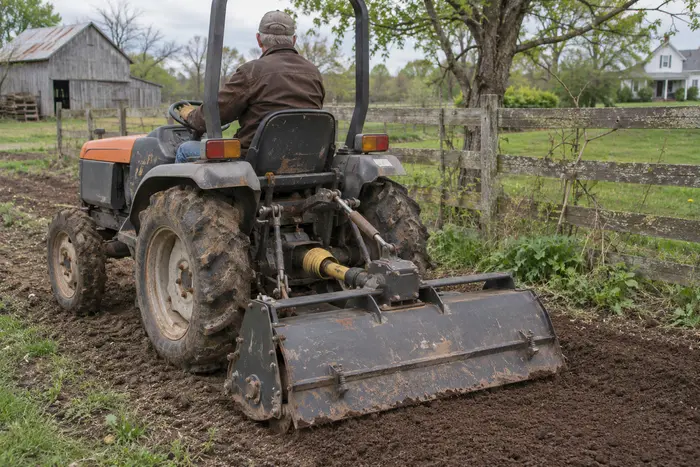
- Rotary tiller. Needs PTO power as well as the right hitch. Working width should match the tractor's PTO rating, not just its size class.
- Finish mower or rotary cutter. Look at both the hitch category and the PTO driveline length.
- Post-hole digger. Lighter and often rated for Category 1 and 2. Check the gearbox rating against your PTO speed.
- Landscape rake and grading tools. Usually a lighter fit. Check the lift capacity at the ends of the lower arms, not at the tractor.
Common three point hitch mistakes
- Buying by horsepower only. Two tractors with the same horsepower can use different categories. Measure the pins.
- Ignoring lift capacity. Look for the lift rating at the lower hitch points, and compare it to the implement weight.
- Using worn pins. Worn or bent pins and balls cause sloppy fit and sway. Replace them instead of shimming.
- Forgetting sway control. Check chains or stabilizers so the implement does not swing into the tires.
- Skipping the PTO shield. Always run PTO shields and follow the operator manual.
Lift capacity and tractor size
Category alone does not tell you whether a tractor can handle an implement. The lift capacity at the lower hitch points does. Look for the rating in the manual, usually measured at a set distance behind the hitch. A heavy implement can exceed it even if the pins fit. Hydraulic lift limits also change if the implement is long or sits far behind the hitch, because the leverage grows. A rule of thumb is to treat the rating as a hard limit and leave margin for uneven ground and shock loads.
If you are comparing machines, our sub-compact tractor attachments guide covers the smaller end of the hitch range.
Get the right fit the first time
If you are not sure which category your tractor uses, send us the make, model and year and a person will check it against the maker's specs. You approve a delivered price before paying. Get a fit-checked quote.
Questions buyers ask
What are the three point hitch categories?
There are five: Category 0, 1, 2, 3 and 4. Each step up has larger pins, wider spacing between the lower arms and suits more tractor power. Compact tractors typically use Category 1, mid-size utility tractors use Category 2, and large tractors use 3 or 4.
What is the difference between Category 1 and Category 2?
Category 2 has bigger pins and, in commonly published figures, about six inches more spacing between the lower arms than Category 1. It also suits more powerful tractors. Category 1 pins are 3/4 inch on the top link and 7/8 inch on the lift arms, while Category 2 uses 1 inch and 1-1/8 inch.
What category hitch does a compact tractor use?
Most compact tractors use Category 1, which covers roughly 20 to 45 horsepower. Very small machines may use Category 0. Some larger compacts have adjustable balls that take Category 1 or 2. Confirm with your owner's manual or by measuring the pins.
Can I use a Category 1 implement on a Category 2 tractor?
Often yes, with bushings or a quick hitch, because the implement is lighter and smaller. Check the weight and the working width against the tractor's lift capacity. The reverse is riskier, since a heavy Category 2 implement can overload a smaller tractor.
What does 1N or 2N mean on a hitch?
The N stands for narrow. A narrow hitch uses the pin size of the listed category with the lower-arm spacing of the category below. This lets a larger tractor use a smaller implement. It is common on quick hitches for utility tractors.