Buying advice guide
Mini Excavator vs Skid Steer: Which Should You Buy?
Quick answer
Choose a mini excavator when the work is digging below grade, such as trenches, footings, ponds and utilities. Choose a skid steer for moving, loading, grading and surface work above grade. The excavator digs deeper and works in place. The skid steer moves material faster and takes more attachments.
Shopping for this now? Get a fit-checked, delivered quote.
Key takeaways
- Mini excavators dig down and reach out from a fixed position; skid steers push, scoop and carry across the surface.
- Skid steers usually win on grading, loading and attachment variety; excavators win on trenching and depth.
- Both can run hydraulic attachments, but the tools differ, so list your jobs first.
- If you do both types of work, an excavator plus a skid steer or a track loader covers most of it.
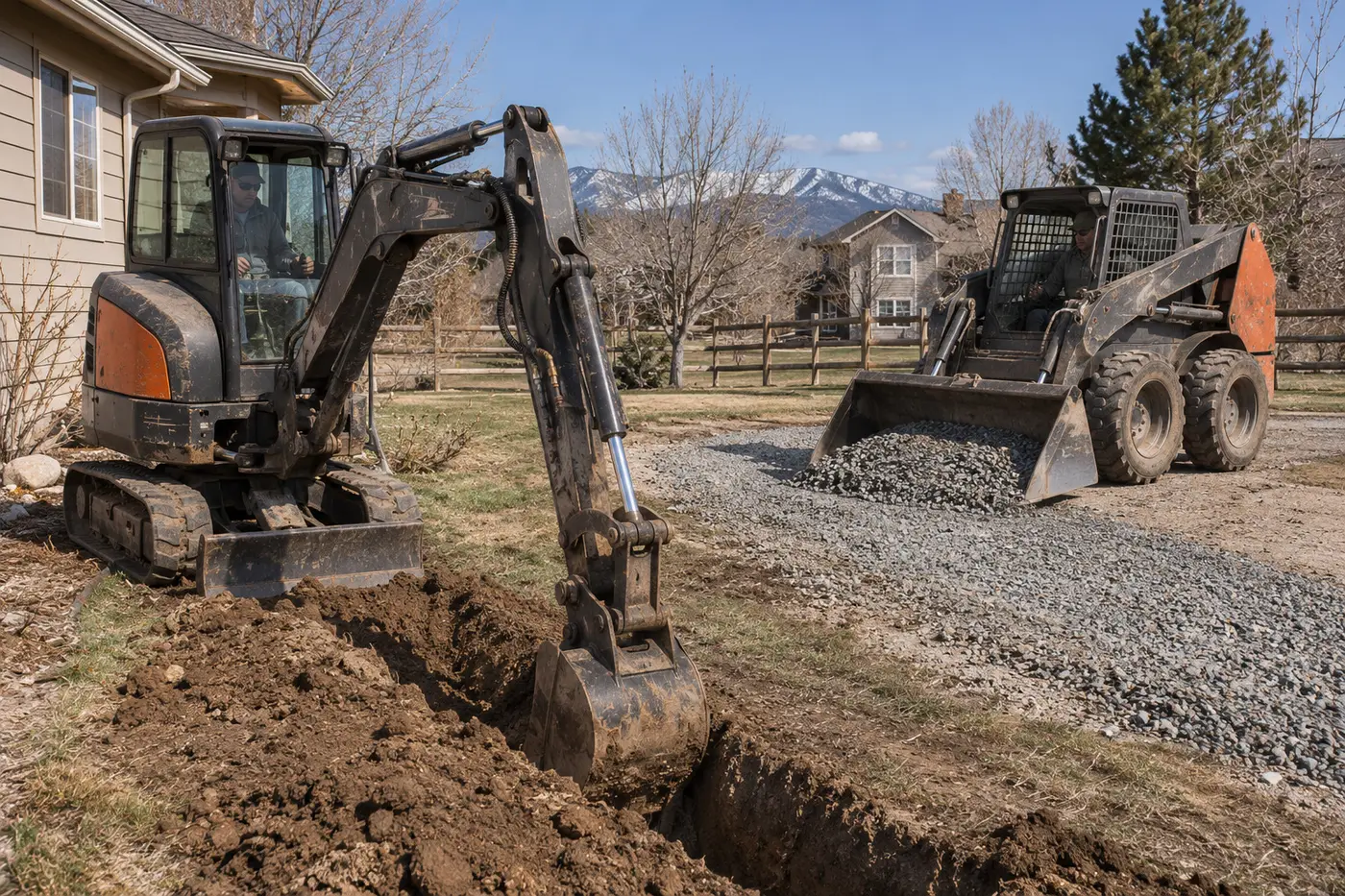
The mini excavator vs skid steer question comes down to one thing: do you dig down or move across? A mini excavator is a digger. A skid steer is a loader. Each can do some of the other's work, but each is clearly better at its own. This guide compares them on the jobs people actually buy them for.
What is the difference between a mini excavator and a skid steer?
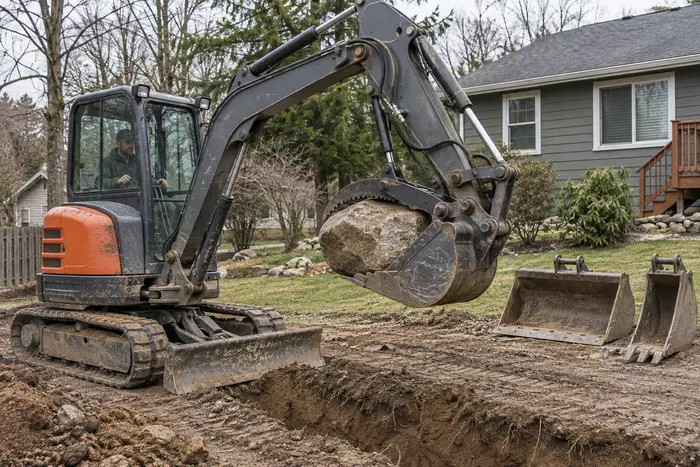
A mini excavator (also called a compact excavator) is a tracked or wheeled machine with a boom, an arm and a bucket on a rotating upper house. It digs by curling the bucket toward the machine, its upper house rotates on the tracks, and it often has a small dozer blade on the front. Reference sources describe mini excavators as machines with an operating weight up to roughly 8.5 tonnes. Many have independent boom swing, so the arm can offset to dig beside a wall or a foundation.
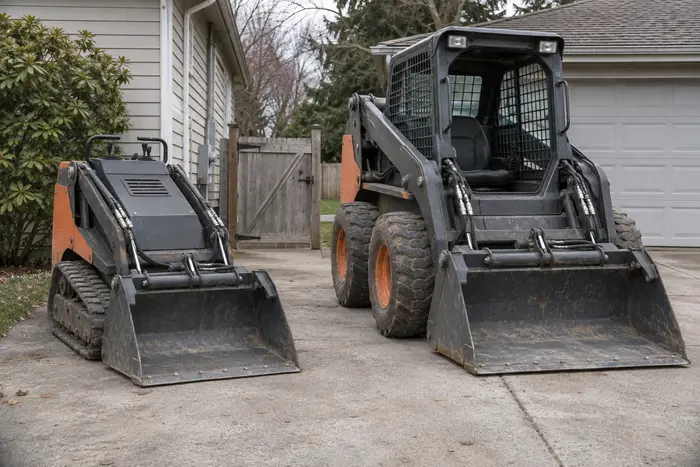
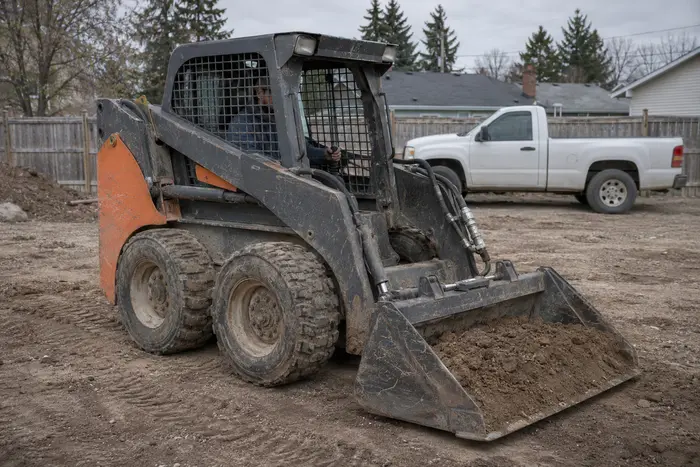
A skid steer is a small four-wheel or tracked loader. It has lift arms that carry a bucket or other tool on the front, and it steers by running the left and right sides at different speeds. That lets it turn on the spot. It excels at scooping, carrying, pushing and leveling over a work area. Our guide to what a skid steer is goes through the basics.
Mini excavator vs skid steer at a glance
| Job or trait | Mini excavator | Skid steer |
|---|---|---|
| Digging trenches and footings | Best choice, deep and precise | Limited depth; bucket digs shallow |
| Moving and carrying material | Slow; has to reposition | Fast; built for carry and dump |
| Grading and leveling | Possible with a blade; slower | Better, especially with a grader or dozer blade |
| Loading trucks | Good reach, slow cycles | Quick cycles; limited dump height |
| Working in tight spaces | Zero-tail-swing models fit well | Very maneuverable; turns in place |
| Attachment variety | Many, but excavator-specific | Very wide range |
| Ground damage | Tracks spread weight; pivot turns can scuff turf | Skid turns scar turf; tracks help |
Which is better for grading?
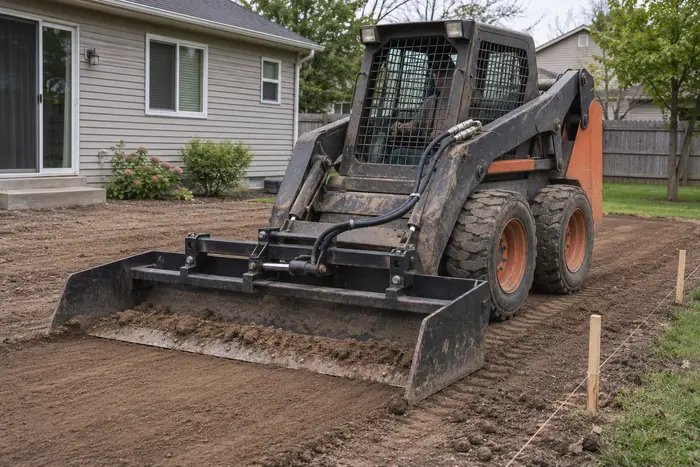
For leveling a driveway, spreading gravel or finishing a pad, the skid steer usually wins. It sits in the work area, sees the surface and can push material forward. With a bucket in float, a land plane or a grader attachment, it produces a flat surface. A mini excavator can grade with its bucket or a blade, but it is slower and needs patience. Our guide on leveling ground with a skid steer covers technique.
Which is better for digging and trenching?
The excavator, clearly. It reaches below grade, controls depth with the boom and arm, and works from one spot without driving over the trench. For utilities, footings, drains and ponds it is the standard tool. A skid steer can do shallow work with a bucket or a trencher attachment, but depth and control are limited. In the US, OSHA requires protective systems once a trench reaches a set depth, regardless of which machine digs it, and Canadian provinces set their own rules, so plan the depth before you choose.
Which is better with an auger?
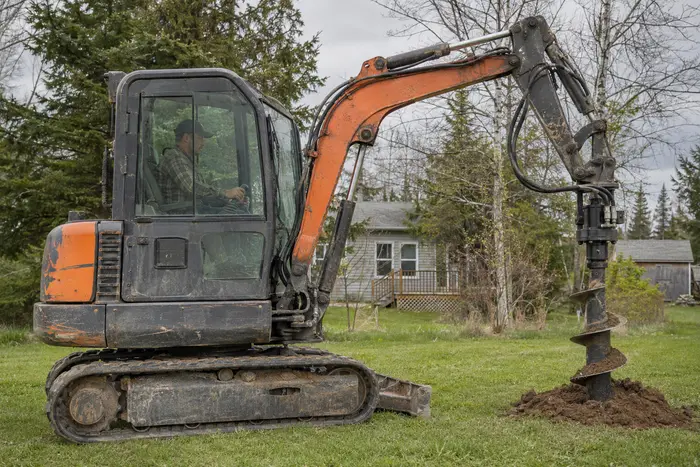
Both can drive an auger. A skid steer auger drills straight down with the machine's weight on the unit, and it is quick for fence posts and plantings. An excavator auger reaches over the work and can drill at an angle or into a slope. The right choice depends on how much terrain and how many holes. See skid steer augers and excavator augers to compare.
Lifting, loading and carrying
A skid steer lifts and carries in one motion and is better for repeated loading cycles. Its rated operating capacity tells you how much it can lift safely. An excavator can lift too, usually with a hook or a thumb, but it is a poor carrier because it moves slowly and swings the load. If you move pallets, brush or soil all day, the skid steer is the more productive machine. See how much a skid steer can lift for a way to read those limits.
Attachments: excavator tools vs skid steer tools
Both machines gain value from attachments, but they use different tool families. Excavators run buckets, thumbs, hammers, augers, tiltrotators and compactors. Skid steers run buckets, forks, grapples, brush cutters, snow tools, mulchers, trenchers and many more. Skid steers generally have the larger range of work tools. A rule of thumb: if the tool works the ground in front of the machine, it is a skid steer tool. If it digs, breaks or lifts from a fixed position, it is an excavator tool.
Footprint, transport and ground impact
Mini excavators are compact and can be hauled on a small trailer. Zero-tail-swing models keep the rear inside the track width, so you can dig next to a wall without the tail hitting it. Skid steers also trail easily and are often narrower. Both can scar finished turf. Tracks lower ground pressure, and a skid steer on wheels will tear turf when it turns. A wheeled skid steer on a lawn is a risk. Plan your travel route.
A decision rule
- List the jobs you do most. Mark each as "dig down" or "move across."
- If most are "dig down," buy or rent an excavator.
- If most are "move across," buy or rent a skid steer.
- If the list is mixed, start with the one that covers your most common job and add the other later.
- If you need both daily, look at a compact track loader plus a mini excavator, or rent the one you use less.
A compact track loader behaves like a skid steer but rides on tracks for better flotation. See skid steer vs mini skid steer if space is your concern, and our guide to mini excavator attachments for the other side.
Cost of ownership: more than the machine
Price is only part of the picture. Compare what each machine needs to keep working.
- Wear parts. Skid steers on wheels wear tires quickly on hard surfaces. Track machines wear tracks and undercarriage parts. Excavators wear track pads, bucket teeth and pins.
- Transport. Check the weight of the machine and the trailer you need. See skid steer weight and dimensions for how to do the math.
- Attachments. Each machine can multiply its use with tools. A skid steer with a few attachments can replace several single-purpose machines.
- Operator skill. An excavator takes longer to learn to run smoothly. A skid steer is easier to start but harder to run safely near edges and slopes.
- Resale and rental. Both hold a market, but check what is popular in your area.
Get the right fit the first time
Whichever machine you choose, attachments must match your make, model and hydraulic flow. Send us your machine's make, model and year and a person checks the fit against the maker's specs. You see the delivered price on your quote before you pay. The supplier ships direct, and warranty terms, if any, are written on your quote. Get a fit-checked quote.
Questions buyers ask
Is a mini excavator or a skid steer better?
Neither is better overall. A mini excavator is better at digging deep, trenching and working in one spot. A skid steer is better at moving, loading, grading and using many attachments. Choose by listing your most common jobs and picking the machine that fits them.
Which is better for grading, a mini excavator or a skid steer?
A skid steer is usually better. It works across the surface, pushes material and can use a grader or land plane attachment. A mini excavator can grade with a blade or bucket, but it is slower and takes more skill to get a flat finish.
Can a skid steer do the work of a mini excavator?
Only for shallow digging. A skid steer can dig with a bucket or a trencher, but it cannot reach deep or work precisely from one position. For footings, utilities and ponds, a mini excavator is the correct tool.
Do mini excavators and skid steers use the same attachments?
Mostly no. A few tools, such as augers and buckets, exist for both, but they are built for different mounts and hydraulic setups. Adapters exist for some tools, but check the rated load and flow before using one.
Should I rent or buy a mini excavator or skid steer?
If you use it a few days a year, renting is simpler. If you use it weekly, owning can make sense. Look at how often you use it, your storage and trailer needs, and whether the machine will hold value for the work you do.