Skid steer guide
Skid Steer Sizes and Frame Classes Explained
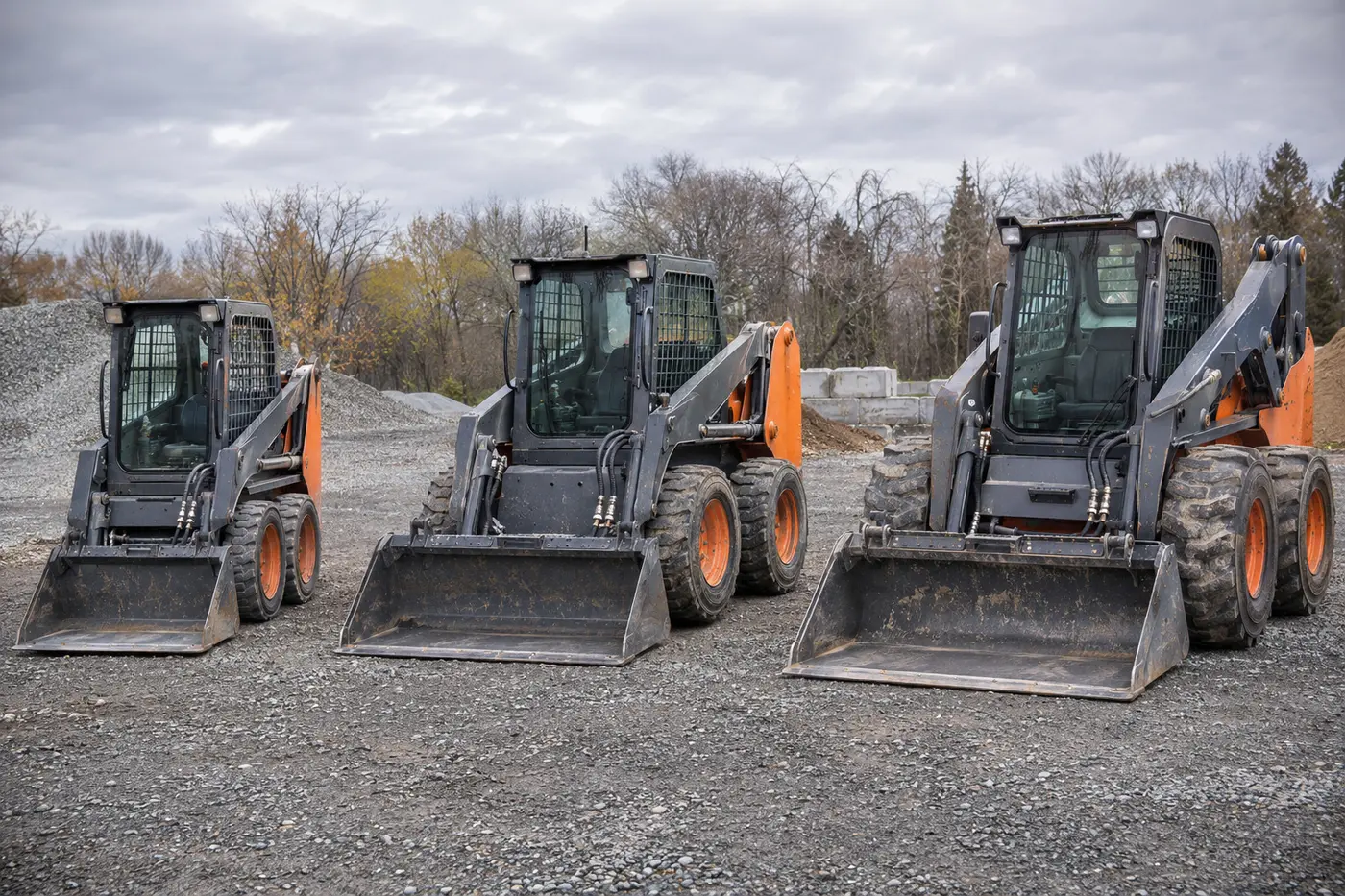
Quick answer
Skid steer sizes fall into small, medium and large frame classes. One rental-industry guide puts them at roughly 1,300 to 1,750 lb, 1,750 to 2,700 lb and above 2,700 lb rated operating capacity. Frame class affects width, lift, hydraulic flow and which attachments your machine can safely run.
Shopping for this now? Get a fit-checked, delivered quote.
Key takeaways
- Three frame classes: small, medium, large.
- ROC is a share of tipping load: about half on wheels, often less on tracks.
- Size sets lift, flow and gate clearance.
- Check the spec sheet; makers draw class lines differently.
What are the skid steer sizes?
Skid steer sizes are grouped into three frame classes: small, medium and large. The classes are set mostly by rated operating capacity (ROC), which is the load the machine can safely lift and carry. One rental-industry guide puts small frames at roughly 1,300 to 1,750 lb ROC, medium frames at roughly 1,750 to 2,700 lb and large frames above roughly 2,700 lb, with some reaching 3,600 lb or more. Makers do not use identical cutoffs, so treat these as typical bands, not rules.
Frame class is a shorthand. It tells you how a machine will behave on a job site: how much it lifts, how wide it is, how much hydraulic power it has and what attachments it can swing. Always read the actual spec sheet and operator manual for your machine.
Skid steer frame class chart
| Frame class | Typical rated operating capacity | Typical width | Typical use |
|---|---|---|---|
| Small frame | About 1,300 to 1,750 lb | Roughly 5 to 6 ft | Residential grading, mulch and soil spreading, tight yards |
| Medium frame | About 1,750 to 2,700 lb | Roughly 6 to 6.5 ft | Grading, site prep, acreage work, snow removal |
| Large frame | Above about 2,700 lb | Often about 7 ft or more | Heavy material handling, commercial sites, loading trucks |
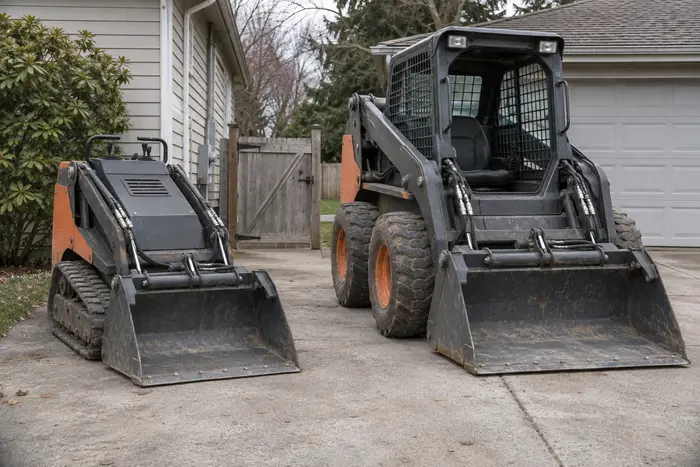
Source figures come from a rental-industry sizing guide. Widths change with tires, tracks and bucket, so measure the machine you have. Compact track loaders follow similar bands, with the ranges shifted slightly because they carry weight on tracks. Our wheels vs tracks guide covers that choice. Below the small frame sits a separate class of ride-on and walk-behind machines. See the skid steer vs mini skid steer guide for how they compare.
What is rated operating capacity?
Rated operating capacity is the number to watch. Tipping load is the point where the machine becomes unstable and starts to tip forward. On wheeled skid steers, ROC is typically 50 percent of the tipping load, so a 4,000 lb tipping load means about a 2,000 lb ROC. Compact track loaders are commonly rated at a lower share, often 35 percent, so never work out a track machine's capacity from the 50 percent rule. The exact figure for your machine is on its decal and in its manual. Work from ROC, not tipping load.
Many operators also leave a margin below ROC in routine work. A machine working at its limit all day wears faster, and a margin helps with uneven ground, slopes and load shift. Our guide on how much a skid steer can lift goes deeper.
How does size change what attachments you can run?
Bigger frames carry bigger buckets, wider forks and heavier tools, and usually have more hydraulic flow. Smaller frames fit tighter spaces, but they cannot safely run a heavy mulching head. Match the attachment to three things on your machine:
- Rated operating capacity. The attachment weight plus its load must stay inside ROC at working height.
- Hydraulic flow and pressure. Many rotating attachments need high flow. A small frame may only have standard flow. See the hydraulic flow guide.
- Mounting. Most machines use a universal quick attach plate, but not all. Read are skid steer attachments universal.
For buckets and forks that fit your frame, browse skid steer buckets and pallet forks.
Which skid steer size do you need?
- Small frame: home lots, landscaping, light grading. It fits wider gates and is lighter on lawns. For a standard 3 to 4 ft garden gate, look at a mini skid steer.
- Medium frame: the all-rounder. Good for acreage cleanup with high flow, grading, snow and general contractor use.
- Large frame: production work, heavy lifting, big attachments and commercial sites.
Think about the heaviest load you will move, the tightest gate you must fit and the attachments you want. It is cheaper and safer to buy attachments that suit the machine you have than to push a small frame with an oversized tool.
Does size include weight and dimensions?
Yes. Operating weight, width, height and turning clearance all vary by frame. Operating weight matters for trailering and for tire or track loading on soft ground. Width matters for gates and trailers. Height matters for entering buildings. Our guide on skid steer weight and dimensions breaks these down. When you plan to haul the machine, check the trailer and tow vehicle ratings against the machine's operating weight in the manual.
Questions to ask before you pick a size
- What is the heaviest pallet, bucket load or attachment I will handle?
- Will I work on turf, soft ground or hard surfaces?
- Do I need high-flow hydraulics for the tools I want?
- What is the narrowest gate, doorway or trailer I must pass?
- How many hours a year will I run it?
Answer those and the right frame class is usually obvious. If you want a second opinion, send your machine make, model and year and a person checks attachment compatibility against the maker's specs.
Radial lift or vertical lift: another size-related choice
Frame class is not the only design choice. Skid steers come with two lift-arm paths. Radial lift arms swing in an arc. They give strong lift capacity when the arms are low, which suits digging and spreading at low height. Capacity falls as the arms rise toward mid-height and the bucket reaches forward. Vertical lift arms rise more straight up, which gives better reach at full height and suits loading trucks and stacking pallets. If your work is mostly ground-level grading, radial lift is a fine fit. If you load high, vertical lift earns its place. Check both the spec sheet and your attachment's mounting before you decide.
Wheels or tracks at each size
Most frame classes come in both wheeled and tracked forms. Wheeled skid steers are quick on hard surfaces and cost less to run. Compact track loaders spread weight over a larger footprint, so they float over soft, wet or loose ground and give better traction on slopes. Tracks also protect finished surfaces better in many cases, but they cost more to maintain. If you are torn, think about your ground first. A small tracked machine can outwork a larger wheeled one on soft sites. Over-the-tire tracks are a middle option. See over-the-tire tracks if you want more traction on a wheeled machine for part of the year.
Hauling and storing the machine
Size drives logistics. A large-frame machine needs a bigger trailer and tow vehicle than a small one, and it may not fit in a standard shed or garage. Check the machine's operating weight against the trailer's rating and the tow vehicle's capacity. Check its height and width against any doors, gates or bridges on the route. These checks are quick and avoid expensive surprises on delivery day.
Get the right fit the first time
Send us your machine make, model and year and tell us the job. A person checks the attachment against the maker's specs, then you get a fit-checked quote with delivered pricing before you pay. The supplier ships direct, and warranty terms, if any, are written on your quote.
Questions buyers ask
What are the sizes of skid steers?
Skid steers are grouped by frame class. A rental-industry guide puts small frames around 1,300 to 1,750 lb rated operating capacity, medium frames around 1,750 to 2,700 lb, and large frames above that. Exact class lines differ by maker, so check each machine's spec sheet.
What is the most common skid steer size?
Medium-frame machines are a popular all-rounder for grading, site prep and acreage work. Small frames suit tight residential spaces, and large frames suit heavy commercial work. The best size depends on your heaviest load, gate width and the attachments you plan to run.
What is rated operating capacity on a skid steer?
Rated operating capacity is the load a skid steer can safely lift and carry. On wheeled skid steers it is typically 50 percent of tipping load; compact track loaders are commonly rated at a lower share, often 35 percent. Work from the ROC on the machine's decal and manual, not from the tipping load figure.
How wide is a skid steer?
Width varies by frame class. A rental-industry guide lists small frames at roughly 5 to 6 feet, medium frames at about 6 to 6.5 feet, and large frames at about 7 feet or more. Check your spec sheet if you need to pass through a gate or onto a trailer.
Does skid steer size affect which attachments fit?
Yes. Size sets lift capacity, hydraulic flow and often the mounting. Heavy or high-flow attachments need a larger frame, while small frames suit lighter tools. Check ROC, flow and the quick attach plate before ordering any attachment.