Skid steer guide
Skid Steer Hydraulic Flow Rate and Pressure Explained
Quick answer
Skid steer hydraulic flow rate is how much oil the auxiliary circuit delivers per minute, usually in gallons per minute or liters per minute. Flow sets attachment speed, while pressure sets force. Standard flow runs augers and buckets, and high flow runs mulchers and cold planers. Always match an attachment's needs to your machine's rated output.
Shopping for this now? Get a fit-checked, delivered quote.
Key takeaways
- Flow (gpm or L/min) controls attachment speed; pressure (psi or bar) controls force.
- Standard flow suits most attachments, but some need high flow to work properly.
- Too little flow makes a tool sluggish; too much heats the oil and damages parts.
- Hose size, couplers and a case drain affect real-world performance.
- Verify your machine's flow and pressure on the spec sheet or with a flow meter before buying.
Ask a dealer whether an attachment "works with your skid steer" and the first question is usually hydraulics. Weight and the mounting plate matter too, but hydraulic flow and pressure decide whether a mulcher spins up or a brush cutter bogs down. This guide explains both terms in plain language and shows how to match them.
What is hydraulic flow on a skid steer?
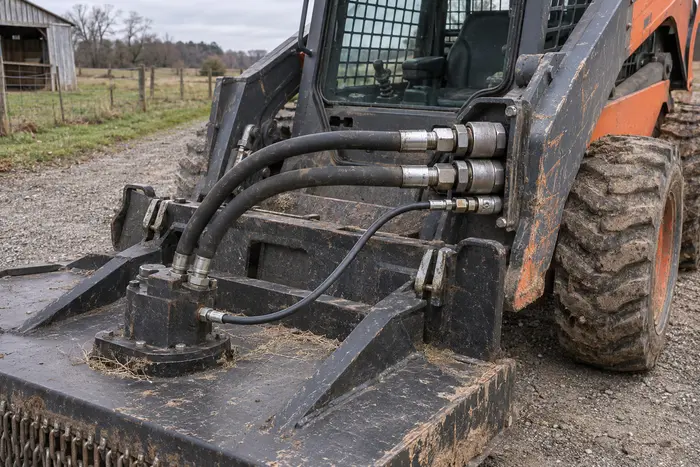
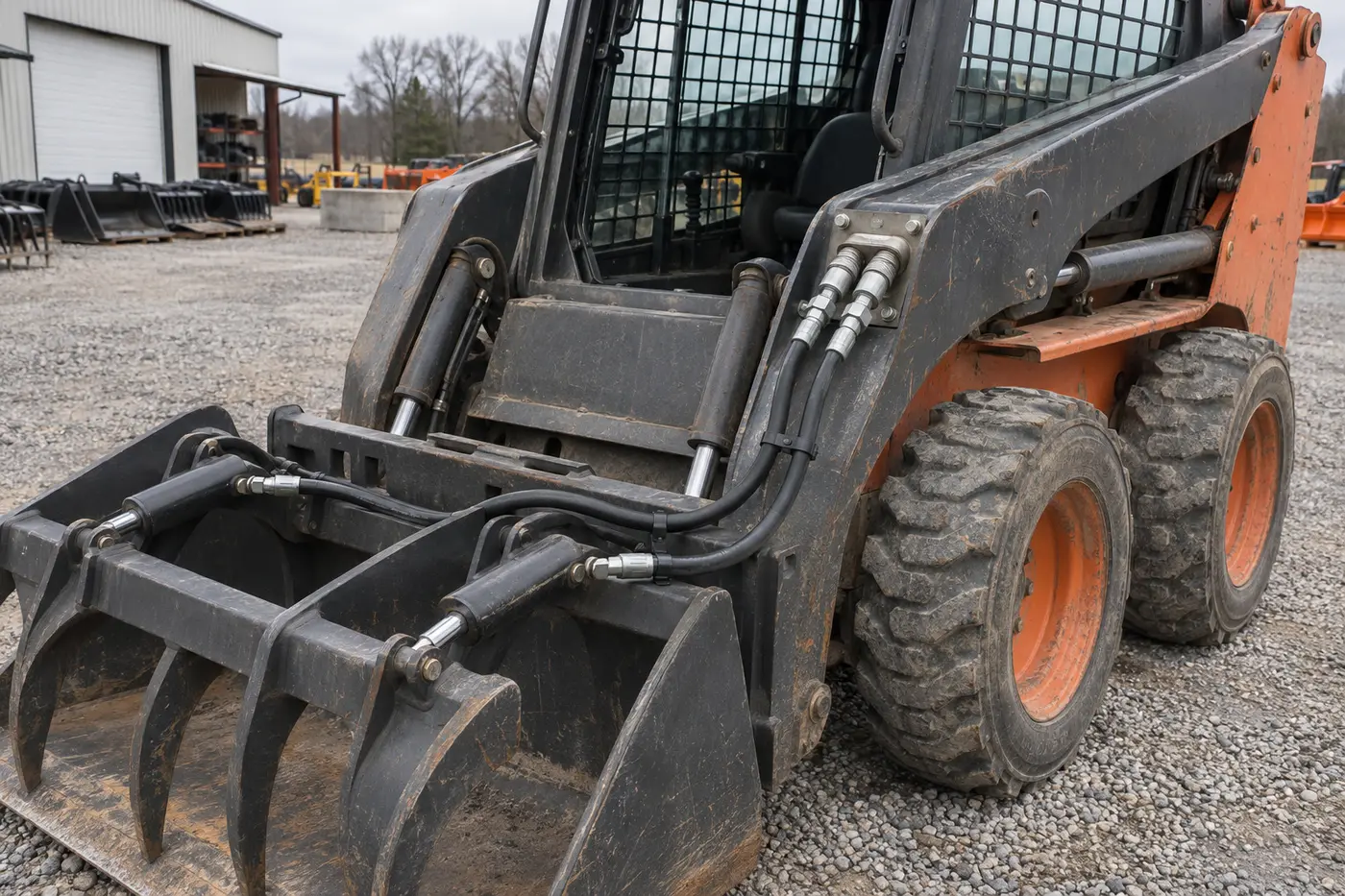
Hydraulic flow is the volume of oil the pump sends to the auxiliary circuit each minute. It is measured in US gallons per minute (gpm) or liters per minute (L/min); one US gallon is about 3.79 liters. The skid steer's own functions, like lift and tilt, use oil from the same system. The auxiliary circuit is the line of hoses at the front that powers an attachment.
Think of flow as the amount of water coming out of a hose. More flow turns a hydraulic motor faster. That is why flow sets attachment speed: how fast a broom spins or how quickly a trencher chain moves.
What is hydraulic pressure, and how is it different?
Pressure is the force pushing on the oil, measured in psi or bar. It is the resistance the attachment puts back on the system. Flow tells you how fast. Pressure tells you how hard. A grapple that needs to squeeze a log wants pressure. A broom that needs to spin quickly wants flow.
Power is the combination. Flow times pressure gives hydraulic power. In US units, horsepower is roughly gpm times psi divided by 1,714. That is why two machines with the same flow can feel different under load if their pressure differs.
What is standard flow versus high flow?
Most skid steers come with a standard auxiliary circuit. Many larger machines offer an optional high-flow circuit, which delivers more oil per minute. Mini skid steers usually have lower flow than full-size machines.
| Circuit | What it runs well | What it struggles with |
|---|---|---|
| Standard flow | Augers, brooms, buckets, grapples, pallet forks, many log splitters, trenchers, post drivers | Large mulchers, cold planers, big snow blowers |
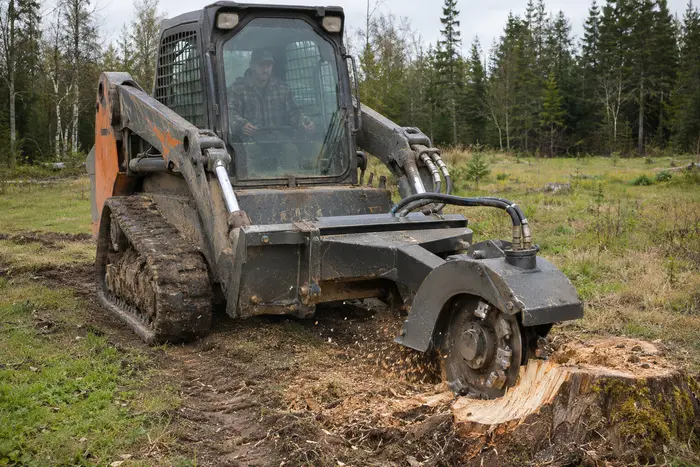
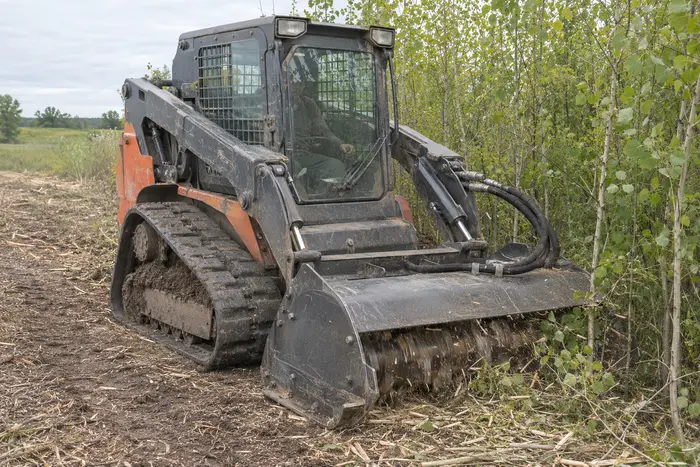
| High flow | Mulchers, cold planers, large snow blowers, stump grinders and other power-hungry tools | Small tools without flow control, which it can overspeed or overheat |
| Mini skid steer circuit | Small brooms, augers, trenchers, small mulchers designed for it | Anything built for a full-size carrier |
See which tools need high flow in our high-flow attachments guide. If you run a lower-flow machine, our low-flow brush cutter guide shows what is possible.
What happens when flow does not match?
- Too little flow. The tool runs slow. A mulcher stalls, a broom turns weakly, and productivity drops. You may think the attachment is weak when the machine is the limit.
- Too much flow. The tool can spin too fast, which wears bearings and motors and can run the oil hot. Some attachments include flow control to prevent this.
- Too little pressure. Cylinders will not squeeze or lift as expected, even if they move quickly.
- Heat. Every mismatch turns energy into heat. Hot oil thins out and damages seals.
How do you find your machine's flow?
- Read the spec sheet or operator manual. It usually lists standard and high-flow output and the relief pressure.
- Check the circuit type. Look for a high-flow switch, a second auxiliary line or a model badge that says so.
- Measure it. A hydraulic flow meter, also called a flow tester, installs between the machine and the attachment hoses and reads actual flow and pressure. This is the best way to confirm an older or modified machine.
- Ask for the numbers in writing. If a machine has been modified, the original spec may be out of date.
Only use a flow meter if you are trained to. High-pressure oil can injure. Follow the operator manual, and have a qualified technician do the test if you are not sure.
What other parts affect real-world flow?
The pump gets the headlines, but the plumbing can hold you back.
- Hose diameter. A hose that is too small restricts flow and heats the oil.
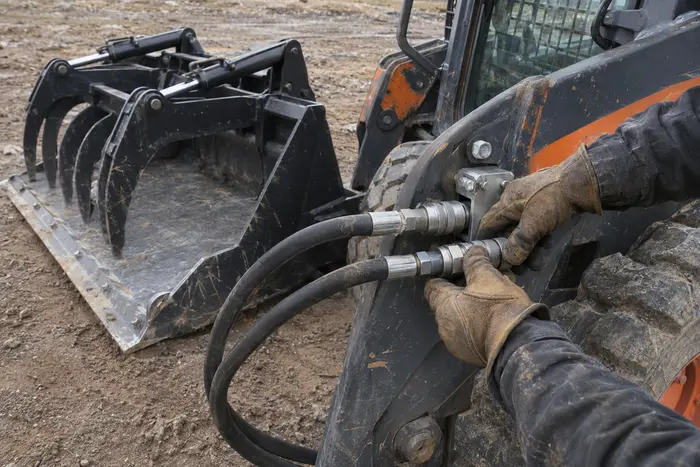
- Quick couplers. Flat-face couplers are common on modern machines. Mismatched or worn couplers cause pressure drop. Read our coupler and hose guide.
- Case drain. Many rotating tools need a separate low-pressure return line to protect the motor seals. See what a case drain is.
- Motor type. Gear motors and piston motors handle load differently. Our piston vs gear motor guide explains why this matters.
- Oil temperature. Hot oil thins out and moves differently. A clean cooler helps.
How do you match an attachment to your skid steer?
- Write down your machine's standard flow, high flow if it has it, and system pressure.
- Get the attachment's required flow range and maximum pressure from the maker.
- Confirm your flow sits inside the range. Do not assume a bigger number is always better.
- Check the connector type and the case drain requirement.
- Check the weight against the machine's rated operating capacity.
- Ask a person to confirm the fit if any step is unclear.
Compact machines are the tightest case. A mini skid steer is limited by both flow and size, so look at mini skid steer brush cutters and mini skid steer trenchers that are built for low-flow circuits. For larger machines, compare mulchers and snow blowers that call for high flow.
Can you add high flow to a machine?
Sometimes. Some models offer a high-flow option from the factory. Others can be modified, but changes affect warranty, cooling and safety systems. Do not modify hydraulics without the maker's guidance. In many cases it is cheaper and safer to choose attachments that match the flow you have.
Also look at cooling. A high-flow tool working hard can overheat a machine that was never meant to run it all day. Take breaks, clean the cooler and watch the temperature gauge.
What does a mismatch look like in real life?
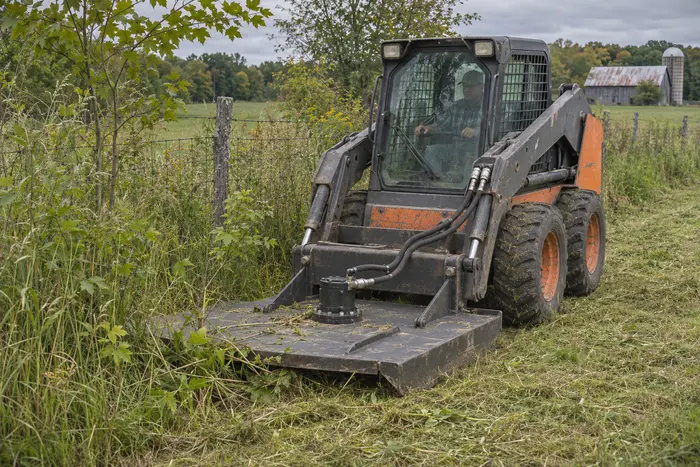
Say you buy a heavy-duty mulcher for a standard-flow machine. It bolts on and the hoses connect, so it looks fine. Then you push into thick brush and the rotor slows to a crawl. The oil gets hot, the machine bogs, and the job takes far longer than planned. Nothing is broken. The attachment simply needs more oil than the circuit can send.
Now flip it. You put a small, flow-sensitive tool on a high-flow circuit with no flow control. The tool spins faster than it was built for. Bearings run hot, seals fail early and the warranty claim gets complicated. In both cases a five-minute spec check would have caught the problem.
That is why a person checks hydraulic fit on every quote we send, comparing your machine's flow, pressure and coupler type to the attachment before you approve a price.
Get the right fit the first time
Hydraulic mismatches are a common reason an attachment disappoints. Send us the make, model and year of your machine. A person checks fit against the maker's specs, and you approve a delivered price before you pay. Get a fit-checked quote or call 1-888-245-1555.
Questions buyers ask
What is the hydraulic flow rate of a skid steer?
It varies by model. Standard auxiliary flow suits most attachments, and larger machines may offer a high-flow option. Mini skid steers have lower flow. Check the spec sheet or measure with a flow meter, because the number depends on the specific machine.
What is the difference between standard flow and high flow?
Standard flow runs most attachments like augers, brooms and buckets. High flow delivers more oil per minute and powers mulchers, cold planers and large snow blowers. High flow is an option on many larger machines, not a given.
How do I check my skid steer hydraulic flow?
Read the operator manual or spec sheet for rated flow and pressure. To verify, a trained person can install a hydraulic flow meter between the machine and attachment hoses. Follow safety rules, because high-pressure oil can cause serious injury.
What happens if hydraulic flow is too low for an attachment?
The attachment runs slowly or stalls. A mulcher may bog down and a broom may spin weakly. The tool is not necessarily faulty. The carrier may not supply the flow the attachment needs, so compare specs before buying.
Does hydraulic flow matter on a mini skid steer?
Yes, more than on larger machines. Mini skid steers have lower flow and smaller hoses, so attachments must be built for that circuit. Choose mini-specific attachments and confirm the flow and pressure ranges with the manufacturer.