Skid steer guide
The History of the Skid Steer Loader
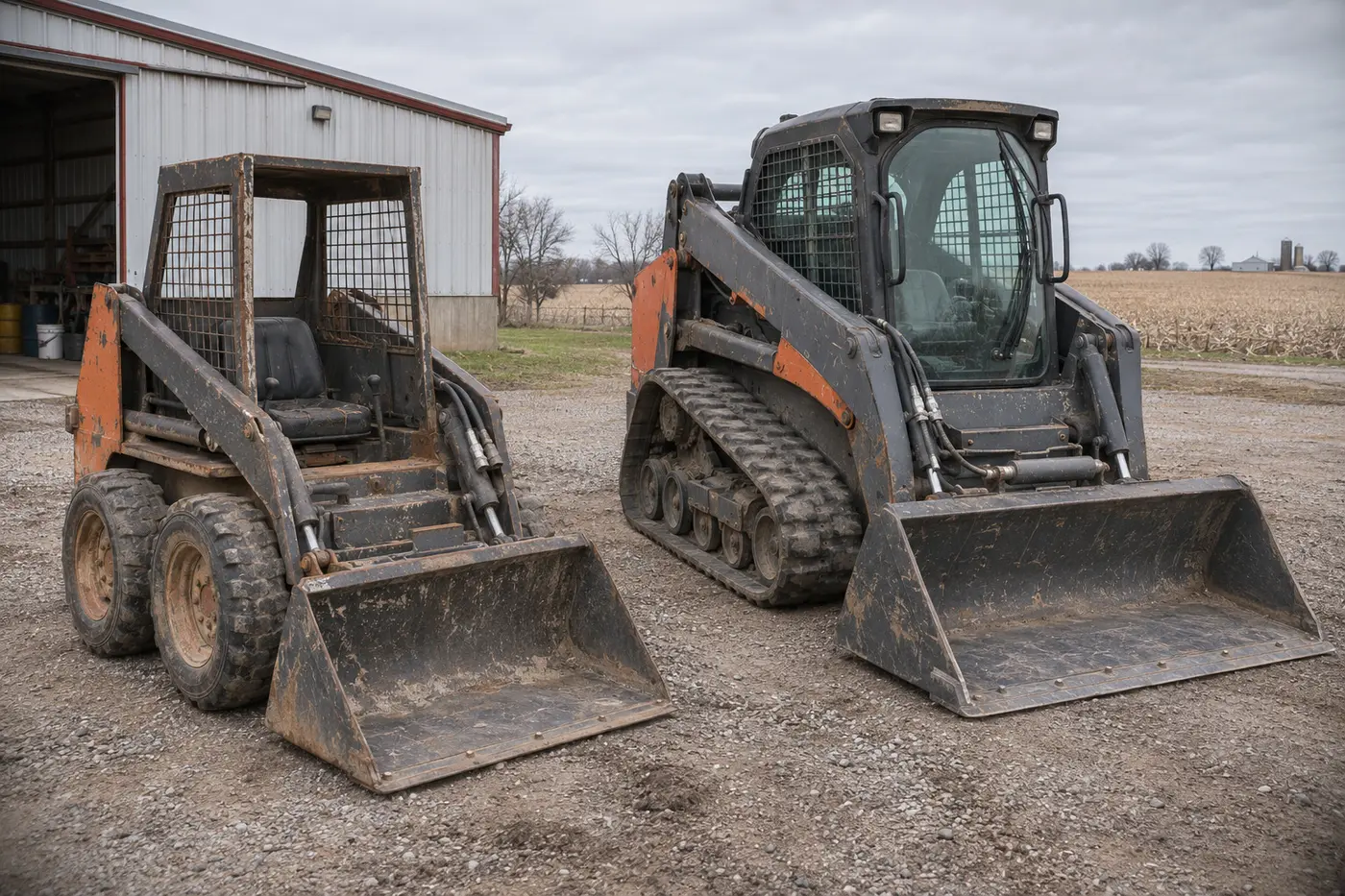
Quick answer
The skid steer began in 1957 when two brothers built a three-wheeled loader in Rothsay, Minnesota, to clean turkey barns. A North Dakota company bought the rights in 1958, began production that year and introduced a four-wheel skid-steer in 1960. Other makers followed in the late 1960s.
Shopping for this now? Get a fit-checked, delivered quote.
Key takeaways
- The first loader was built in 1957 in Minnesota to clean a turkey barn.
- A North Dakota company bought the rights in 1958 and began production.
- In 1960 a four-wheel design became the first true skid-steer.
- Hydraulics, cabs and quick-attach plates grew its role over the decades.
- Compact track loaders and electric models are the newest steps.
The skid steer started as a small fix for a farm chore. Within a few decades it became one of the most common machines on a job site. Here is how it happened, based on the main reference record, and what changed along the way.
When were skid steers invented?
The first loader of this type was built in 1957 in Rothsay, Minnesota. Brothers Cyril and Louis Keller made a three-wheeled front-end loader to help a farmer clean turkey manure out of a barn. The machine had to turn in a tight space, which is why its steering was so different from other loaders. It was simple, compact and easy to move around inside a building.
Who turned it into a product?
In 1958, a pair of brothers who ran a manufacturing company in Gwinner, North Dakota, bought the rights to the loader. They hired the Kellers to refine it. At the end of 1958 the company introduced its first production model. That machine had two independent front drive wheels, a rear caster wheel, a small engine of about 12.9 horsepower and a lift capacity of 750 pounds. By modern standards it was tiny. In its day it was a clever solution for small jobs.
What changed in 1960?
In 1960, the company replaced the rear caster wheel with a rear axle and introduced a model described as the first four-wheel, true skid-steer loader. That change set the pattern still used today. A later update gave the machine 15.5 horsepower and a rated capacity of 1,100 pounds. The company adopted a trademarked name in 1962, and development continued through the mid-1960s. In the late 1960s, competing manufacturers began to sell machines of this form.
How did the machine grow up?
| Period | Change |
|---|---|
| 1957 | First three-wheeled loader built for a barn |
| 1958 | Rights bought, production model introduced |
| 1960 | Four-wheel true skid-steer design |
| Late 1960s | Competitors begin selling similar machines |
| 1970s and 1980s | More powerful engines, enclosed cabs, hydraulics for more attachments |
| 1990s | Joystick controls, better visibility, quick-attach systems |
| 2000s and 2010s | Electronic controls, telematics and tighter engine emissions rules |
| Recent years | Semi-autonomous features and electric models |
How did steering evolve?
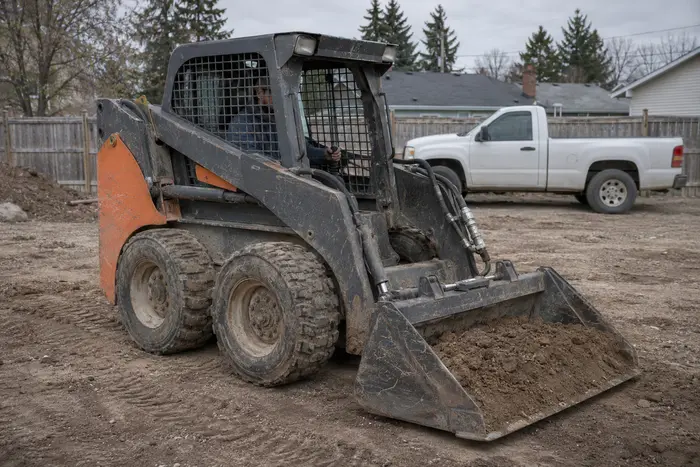
Early machines used forward and reverse clutch drives. Since the mid-1970s, nearly all models have used two separate hydrostatic transmissions, one for each side. This change gave smooth, variable control. It also made the zero-radius turn easier. The machine can drive one side forward and the other backward, turning within its own length. That ability, along with a short wheelbase and a compact frame, is still the core of the design. See what is a skid steer for how steering works today.
Why did attachments matter?
As engines and hydraulics improved in the 1970s and 1980s, makers added hydraulic circuits that could power attachments. That turned the loader into a tool carrier. The quick-attach systems that arrived in the 1990s made swapping tools quick. Buckets, forks, augers, brooms, brush cutters and many other tools could now share one carrier. Browse pallet forks and augers for two classic examples. The guide to skid steer quick-attach plate types covers how the mounting standard works today.
What is the compact track loader?
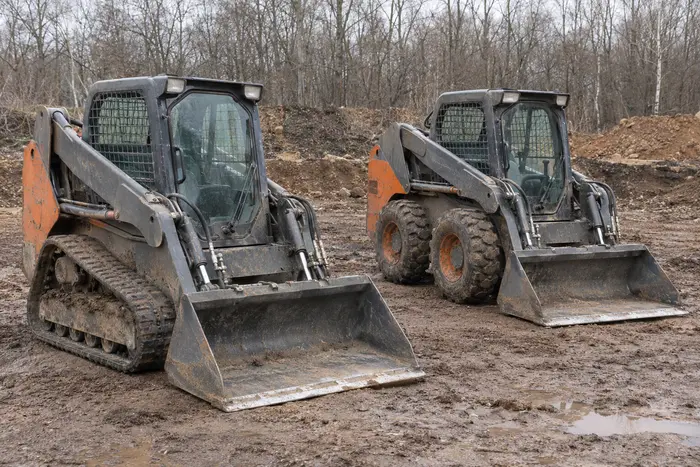
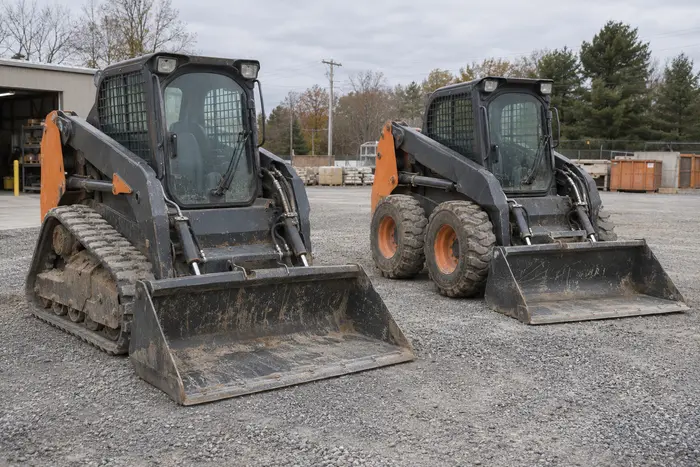
A compact track loader is a skid steer with tracks in place of wheels. The steering method is the same. Tracks spread weight and improve traction in soft ground, mud and snow. They arrived later than wheeled machines and have grown in popularity, especially in grading and landscaping. See skid steer wheels vs tracks for a comparison.
What about mini skid steers?
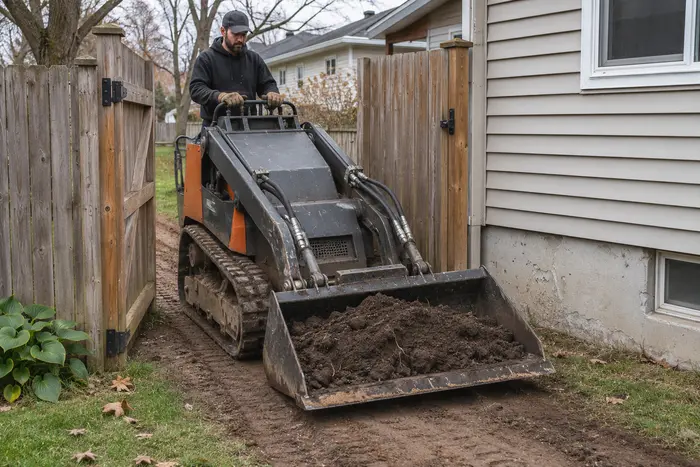
Smaller versions, often called mini skid steers or mini track loaders, grew up alongside the larger machines. They are narrower, lighter and designed for tight access, like backyards and interior work. They share the same basic idea, with scaled-down hydraulics and attachments. Browse mini skid steer buckets for a sense of how the attachments scale.
Where is the design headed?
Recent developments include autonomous and semi-autonomous features and electric drive. These aim to reduce operator workload, noise and emissions. The core idea from 1957 is unchanged: a compact, strong machine that turns in its own length and works with a wide set of tools. Rated operating capacity has grown from hundreds of pounds on early units to far more on modern machines, which is why attachment choice now covers everything from small tools to heavy brush cutters and cold planers.
What does the history tell a buyer?
It explains why the skid steer ecosystem is so large. A shared mounting plate and common hydraulic couplers mean many attachments fit many machines. It also explains why details still matter: capacity, flow and plate type vary by model and year. A machine built decades ago may not support a modern attachment's hydraulic needs. Always check fit against the maker's specs, not just the plate shape.
What did early operators actually gain?
Before compact loaders, moving material in a small space meant hand labor, a wheelbarrow or a larger machine that couldn't turn in a barn. A loader that spins in place and carries a bucket changed that. Farmers, small contractors and landscapers could now do jobs that were out of reach for their budget and site.
Over time, safety features grew too. Operator cabs that serve as roll-over and falling-object protection, seat belts and restraint bars became standard as the machines got stronger and faster. Modern operator manuals stress using these features every time, and they remain the first rule of safe operation.
How does the history shape how you shop today?
Standards that emerged over decades, like the universal quick-attach plate, mean many tools fit many carriers. That is why buyers can choose attachments from multiple makers for the same machine. But the standard covers the mount, not the hydraulics, weight or capacity. Two machines with the same plate can have different flow and lift limits, so the plate shape alone doesn't decide fit.
When you look at a used machine, its age tells you about its hydraulics and controls. Older units may lack auxiliary hydraulics or have a lower flow than modern attachments expect. Newer units often include electronic controls and monitoring that support more complex tools.
Looking back, the pattern is clear. Each decade added a layer: power in the 1970s, comfort and control in the 1990s, and electronics in the 2000s. Attachments grew in step, and the tool library today covers nearly every trade that moves material or prepares ground.
Get the right fit the first time
Every attachment depends on your machine's mount, hydraulics and rated capacity. Send us the make, model and year and a person will check fit against the maker's specs. You approve a delivered price before you pay, and the manufacturer ships direct. Get a fit-checked quote or call 1-888-245-1555.
Questions buyers ask
When were skid steers invented?
The first three-wheeled loader of this type was built in 1957 in Rothsay, Minnesota, by two brothers. A North Dakota company bought the rights in 1958 and introduced a production model that same year. A four-wheel true skid-steer followed in 1960.
Who invented the skid steer loader?
Cyril and Louis Keller built the first design in 1957 to clean turkey manure from a barn. A company run by two brothers bought the rights in 1958, hired the Kellers to refine it and began production.
What was the first skid steer like?
It had two front drive wheels and a rear caster wheel, a small engine of about 12.9 horsepower and a 750-pound lift capacity. A 1960 update added a rear axle and made it a four-wheel machine, which set the design pattern still used.
When did other companies start making skid steers?
Competing manufacturers began selling machines of this form in the late 1960s. In the following decades, more powerful engines, enclosed cabs and better hydraulics spread across the industry, and quick-attach systems arrived in the 1990s.
When did compact track loaders appear?
A compact track loader is a skid steer with tracks instead of wheels. It came after wheeled machines and has grown in use, particularly where traction and flotation on soft ground matter. Steering works the same way as on a wheeled machine.