Forklift guide
Forklift Dimensions Guide: Size, Height and Turning
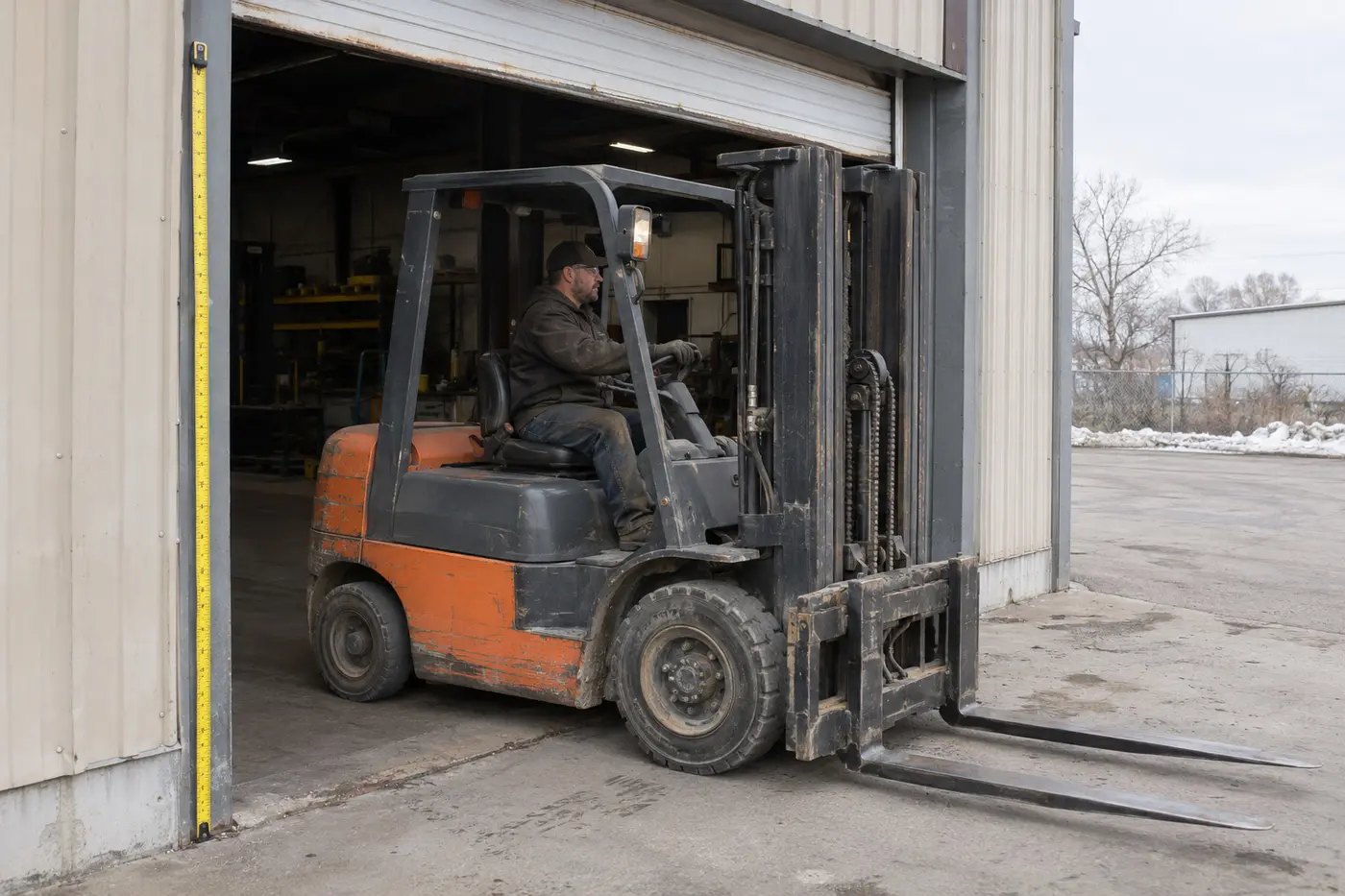
Quick answer
Forklift dimensions depend on the type, capacity and mast, so no single size applies. The numbers that matter are overall width, length to the fork face, lowered mast height, extended mast height, fork length and turning radius. Find the exact figures on the truck's spec sheet or data plate, and check them against your aisles, doors and trailers.
Shopping for this now? Get a fit-checked, delivered quote.
Key takeaways
- No single forklift size exists; dimensions change with type, capacity and mast.
- Width, length, lowered height and turning radius decide where a truck fits.
- Mast type changes both lowered and raised height.
- Fork length should be matched to the load, at least two-thirds of its length.
- Use the manufacturer's spec sheet for exact figures.
Anyone who has tried to push a forklift through a door that is too narrow or park one under a low beam knows dimensions matter. The trouble is that "forklift dimensions" is not one set of numbers. It changes by truck type, by capacity and by how the truck is configured. This guide shows what to measure and why, without pretending there is one standard size.
What dimensions matter on a forklift?
These are the figures you will see on a spec sheet, and what each one tells you:
| Dimension | What it tells you |
|---|---|
| Overall width | Whether it fits through doors, aisles and trailer openings |
| Overall length (to fork face) | Parking space and trailer fit, without the forks |
| Overall length (with forks) | Total footprint, including the load-carrying forks |
| Lowered mast height | Clearance through doorways, under beams and into containers |
| Extended mast height | Clearance when lifting, and ceiling limits |
| Maximum fork height | How high a load can be placed |
| Turning radius | How tight a turn the truck can make |
| Right-angle stacking aisle width | The aisle width needed to stack a pallet at 90 degrees |
| Wheelbase and tread | Stability and turning behavior |
How do dimensions change by forklift type?
Different trucks are built for different spaces, so their sizes differ a lot.
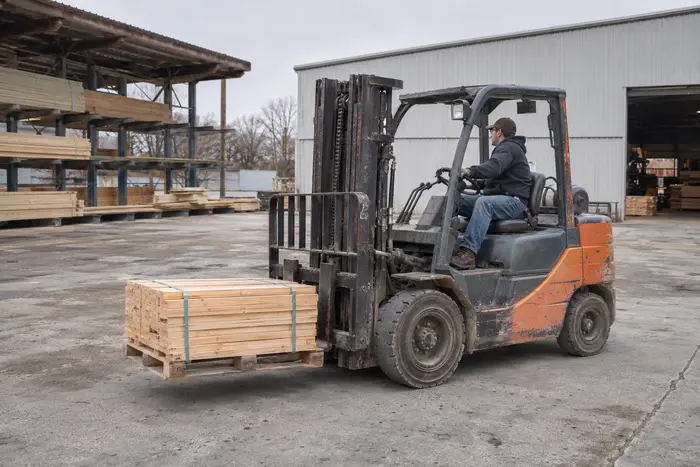
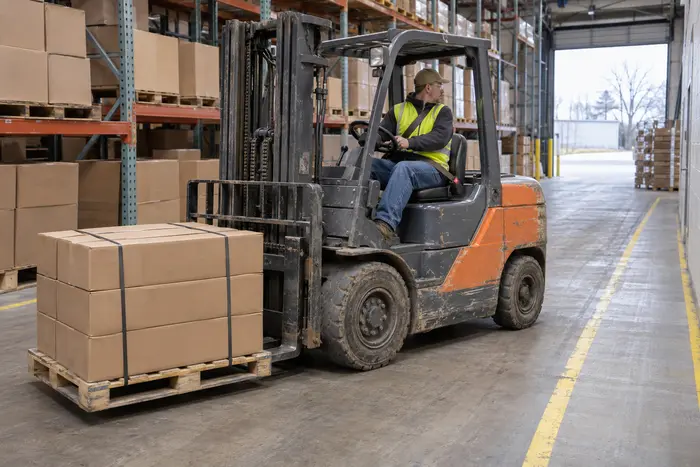
- Warehouse counterbalance trucks are compact enough to work in standard aisles and doors, with a rear counterweight that balances the load.
- Narrow-aisle and very-narrow-aisle trucks are built for tight racking. A reference notes guided very-narrow-aisle trucks can lift to heights up to 40 feet non-top-tied and up to 98 feet top-tied.
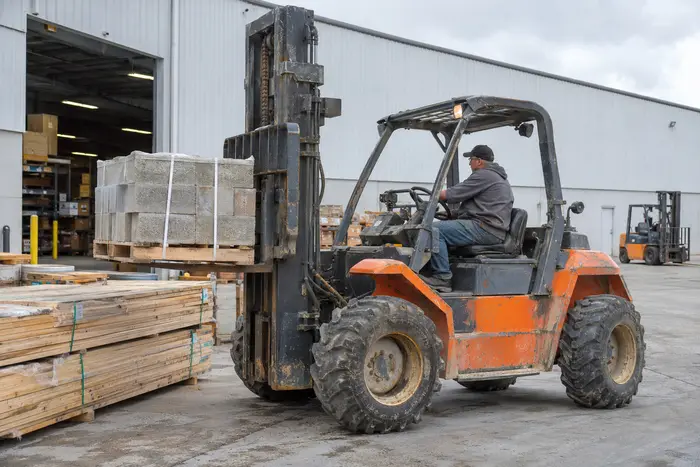
- Rough-terrain trucks are larger and wider, with big tires and higher ground clearance. They are made for job sites, not for tight aisles.
- Heavy-duty and container trucks are much larger, with high capacity and long forks or special attachments.
Even fork length varies widely. A general reference mentions some marina forklifts with forks up to 24 feet long. For ordinary pallet work, forks are much shorter. Our guide to types of forklifts covers the families.
How long should forks be?
Match forks to the load. Canadian occupational safety guidance says to drive the forks fully under the load, using forks at least two-thirds of the load's length, and to set them as wide as the load allows, evenly spaced around the pallet's center. Forks that are too short can let the load tilt or fall. Forks that are too long can reach through and damage what is behind. In tight spaces, do not let forks extend past the back of the pallet.
What is the mast, and why does it change height?
The mast is the vertical frame that raises and lowers the forks. A standard mast raises forks in stages. A container-style mast lets the forks rise a few meters without increasing the truck's overall height, which is useful in trailers and low doorways. Overall height with the mast lowered is the number you check for doorways and trailer roofs. Extended mast height is what you check against ceilings, sprinklers and beams. A taller mast also adds weight, as covered in how much a forklift weighs.
What is turning radius, and why does it matter?
Turning radius is how tight the truck can turn, usually measured from the center of the turn to the outermost point at the rear of the truck. Check how each maker defines it. A small turning radius lets you work in narrow aisles. It also affects how much space you need at dock doors and in staging areas. Right-angle stacking aisle width is a related spec: it gives the aisle width needed to turn 90 degrees and place a pallet into a rack. Both numbers are listed by the manufacturer, and both change with truck type and load.
Forklift dimensions in feet, meters and mm
Spec sheets are published in feet and inches in North America, and in millimeters or meters elsewhere. Convert carefully.
- 1 foot equals 304.8 mm, or 0.3048 m.
- 1 meter equals about 3.28 feet.
- 1 inch equals 25.4 mm.
Always read the unit on the spec sheet, and be careful with mixed units on PDFs from international makers.
Where to find exact dimensions
- Read the truck's data plate for model and serial number.
- Find the manufacturer's spec sheet or manual for that exact model.
- Check the mast type, fork length and any attachments, since specs are often for a base unit and the truck may differ.
- If you are buying or renting, ask for a dimensioned drawing.
Specification listings commonly note that figures are for the base unit and that actual equipment may vary with options. That caution is worth taking seriously.
A quick fit-check before you bring a forklift in
- Measure the narrowest door, aisle or gate on the path.
- Measure the lowest overhead obstruction, including lights and sprinklers.
- Compare to the truck's width, lowered height and turning radius, with margin.
- Check the floor and ramp ratings for the truck's weight plus load.
- Confirm the operator is trained for that truck type.
What if a forklift is too big for the space?
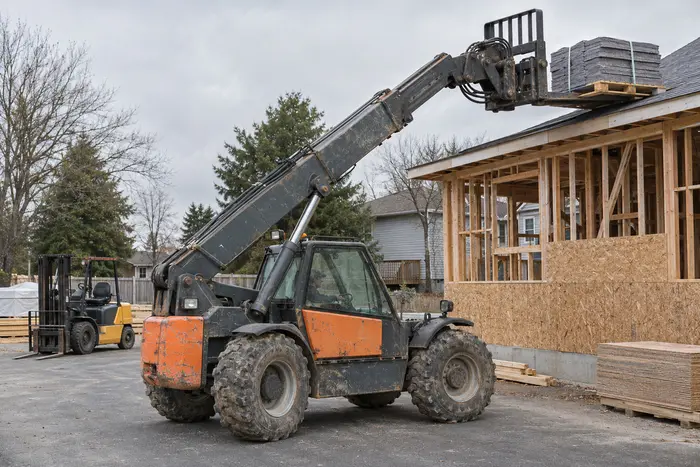
Sometimes a smaller machine solves the problem. On a yard or job site, a compact loader fitted with pallet forks can reach where a counterbalance truck cannot. See pallet forks for skid steers for the tool, and skid steer pallet fork weight capacity to size it. A telehandler adds reach, and telehandler fork extensions lengthen the forks for longer loads. For safety basics, see our forklift safety guide.
Safety around dimensions
Raised loads reduce stability, and a raised mast can strike overhead objects. Check overhead clearance before lifting and travel with forks low. Follow the operator manual and the rated capacity on the data plate.
Dimensions you might overlook
- Overhead guard height. The operator cage is often the tallest point of a sit-down truck with the mast lowered. Check it, not just the mast.
- Counterweight overhang. The rear of the truck swings wide in a turn. Leave room at the back.
- Load width. A wide load can be wider than the truck itself. Measure the load as well as the machine.
- Tire type. Larger pneumatic tires raise the truck and widen the stance compared with cushion tires.
- Attachments. A side shifter, clamp or rotator adds length to the front of the truck and reduces rated capacity at the load center.
Trailer and container loading
Loading into a trailer or container needs more than a door check. Confirm the opening height with the mast lowered, the trailer floor strength and the dock-to-trailer gap. OSHA lists lifts falling between a dock and an unsecured trailer as one of the common injury scenarios, so secure the trailer before the truck drives onto it. If the truck needs more headroom, a container-style mast keeps the overall height low while the forks rise.
Get the right fit the first time
Send us your machine's make, model and year, and a person will check fit against the maker's specs. You approve a delivered price before you pay, and the manufacturer ships direct. Start your fit-checked quote.
Questions buyers ask
What are the dimensions of a forklift?
There is no single size. Dimensions vary by type, capacity and mast. Warehouse counterbalance trucks are compact, while rough-terrain and heavy-duty trucks are larger. Check the manufacturer's spec sheet for the exact width, length, mast height and turning radius of your model.
What is the turning radius of a forklift?
Turning radius depends on the truck type and size. Warehouse trucks turn tighter than rough-terrain trucks. The figure is on the spec sheet, alongside the right-angle stacking aisle width. Use those numbers to check aisle and dock-door space before you commit.
How long are forklift forks?
Standard pallet forks are much shorter than specialty ones, and some marina forklifts use forks up to 24 feet long. As a safety rule, use forks at least two-thirds the length of the load and set them as wide as the load allows.
How tall is a forklift?
It depends on the mast. Lowered mast height decides doorway and trailer clearance. Extended mast height decides ceiling clearance. Guided very-narrow-aisle trucks can lift loads up to 40 feet or more, so always read both heights on the spec sheet.
Where can I find forklift dimensions in a PDF?
Manufacturers publish spec sheets and operator manuals as PDFs for each model. Use the model and serial number from the data plate to find the right one. Note whether figures are in feet, meters or mm, and whether they apply to a base unit.