Concrete guide
Skid Steer Hydraulic Breaker: A Buyer's Guide
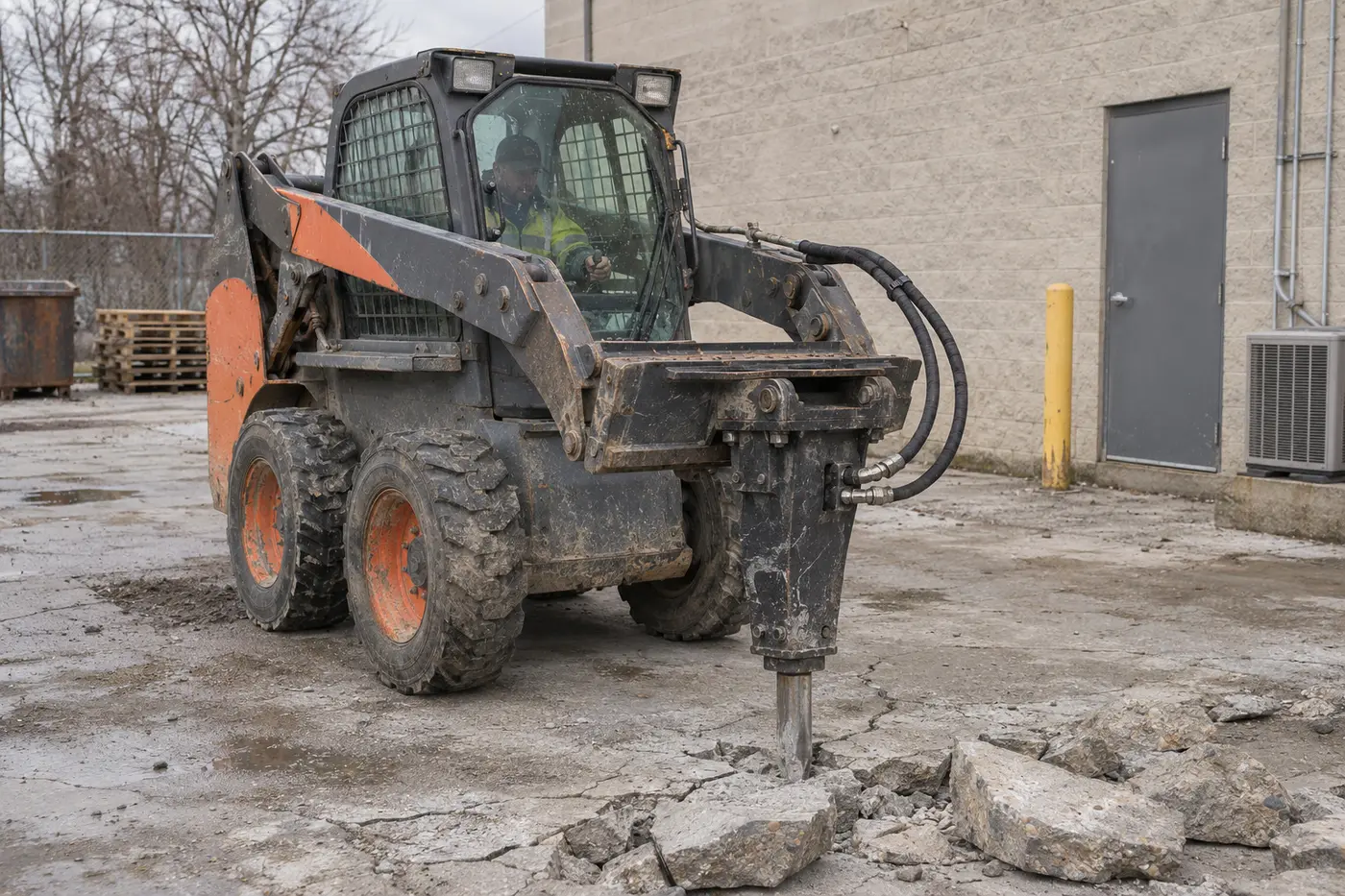
Quick answer
A skid steer hydraulic breaker is a percussion hammer that breaks concrete, asphalt and rock using the loader's auxiliary hydraulics. Buy by matching its flow, pressure and weight to your machine, picking a tool bit for the material, and confirming the mount, hoses and guarding before you hammer.
Shopping for this now? Get a fit-checked, delivered quote.
Key takeaways
- A breaker is a hydraulic percussion hammer driven by the machine's auxiliary circuit
- Its flow, pressure and weight must match your skid steer's ratings
- Larger carriers take larger breakers; the maker's sizing chart governs
- Tool bit shape changes how it breaks concrete, asphalt or rock
- Eye, ear and dust protection and keeping bystanders clear are required for safe use
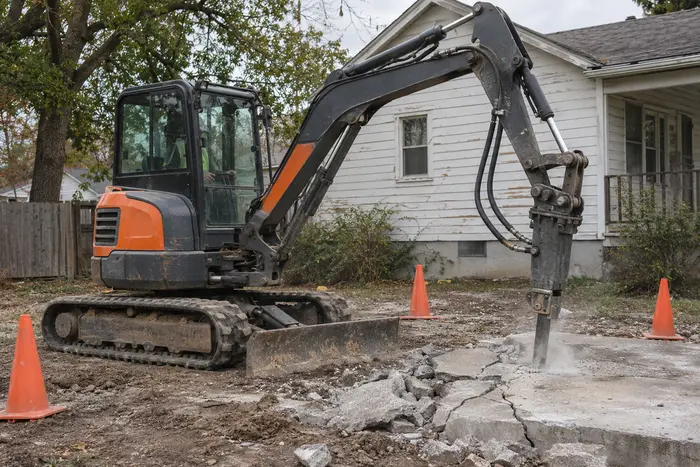
Breakers on skid steers handle the demolition jobs that are too big for a handheld jackhammer and too small to bring in an excavator. They break driveways, slabs, footings and rock in places where a larger machine cannot get in. The attachment is simple, but a bad match to the machine wastes money and damages hydraulics. Here is how to buy one right.
What is a hydraulic breaker?
A breaker is a powerful percussion hammer fitted to a carrier machine for demolishing hard structures such as rock and concrete. It runs on the machine's auxiliary hydraulic system. Other names include hammer, pecker and hoe ram. The first hydraulic breaker was invented in 1967 in Essen, Germany, and the design is now standard across excavators and loaders. A skid steer carrier uses a breaker made for the loader's smaller size, and a quick-attach plate mounts it to the arms.
Demolition crews choose hydraulic breakers for work that is too large for jackhammering, or when blasting is not possible for safety or environmental reasons.
How do breakers scale with the carrier?
The key rule is that the breaker has to suit the carrier. A reference table of typical breaker specifications, reproduced in the Wikipedia article on hydraulic breakers, shows how breakers scale with the weight of the excavator that carries them. For example, a breaker listed for a very small carrier of around 0.8 to 2.0 tonnes uses about 15 to 25 liters per minute of oil, operates at around 90 to 120 kg per square centimeter, and weighs about 115 kg. A breaker made for an 11 to 18 tonne excavator uses 80 to 120 liters per minute and weighs about 973 kg. A breaker for a 40 to 55 tonne excavator uses 210 to 290 liters per minute and weighs about 4,210 kg.
| Carrier weight | Oil flow (L/min) | Breaker weight (kg) | Impact rate (blows/min) |
|---|---|---|---|
| 0.8 to 2.0 tonnes | 15 to 25 | 115 | 800 to 1,400 |
| 11 to 18 tonnes | 80 to 120 | 973 | 400 to 700 |
| 40 to 55 tonnes | 210 to 290 | 4,210 | 200 to 350 |
Treat these figures as illustrative, not as a spec for your machine. The table is written for excavators, and real models vary. It still shows the pattern: heavier carriers take larger breakers that use more oil, hit harder and strike less often. A skid steer sits at the light end of the scale, so its breaker is small and light compared with a large excavator's. Always use the breaker maker's chart and your loader's rated auxiliary flow and pressure, because ranges overlap.
What should you check on your skid steer?
- Auxiliary flow and pressure. The breaker has a required flow and pressure range on its spec sheet. Your machine's auxiliary circuit has to deliver both. Too little flow and it hits weakly. Too much flow or pressure and it can overheat or damage the breaker.
- Relief setting. The auxiliary relief valve limits maximum pressure. It must sit within the breaker's allowed range.
- Weight and rated operating capacity. The breaker's weight counts against the loader's capacity. A heavy breaker at full reach reduces stability.
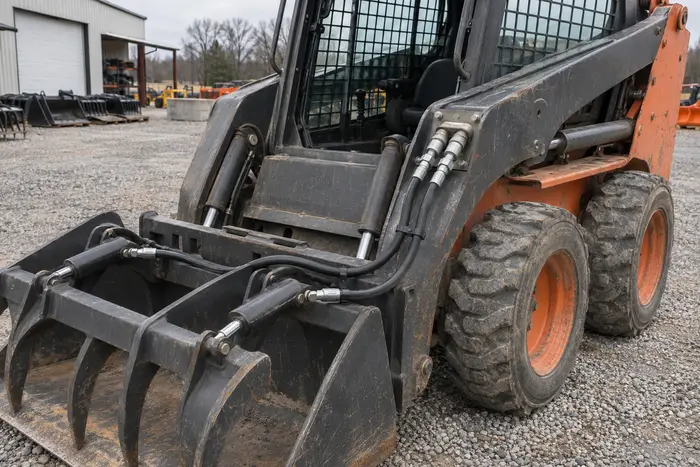
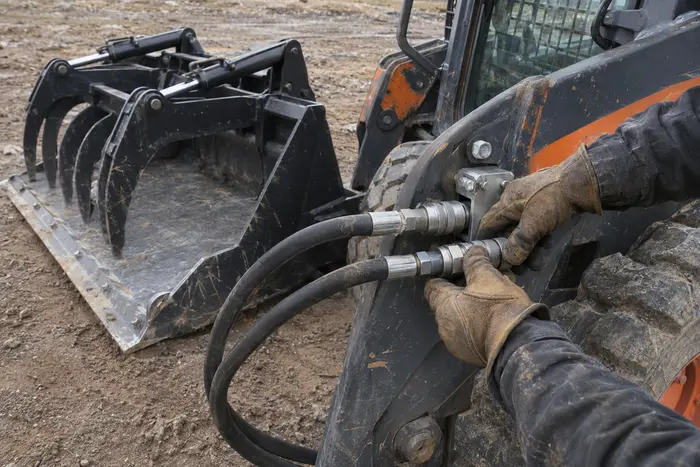
- Coupler type. Flat-face couplers are common, but sizes vary. A mismatch can restrict flow.
- Return line. A breaker needs a return line with low backpressure. A restricted return can hurt performance. Follow the maker's instructions for the return connection.
- Mounting. A universal skid steer quick attach plate is common. Verify the pattern against your machine.
Our guides on hydraulic flow and flat-face couplers and hoses explain these in plain language.
What tool bits are available?
The bit, sometimes called a tool or chisel, decides how the breaker attacks the material.
- Moil point. A pointed tool that concentrates force. Good for breaking rock and thick concrete.
- Chisel. A flat edge that cuts and splits. Good for trenching through concrete, asphalt and frozen ground.
- Blunt tool. A flat, wide face used to break boulders and oversize rock without penetrating deeply.
Choose the bit for the material. A moil point can get stuck in tough concrete if it penetrates too deep, while a chisel may skate across a hard rock face. Many buyers keep two bits.
Breaker vs other options
A breaker on a skid steer is a good fit for sidewalks, slabs, driveways and small footings. For larger demolition, an excavator breaker has more power and reach. For small interior work, a mini skid steer can carry a smaller unit. See skid steer breakers, mini skid steer concrete breakers and excavator breaker hammers. Our guide to hydraulic hammers for mini excavators covers the next size up.
How to operate a breaker safely
- Personal protection. Wear eye, ear and respiratory protection, since dust and noise are heavy. Silica dust from concrete is a recognized hazard, so control dust with water where you can.
- Keep bystanders clear. Pieces fly. Follow the manual's safe distance.
- Do not blank fire. Firing the breaker without the tool pressed on material damages it and the carrier.
- Do not pry. A breaker is for striking, not for levering. Prying can break the tool.
- Check for utilities. Know what is under the slab before you break.
- Use guarding. A forestry or demolition door protects the operator from flying debris, where the machine maker calls for it.
- Follow the manuals. Operator manuals for the machine and the breaker govern.
What jobs suit a skid steer breaker?
The sweet spot is breaking sidewalks, patios, garage slabs, driveways, small footings and rock outcrops in places where an excavator will not fit or would cost too much to mobilize. The skid steer's low profile and tight turning let it work close to buildings and inside gates. It is also handy for breaking frozen ground and for cutting trenches through asphalt. For very thick or heavily reinforced concrete and for large rock, an excavator breaker has the power and reach to do it faster.
Maintenance basics
Breakers are simple, but they need regular care. Grease the tool bushing as the manual says, because a dry tool wears the bushing and the tool fast. Check hoses and fittings for leaks and rub marks. Inspect the tool for mushrooming or cracks, and replace worn bushings and pins before they let the tool misalign. Keep the hydraulic oil clean and at the right level. Allow the machine to warm up in cold weather. Check the mounting plate bolts for looseness at the interval the manual gives, since vibration works them loose. And store the breaker with the tool relaxed and the hose ends capped.
New or used, buy or rent?
If you break concrete a few times a year, renting usually costs less. If you do it every week, owning can pay off. For used breakers, the internal seals and, on gas-assisted models, the nitrogen charge are the hidden costs, and you cannot see them from outside. Ask for service records, check the tool and bushing for wear, and run the breaker to listen for a weak or irregular blow. Since fit matters so much, check the hydraulics first.
Get the right fit the first time
Send us your machine make, model and year and what you plan to do with it. A person checks fit against the maker's specs, and you approve a delivered price before you pay. Get a fit-checked quote.
Questions buyers ask
What does a skid steer hydraulic breaker do?
It hits concrete, asphalt or rock with rapid hydraulic percussion to break it into pieces. It uses the skid steer's auxiliary hydraulics and a quick-attach mount, and suits jobs too big for a jackhammer but where an excavator will not fit.
What flow does a skid steer breaker need?
Each breaker lists a required flow and pressure range on its spec sheet, and the carrier must deliver both. Breakers for small carriers use a fraction of what an excavator breaker uses. Match your machine's auxiliary flow to the breaker's range.
Can any skid steer run a hydraulic breaker?
Only if its auxiliary hydraulic flow, pressure, couplers and lifting capacity suit the breaker. Check the breaker's flow and weight against the machine, and confirm the mount and return line. A fit check against the maker's specs avoids mistakes.
What is the difference between a moil point and a chisel?
A moil point is a pointed tool that concentrates force and breaks rock and thick concrete. A chisel has a flat edge that cuts and splits material, and suits trenching in concrete or asphalt. Pick the bit by the material you break.
Is it better to buy or rent a skid steer breaker?
Rent if you break concrete only a few times a year. Buy if you use one regularly. Either way, confirm flow, pressure and mounting before you commit, since a poor match damages the breaker and the machine's hydraulics.