Telehandler guide
Truss Booms and Jibs for Skid Steers and Telehandlers
Quick answer
A truss boom is a lifting arm that mounts to a skid steer or telehandler carriage so you can hang loads from a hook, such as trusses, beams and pipe. A jib is a similar boom with a lifting point at its tip. Capacity depends on boom length, reach and your machine's rating.
Shopping for this now? Get a fit-checked, delivered quote.
Key takeaways
- A truss boom turns the machine into a mobile crane-style lifter
- Capacity falls as the hook moves further from the machine
- Use rigging rated for the load and follow the machine's load chart
- Do not exceed the loader's or telehandler's rated capacity at the load point
- Match the boom to your carriage type and quick attach
Truss booms and jibs are simple tools that solve a common site problem: you have to place something heavy at height or at a distance, and forks cannot do it. A truss boom bolts to the front carriage and gives you a lifting point on a beam that sticks out in front of the machine. This guide covers how they work, the limits on what they can lift, and how to choose one.
What is a truss boom?
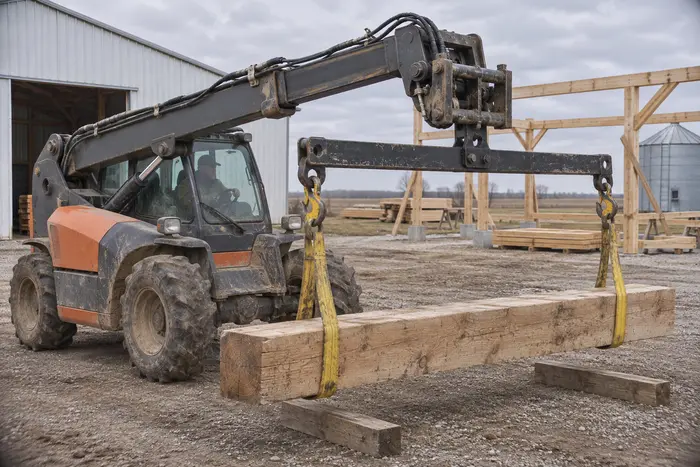
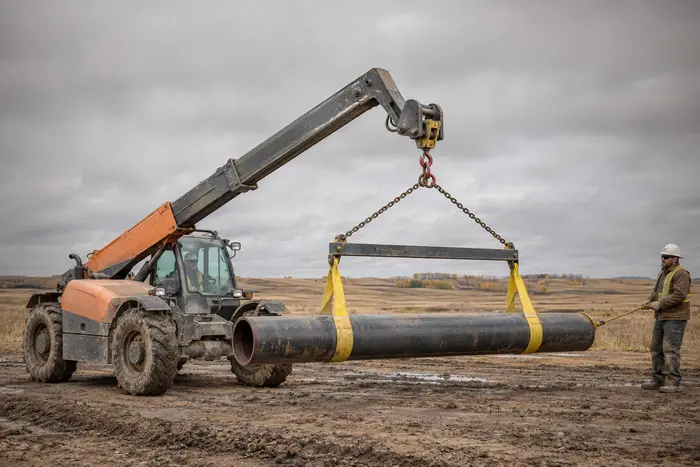
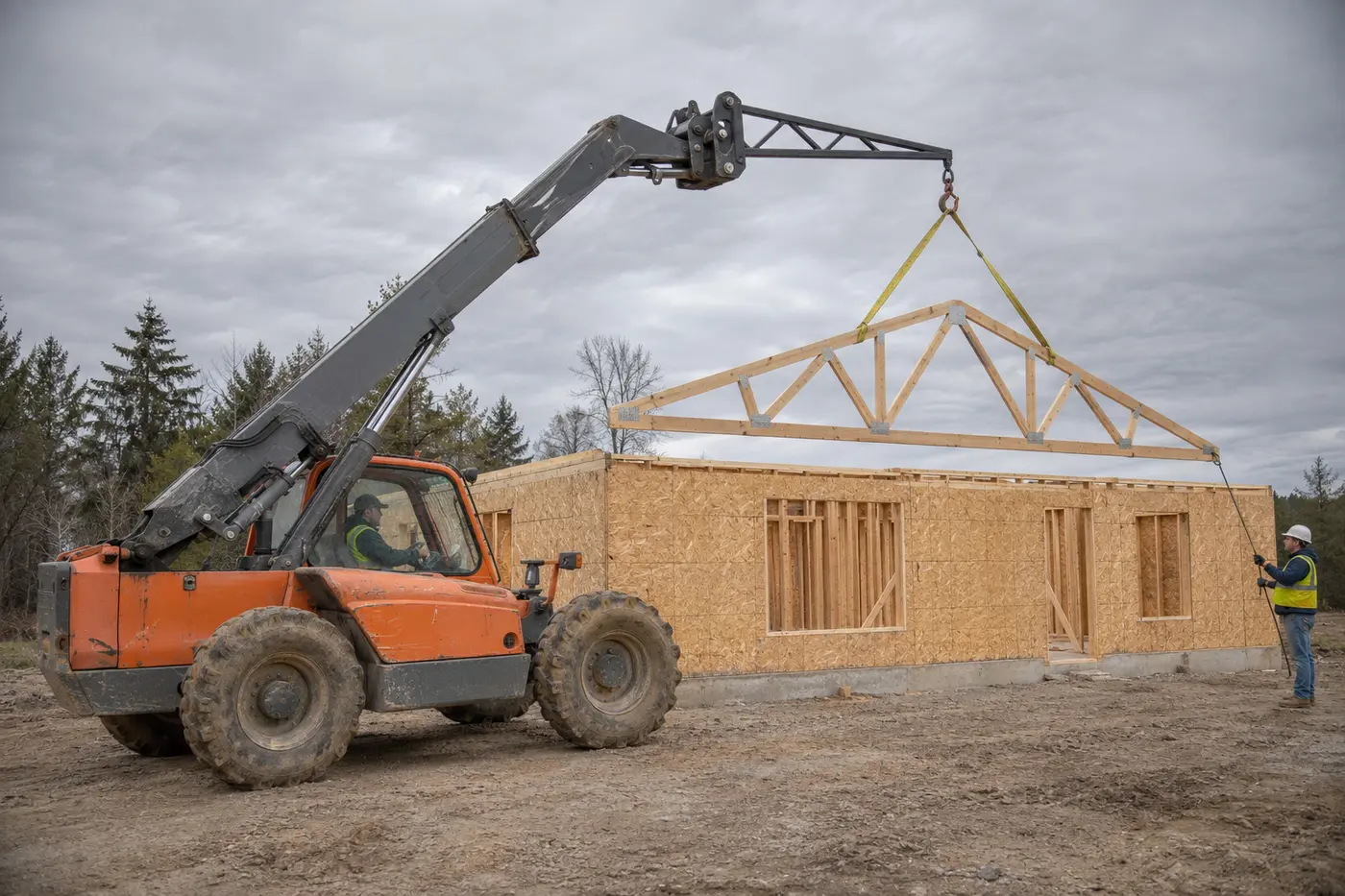
For background on the carrier, see what a telehandler is. A truss boom is a fabricated boom with a hook or lifting point at its tip. It mounts on the carriage of a skid steer or telehandler. You hang the load from the hook using a sling or a hook-and-shackle setup, lift with the machine's arms, and place the load where you need it. Roof trusses, steel beams, pipe, precast sections and bundles of lumber are typical loads.
Booms come in fixed lengths, in sections that bolt together, and in telescopic versions that extend on a hydraulic or manual pin. Some include a winch at the base, which lets you change hook height without moving the machine's arms.
Truss boom vs jib: what is the difference?
People use the words loosely. In general, a truss boom is a longer, trussed boom made for placing structural pieces such as roof trusses. A jib is a shorter lifting arm, sometimes with several hook positions, that adds modest reach to a loader or telehandler. Both turn a carrier into a basic lifter. Both are covered by the same rule: use the load chart, not guesswork.
| Feature | Truss boom | Jib |
|---|---|---|
| Typical use | Setting trusses, beams, pipe | Hoisting smaller loads, hanging items on site |
| Length | Longer, sometimes sectional or telescopic | Shorter, sometimes adjustable hook positions |
| Effect on capacity | Larger drop as it extends | Smaller drop, but still reduces capacity |
| Works on | Telehandlers, large skid steers | Skid steers, telehandlers |
Why does capacity drop as the hook moves out?
A telehandler's boom works like a lever. When the load moves away from the front wheels, the machine has to resist more tipping force. That is why a telehandler can lift much more with the boom retracted than with it fully extended. For example, one telehandler description notes that a machine rated for 5,000 lb with the boom retracted may safely lift as little as 400 lb with the boom fully extended at a low angle. A truss boom adds its own length on top of that, so the hook can be well past the front axle.
A skid steer has the same physics with a much shorter lever. Skid steers have a rated operating capacity, and a boom mounted on the front pushes the load further out, which cuts what you can lift. The machine's rated operating capacity applies to the load at the specified load point, not to a hook sitting well beyond it.
Practical takeaway: capacity depends on the machine, the boom, the angle, and the reach. Do not guess. Use the load chart for the machine with the boom fitted, and ask the boom's maker for its working load limit at each hook position.
How to match a truss boom to your machine
- Carrier type. Most skid steer booms mount to the common universal quick attach plate. Telehandler booms mount to the carriage in different ways, so confirm the type.
- Machine capacity. Look at the rated operating capacity or the load chart and compare it to the boom's rated load.
- Boom length and hook positions. Longer is not better. The reach you need drives the choice.
- Weight of the boom itself. The weight of the boom counts against the machine's capacity.
- Winch option. Useful for fine height adjustments, but check winch capacity and the control arrangement.
- Stability on the site. Ground that is soft or sloped reduces stability. Consider tracked machines or stabilizers where available.
You can browse telehandler truss booms and jibs or skid steer jib booms. We confirm fit against the machine's specs before quoting, because carriage patterns vary.
Safety basics for lifting with a boom
- Use rated rigging. Slings, shackles and hooks must have a working load limit that covers the load.
- Keep the load low and close. Lift only as high as needed. Travel slowly with the load as near the ground as practical.
- Control swinging loads. Use tag lines when the load can swing. Stay out from under it.
- Check the ground. Soft or uneven ground can tip the machine.
- Watch overhead. Know where power lines are before raising a boom.
- Follow the manual. The operator manual and the boom's instructions govern.
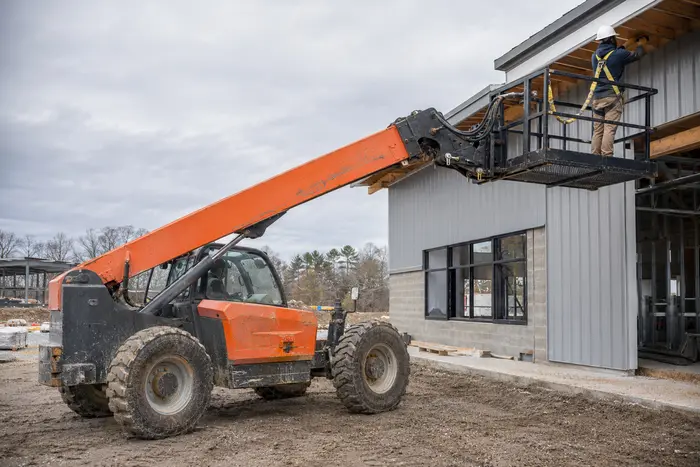
Never lift people on a truss boom, jib or hook. For work at height, use a purpose-built platform. See our telehandler work platform FAQ for more.
Planning a lift step by step
- Weigh or confirm the load's weight from the supplier. Do not estimate.
- Add the weight of slings, shackles and spreader gear.
- Decide where the hook has to be at the pick and at the placement. Measure the reach at both points.
- Check the machine's load chart for that reach and height with the boom fitted.
- Walk the travel path. Look for soft ground, slopes, ruts and overhead lines.
- Brief the crew. One person signals, and everyone knows the stop signal.
- Lift a few inches first to check balance and stability, then continue.
If any figure does not match, stop and change the plan. A smaller load, a shorter reach or a larger machine costs far less than a tip-over.
Do you need a winch or a telescopic boom?
A fixed boom is cheaper and simpler, and it is enough when you always lift to the same hook position. A telescopic boom lets you change reach without changing attachments, which helps when jobs vary. A winch lets you raise and lower the load without moving the machine's arms, so placement is smoother. The tradeoff is weight and complexity. The extra weight sits far out in front, so it takes capacity away. If your work is mostly setting trusses from the ground, a simple boom with the right length usually serves better than a feature-heavy one.
Common mistakes
The biggest mistake is lifting by feel. A load that seems light for the machine can be too much at full reach. Another is using a fork-mounted hook or a chain looped over the forks as a substitute for a rated boom. A third is mounting a boom that fits but is not rated for the carrier. Finally, many operators forget that wind can swing a long load. Plan the lift, then walk the path before you start.
Get the right fit the first time
Send us your machine make, model and year and what you plan to do with it. A person checks fit against the maker's specs, and you approve a delivered price before you pay. Get a fit-checked quote.
Questions buyers ask
What is a truss boom used for?
A truss boom lets a skid steer or telehandler lift loads by a hook. Typical uses include setting roof trusses and steel beams, lifting pipe and placing precast pieces. It is a lifting tool, so rated rigging and the machine's load chart govern each lift.
Can a skid steer use a truss boom?
Yes, many truss booms and jibs mount to a skid steer's quick attach plate. The load capacity is limited by the machine's rated operating capacity, and the boom's added reach lowers what you can lift. Confirm the combination before you lift.
What is the difference between a jib and a truss boom?
A truss boom is generally a longer, trussed boom for placing structural pieces. A jib is shorter and adds modest reach. Both mount to a carrier and both reduce capacity as the load moves out, so use the load chart.
How much can a truss boom lift on a telehandler?
It depends on the boom, the telehandler and the reach. Telehandler capacity falls as the boom extends, so the chart for the machine with the boom fitted applies. Ask the maker for the boom's working load limit at each hook position.
Can I lift people with a truss boom?
No. A truss boom and hook are for loads only. If you need to lift people, use a purpose-built work platform made for your machine, and follow your local rules, the platform maker's instructions and the operator manual.