Tractor guide
Best Flail Mower for Compact Tractor: How to Size One
Quick answer
The best flail mower for compact tractor work is one sized to your PTO horsepower, hitch category and a working width you can steer. Match the maker's minimum tractor rating, pick rear-mounted for open ground or offset for ditches and fence lines, and confirm shaft length, ballast and guards before ordering.
Shopping for this now? Get a fit-checked, delivered quote.
Key takeaways
- Size by PTO horsepower first, then width, then hitch category.
- Rear-mounted suits open ground; offset suits ditches and fence lines.
- A flail mulches finer and usually throws less debris than a rotary cutter.
- Wait for the drum to stop and keep guards on every time.
What is the best flail mower for a compact tractor?
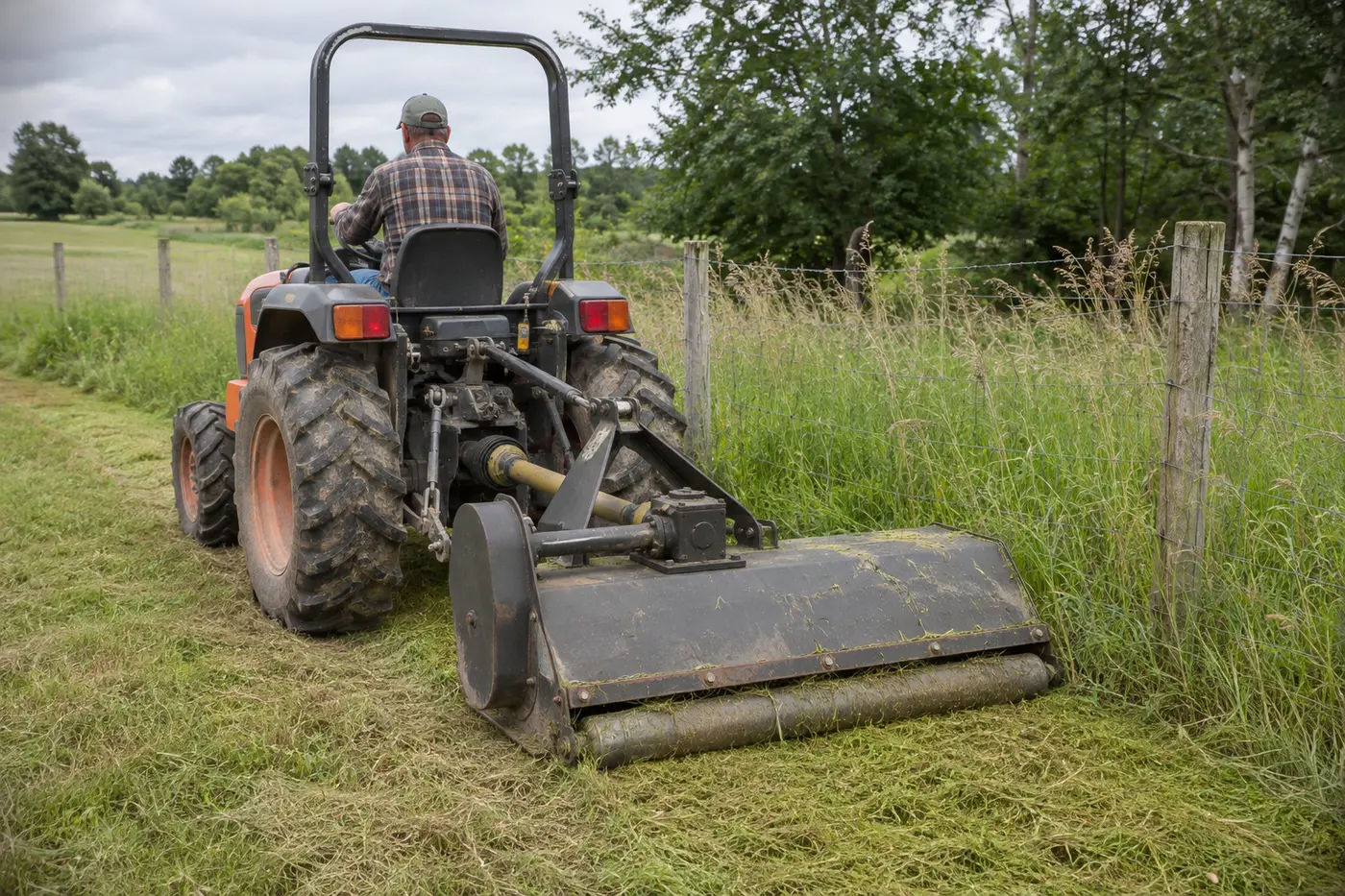
The best flail mower for a compact tractor is the one your tractor can drive at full rated PTO speed without bogging down, that hangs on your hitch category, and that is wide enough to be useful but not wider than you can see and steer. Brand and paint matter less than those three fits.
A flail mower swings short hammers or blades on a horizontal drum. The drum spins parallel to the tractor's rear axle. The tractor's PTO shaft feeds a gearbox that turns the power through a right angle into the drum. The flails hang loose, so they cut, shred and throw clippings into a fine mulch instead of slicing like a spinning blade. That is why a flail handles thick grass, brush and ditch banks that would beat up a standard mower.
How do you size a flail mower to a compact tractor?
Start with power, then width, then hitch. Do it in that order.
- PTO horsepower. The mower maker lists a minimum and a maximum tractor horsepower. Use PTO horsepower, not the engine number on the brochure. A drum full of flails is heavy and takes real power to spin up. Running below the minimum makes the engine labor and the drum slow down in thick cover.
- Working width. Pick a cut that is close to the width of the tractor's rear tires, plus a bit of overlap. A mower much wider than the tractor feels tippy on side slopes and is hard to place near trees and fences.
- Three-point hitch category. Compact and sub-compact tractors usually run the smaller hitch categories. Confirm the category and the top-link and lower-arm pin sizes before you order. Our three-point hitch categories guide shows how to read them.
- PTO speed and rotation. Match the mower's input speed to the tractor's PTO. Check the shaft length too, because a shaft that bottoms out or pulls apart when you raise the mower is a safety problem.
- Weight. A heavy mower on a light tractor lifts the front end when you raise it. Check the maker's recommended tractor weight and add front ballast if the manual says so.
Should you choose a rear-mounted or offset flail mower?
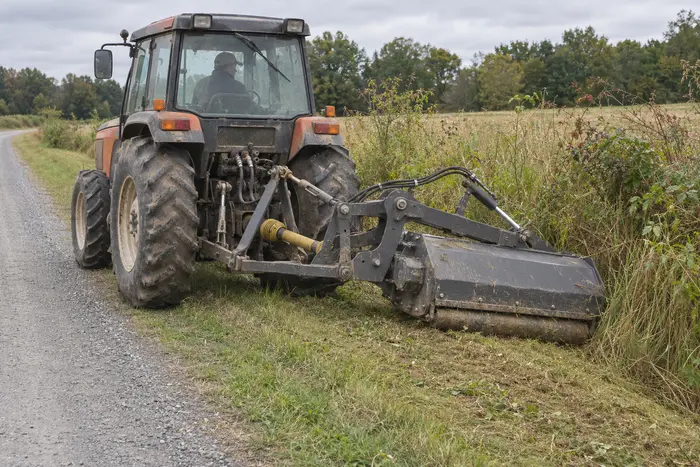
This is the biggest layout decision. A rear-mounted mower sits straight behind the tractor and cuts the same path you drove. It is simple, balanced and good for open fields and pasture. An offset flail mower shifts out to the side, so you can mow a ditch, a fence line or the base of a hedge while the tractor stays on firm ground. Some offset units pivot, so you can cut a bank angled up or down.
Offset mowers put more side load on the tractor and need more careful ballast and slower travel. If your main job is roadside ditches and fence lines, an offset or a boom-mounted unit earns its place. If you are mostly keeping an acreage tidy, a straight rear mower is easier to live with.
| Layout | Best for | Watch out for |
|---|---|---|
| Rear-mounted | Open fields, pasture, tall grass | Cannot reach beside the tractor |
| Offset | Ditches, fence lines, hedge bases | Side load, needs ballast and slow travel |
| Boom-mounted | Steep banks, roadside, hard-to-reach cuts | Needs a tractor built to carry the boom |
Owners who also run a loader can use three-point adapters to hang three-point tools on a skid steer plate.
Which flail types and blades should you pick?
Flails come in a few shapes. Hammer-style flails are heavy and shred woody growth and small saplings. Blade-style flails cut cleaner and suit grass and softer brush. Some makers offer a combination. Pick the heavy style for rough ground with brush, and the lighter style for cleaner, more regular mowing.
A few build details separate a long-lasting mower from a frustrating one:
- Rotor balance. A well-balanced drum runs smooth. Vibration shows up as cracked welds and worn bearings.
- Rear roller. A full-width roller sets cutting height and protects the turf. Skids work on rougher ground.
- Cutting height adjustment. Look for simple, tool-free adjustment on the roller or skids.
- Guards and chains. Flails throw debris. Front and rear guards or chain curtains should be intact and in place every time you run it.
- Gearbox. Use the grease and oil the manual specifies and check levels often.
If you want to see how mowers fit alongside the other clearing tools in the range, browse our brush cutters category, which covers brush-cutting heads for loaders.
Flail mower vs rotary cutter: which is better?
A rotary cutter spins one or more blades horizontally on a vertical shaft. It is the standard tool for tall grass and light brush in open fields. It is typically cheaper and simpler. But it can throw large chunks of debris and leaves a rougher finish, and a hard strike on a stump or rock can bend a blade.
A flail mower cuts closer, leaves finer clippings and tolerates thrown debris better because the flails swing back on impact. It needs more power for its width and has more moving parts, so it costs more to maintain. For a deeper comparison read our flail mower vs rotary cutter guide. Use a rotary cutter for big open acreage. Use a flail for ditches, roadsides, orchards, horse paddocks and anywhere a finer finish and less thrown debris matter. Guards still have to stay on.
How to run a flail mower safely
A flail drum is an exposed, high-speed hazard. Follow the operator manual for your mower and tractor on every point below.
- Walk the area first and remove wire, rebar, large rocks and anything that can be thrown.
- Keep people and animals well clear of the mowing area while the drum is turning.
- Engage the PTO at low engine speed, then bring it up to rated PTO speed.
- Mow slopes across or up and down only as the tractor manual allows, and keep speed down.
- Disengage the PTO and wait for the drum to stop completely before you leave the seat, check the flails or clear a jam.
- Check flails, bolts and guards for damage before every use. Replace damaged or missing flails as a matched set to keep the drum balanced.
What to ask before you order
Have these on hand when you request a quote: your tractor make, model and year, PTO horsepower, hitch category, PTO speed, and whether you need rear or offset mounting. Tell us what you will mow, such as pasture, ditches or light brush. That lets a person confirm the fit against the manufacturer's specs instead of guessing.
Get the right fit the first time
Send us your machine make, model and year and tell us the job. A person checks the attachment against the maker's specs, then you get a fit-checked quote with delivered pricing before you pay. The supplier ships direct, and warranty terms, if any, are written on your quote.
Questions buyers ask
What size flail mower for a 25 hp tractor?
Match the mower to PTO horsepower, not engine horsepower. Check the maker's minimum tractor rating for the working width you want, and choose a narrower unit if the tractor is near the minimum. A narrower mower at full drum speed outperforms a wide one that bogs down.
Can a compact tractor run a flail mower?
Yes, if the tractor has a rear PTO and a three-point hitch, and the mower's PTO horsepower and hitch category match. Compact tractors usually suit narrower rear-mounted or offset mowers. Always follow the tractor and mower manuals for weight, ballast and PTO speed.
Is a flail mower better than a rotary cutter?
It depends on the job. A flail leaves a finer cut, usually throws less debris and handles ditches and hedges well, but needs more power and maintenance. A rotary cutter is simpler and cheaper for big open fields with tall grass and light brush.
What is an offset flail mower used for?
An offset flail mower shifts to the side of the tractor so you can cut ditches, fence lines and the base of hedges while the tractor stays on firmer ground. It puts more side load on the tractor, so you need proper ballast and slower travel.
How does a flail mower work?
A flail mower spins a horizontal drum fitted with swinging hammers or blades. The tractor's PTO drives a gearbox that turns the power through a right angle into the drum. The loose flails chop growth into small pieces and mulch it as they pass.