Skid steer guide
Skid Steer Trailer Mover Attachments: A Buyer's Guide
Quick answer
A skid steer trailer mover is an attachment that carries the trailer's tongue so you can push, pull and spot trailers in tight yards. Choose one by hitch style, tongue weight capacity, quick attach plate and rated operating capacity. It is for short, slow moves on the property, not for road travel.
Shopping for this now? Get a fit-checked, delivered quote.
Key takeaways
- A trailer mover turns a skid steer into a precise yard spotter.
- Match the hitch style to your trailers: ball, pintle or fifth-wheel style plates.
- The tongue weight must stay within the mover's rating and the machine's rated operating capacity.
- Use it for slow, short moves on firm, level ground only.
- Never tow on public roads and never stand between the machine and the trailer.
If you run a lot of trailers on a lot, a yard or a farm, you know the pain of backing them into tight spots. A skid steer trailer mover fixes that. It lifts the tongue of a trailer and lets a skid steer place it exactly where you want. This guide explains how these attachments work, which type to buy, and how to use one safely.
What is a skid steer trailer mover?
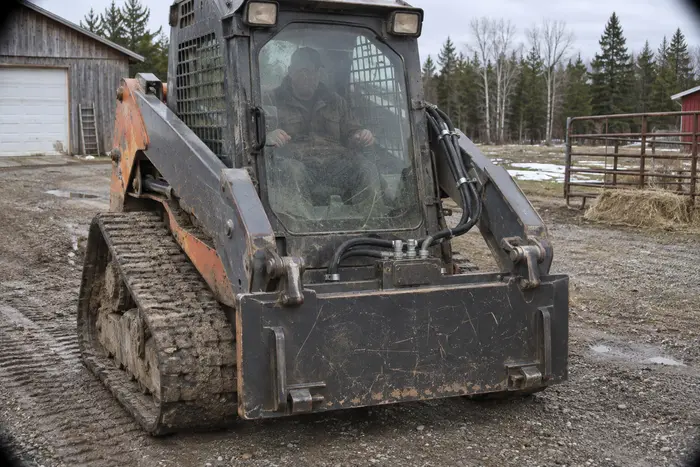
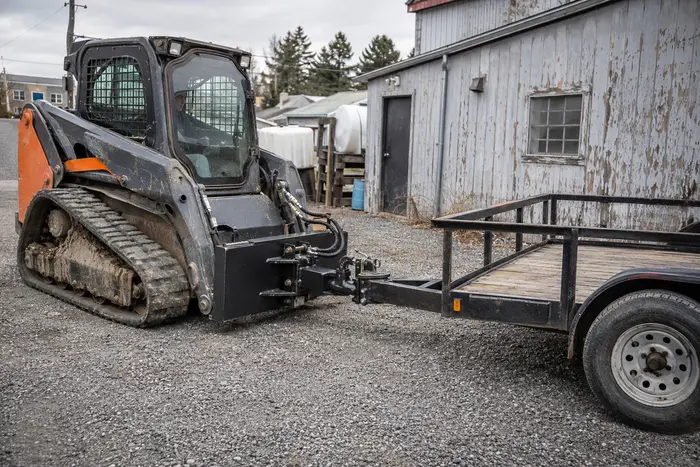
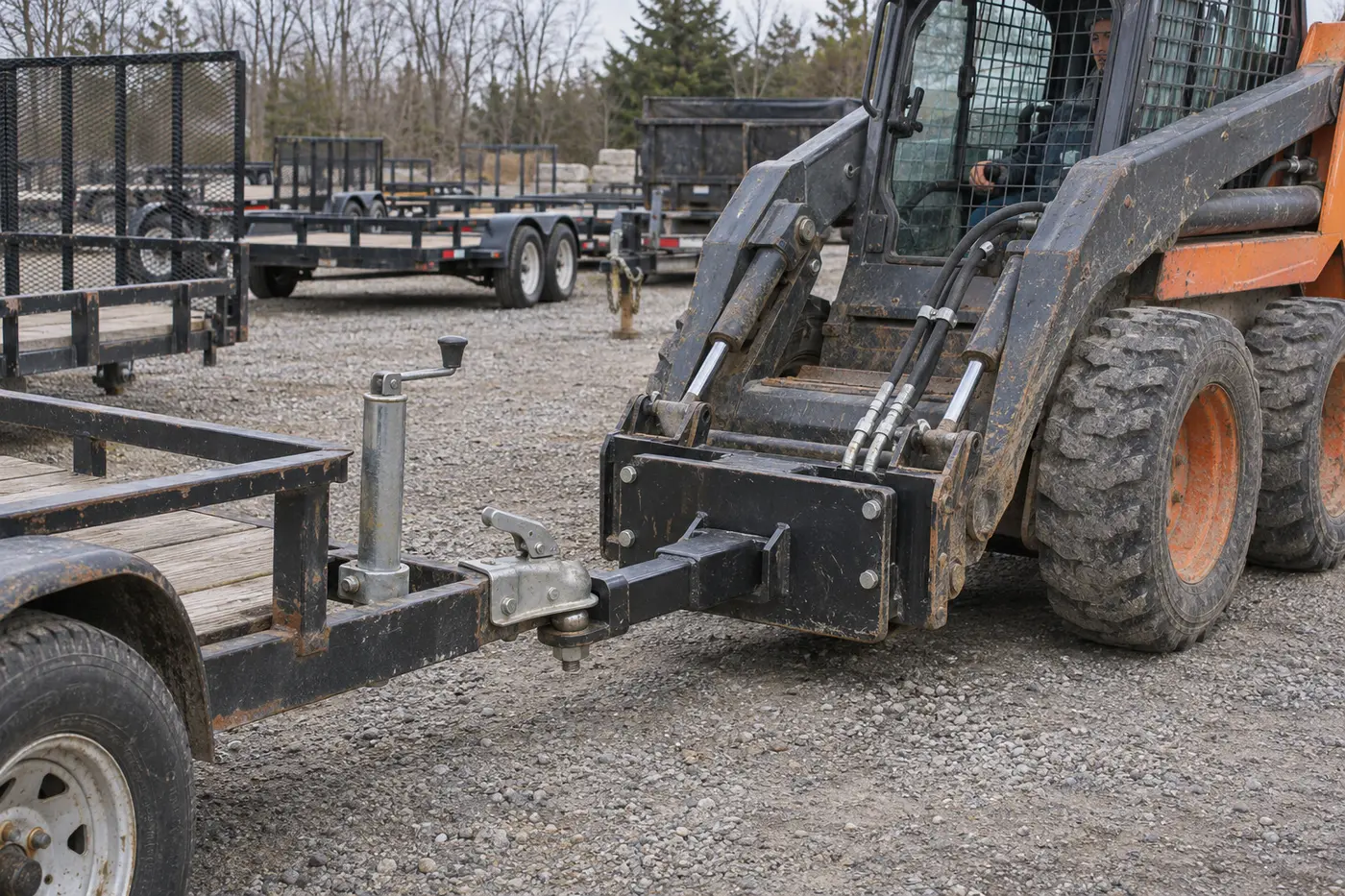
A trailer mover is an attachment that mounts on the skid steer's quick attach plate and carries a trailer hitch. You back up to a trailer, connect the hitch to the tongue, lift the tongue slightly, then drive. A skid steer is highly maneuverable with good traction, so it can spin a trailer in tight spaces where a truck cannot reach. Landscapers, equipment dealers, farms, RV lots and construction yards use them to reposition trailers without a tow vehicle.
What types of trailer movers are there?
| Type | How it connects | Good for |
|---|---|---|
| Ball hitch mover | Coupler on the trailer drops over a hitch ball on the plate | Utility, car and equipment trailers with ball couplers |
| Pintle hook mover | Lunette ring on the trailer drops into a hook | Heavier trailers and ag trailers with pintle rings |
| Fifth-wheel or gooseneck plate | Kingpin or gooseneck ball on the trailer | Gooseneck and fifth-wheel trailers within the machine's rating |
| Fork-style mover | Forks or a cradle lift the tongue | Light trailers and mixed use with pallet work |
| Dolly or caster style | Wheeled dolly under the tongue | Small trailers and workshop use |
Many plates combine a ball and a pintle so you can handle both ball and ring trailers with one attachment. Look at what your trailers use before you pick. See our skid steer trailer movers and mini skid steer trailer movers for the range.
How much trailer can a skid steer move?
Three limits apply, and the lowest one governs.
- The mover's rating. The attachment has a stated tongue weight and gross trailer capacity. Do not exceed either.
- The skid steer's rated operating capacity. This is the weight the machine can lift and carry without tipping. A trailer tongue loads the front of the machine like a lifted load. Check the operator manual.
- Traction and ground conditions. A skid steer can pull more on tracks or on firm ground than on soft or sloped ground. A heavy trailer on a muddy yard can push the machine around instead.
Tongue weight is the downward force of the tongue on the hitch. It is usually a fraction of the trailer's total weight, but a trailer loaded with the weight forward can have a heavy tongue. A tongue scale or a careful estimate helps. Our guide to how much a skid steer can lift explains the rated operating capacity.
What should you check before you buy?
- Hitch style. Ball size, pintle ring or gooseneck. The wrong one will not connect.
- Quick attach plate. Confirm your machine uses a universal quick attach, or check the pattern. See skid steer quick attach plate types.
- Weight of the attachment. A heavy steel mover eats into your rated operating capacity.
- Safety chains and lights. For yard use, see if your trailers carry them. Some movers have chain loops.
- Visibility. The mover should not block your view of the trailer tongue and the ground ahead.
- Adjustability. A hitch with several height positions helps you match different trailer tongues.
- Construction. Look for thick plate, solid welds and a robust latch or safety pin.
How do you use a trailer mover safely?
Trailer moving looks simple and goes wrong in a second. Follow the operator manuals for the machine and the attachment.
- Prepare the area. Clear people and obstacles. Work on firm, level ground.
- Check the trailer. Know its weight and its tongue weight. Make sure the trailer is not loaded beyond its rating.
- Align carefully. Approach the tongue slowly and straight. Never let anyone stand between the machine and the trailer.
- Connect and secure. Latch the hitch, fit the pin or safety device, and connect chains if provided.
- Lift gently. Raise the tongue only as high as needed, then check that the machine is stable.
- Move slowly. Keep speeds low and turns wide. Do not turn sharply with a loaded tongue.
- Avoid slopes. Trailers can push the machine down a grade. Stay on level ground, and put the brake or wheel chocks on the trailer when you park it.
- Park and release. Lower the trailer jack or tongue stand first, then release the hitch.
- Do not use a skid steer trailer mover on public roads.
- Do not move trailers that have brakes locked or that are carrying shifting loads.
- Do not exceed the rated operating capacity of the machine.
Skid steer mover, tow truck or hand dolly: which is better?
A tow truck is the right tool for road travel and long hauls. It is a poor tool for tight yards, where turning radius and backing skill slow everything down. A hand dolly works on small, light trailers but struggles on gravel, grass or slopes. A skid steer trailer mover fills the middle: it turns in its own length, it has strong traction, and you can see the tongue as you work. If you already own a loader, the attachment is a small addition that saves a lot of time. If you do not own one, buying a machine only to move trailers rarely makes sense.
How do you maintain a trailer mover?
- Inspect the hitch ball or pintle hook for wear and cracks.
- Check the latch, safety pin and chain loops before every move.
- Look at welds around the hitch mount and the attachment frame.
- Grease pivot points if the hitch has any.
- Replace worn or bent parts. A damaged hitch can let a trailer drop at the worst moment.
- Store the attachment on a flat surface so the quick attach frame does not warp.
Which jobs suit a trailer mover?
- Equipment dealers placing trailers in rows.
- Contractors moving job trailers, dump trailers and light equipment trailers.
- RV and boat storage yards.
- Farms moving implement and livestock trailers.
- Positioning sheds, small cabins or tiny-home trailers on private land, only within the mover's and the machine's ratings.
For comparison with other tools, read our guide to the best attachment for moving trailers.
Get the right fit the first time
A trailer mover has to match your hitch types and your machine's quick attach and capacity. Send us your make, model and year, and tell us what trailers you move. We will confirm fit against the manufacturer's specs and give you a delivered price to approve before you pay. Start with a fit-checked quote.
Questions buyers ask
What is a skid steer trailer mover?
It is an attachment that mounts on the skid steer's quick attach plate and carries a trailer hitch. It lifts the trailer tongue so you can push, pull and place trailers in tight spaces. It is for slow yard moves on private ground, not for towing on the road.
How heavy a trailer can a skid steer trailer mover handle?
It depends on three limits: the mover's rating, the skid steer's rated operating capacity and the traction of the ground. The lowest of the three governs. Check tongue weight as well as gross trailer weight, and stay well inside the ratings in your manuals.
Can a skid steer move a gooseneck trailer?
Yes, with a mover that has a gooseneck or fifth-wheel plate and enough capacity. Gooseneck and fifth-wheel trailers put a larger share of their weight on the hitch than ball-coupler trailers, so check the machine's rated operating capacity, the tongue weight and the traction on your ground before you try it.
Can I use a trailer mover on the road?
No. A skid steer trailer mover is meant for short, slow moves on private property. Public road towing has its own equipment, lights, brakes and legal requirements, and a skid steer does not meet them. Use a tow vehicle rated for the trailer instead.
How do I know which hitch type I need?
Look at what your trailers use: a ball coupler, a pintle lunette ring, or a gooseneck. Some mover plates combine a ball and a pintle hook so you can handle two styles. Match ball size and ring size, and confirm the quick attach pattern on your machine.