Skid steer guide
Skid Steer Log Splitter Attachments: Buying Guide
Quick answer
A skid steer log splitter attachment mounts on the quick attach plate and splits logs using the loader's auxiliary hydraulics. Choose by wood type, log size, hydraulic flow and pressure, mount and safety features, and consider a grapple for handling rounds and a multi-way wedge for faster output.
Shopping for this now? Get a fit-checked, delivered quote.
Key takeaways
- Most skid steer splitters mount on the universal quick attach plate and use auxiliary hydraulics.
- Flow sets speed and pressure sets force, so match both to your loader.
- Multi-way wedges split larger rounds faster.
- Keep hands away from the wedge and stay within rated capacity.
What is a skid steer log splitter attachment?
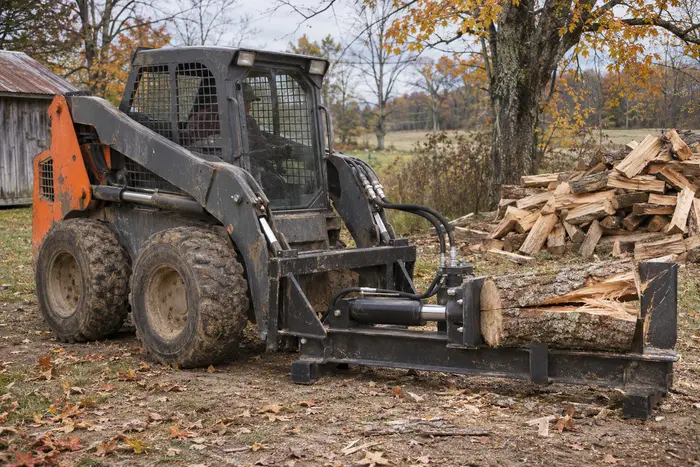
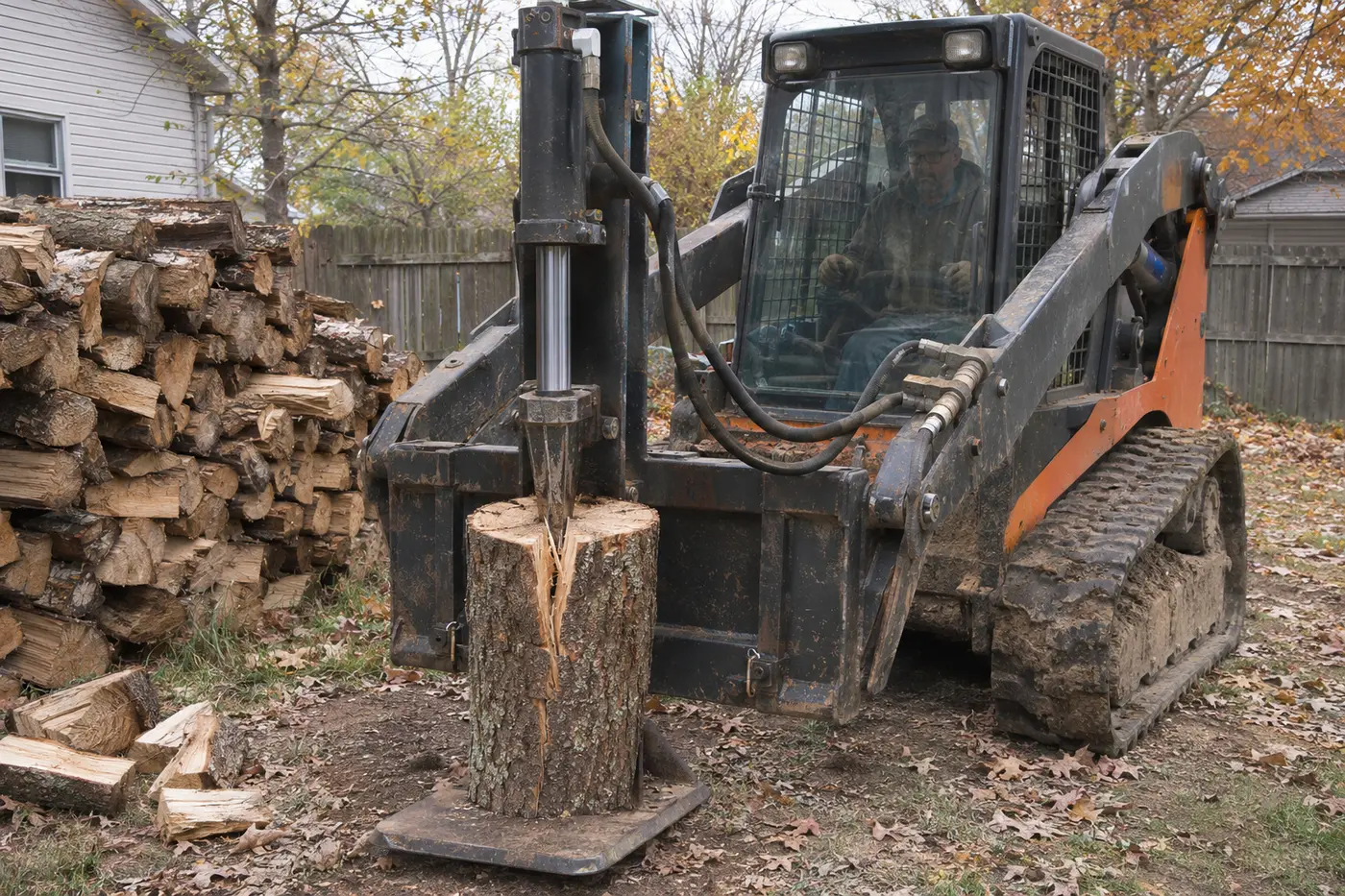
A skid steer log splitter attachment is a hydraulic splitter that mounts on the loader's quick attach plate and runs off its auxiliary hydraulics. You push a log against the wedge, or push the wedge into the log, and a cylinder splits it. Because the loader is already in the yard, you can pick up logs with the same machine, place them and split them without a separate engine or trailer.
It is a good fit when you already own a skid steer and need to process cordwood, split large rounds or clear storm-felled trees. It is less of a fit for heavy daily commercial firewood volume, where a dedicated firewood processor with its own saw and conveyor is built for throughput.
Types of skid steer log splitters
| Type | How it works | Best for |
|---|---|---|
| Cylinder and wedge splitter | Hydraulic cylinder pushes the log into a wedge or a wedge into the log | Most firewood and general splitting |
| Multi-way wedge (4, 6 or 8-way) | One stroke splits a round into several pieces | Faster output on bigger rounds |
| Screw (cone) splitter | A rotating cone screws into the log | Knotty, stringy or twisted wood; needs strong hydraulics |
| Combination splitter and saw | Saw bar cuts to length, then the splitter handles the round | Higher-volume processing from long logs |
Our guide to log splitter wedge types explains how a standard wedge differs from a multi-way wedge and when each one makes sense.
How do you choose a skid steer log splitter?
- Know your wood. Hardwoods with knots and crotches resist splitting more than clean softwood. Plan for the toughest wood you will actually split.
- Log length and diameter. Match the splitter's rated log length and diameter to your cordwood. A longer stroke handles longer rounds. Check the maker's specifications.
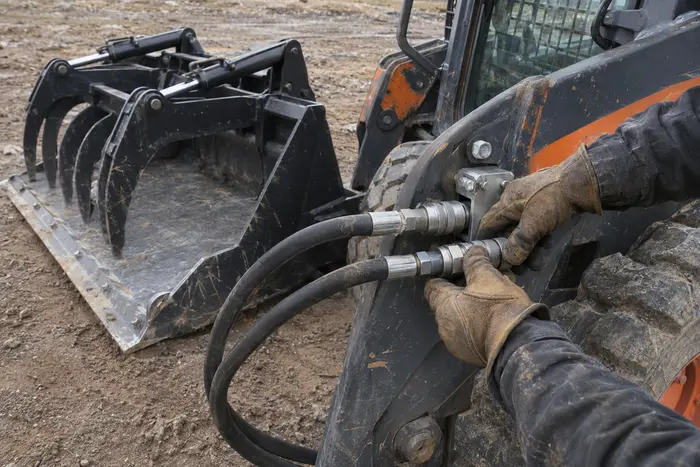
- Hydraulic flow and pressure. The splitter uses the loader's auxiliary circuit. Flow sets cycle speed. Pressure sets force. Compare both with your machine. See the hydraulic flow guide for the difference between standard and high flow.
- Mounting. Most use a universal skid steer quick attach plate. Verify the plate, the hose couplers and the loader's lift height. Our coupler hose guide covers flat-face connectors.
- Splitter orientation. Some units are vertical, some horizontal, some adjustable. Vertical splitting saves lifting heavy rounds onto a beam. Check whether the unit can tilt.
- Safety features. Guards, a clear zone around the wedge and the ability to run the splitter from the seat matter more than a brochure speed number.
Browse the skid steer log splitters category. Smaller carriers have a mini skid steer log splitter option, and excavator owners can look at excavator log splitters.
Do you need a grapple with it?
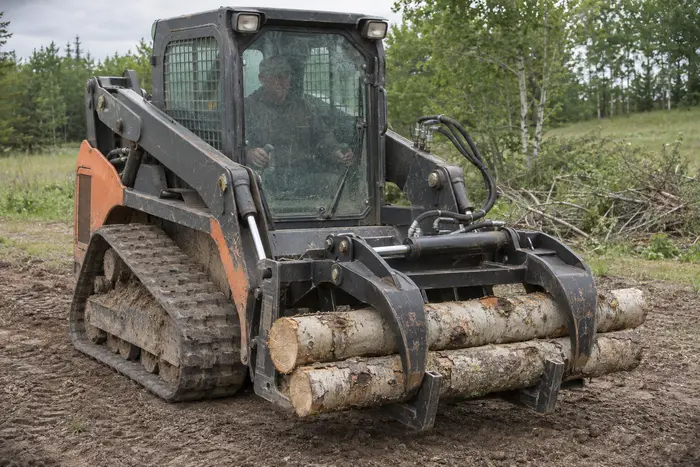
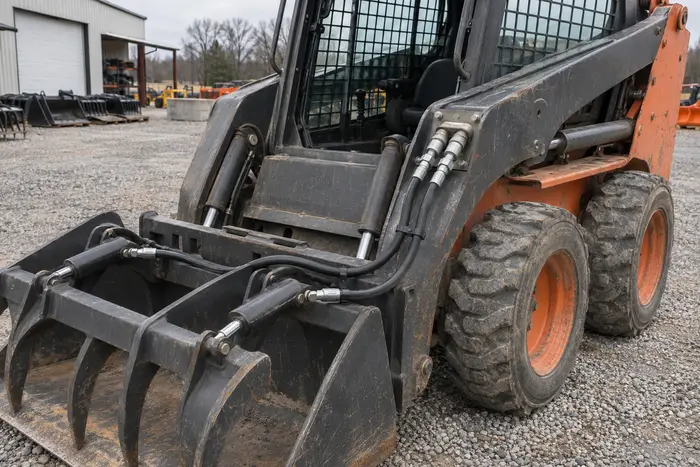
Often yes. If you will be moving full-length logs or heavy rounds, a grapple or a pair of forks makes loading much easier. Many operators use a grapple to pull logs from a pile, then switch to the splitter. Look at skid steer grapples alongside the splitter so you can handle logs without hand lifting.
Splitting safety
Log splitting causes crushing and laceration injuries when people put hands near the wedge. Follow the splitter and loader manuals, and keep these basics in mind.
- Never hold or steady a log with your hands near the wedge or beam. Use the machine to position it.
- Keep bystanders, children and animals well away from the splitting area.
- Wear safety glasses, hearing protection, gloves and steel-toe boots.
- Split on level, firm ground and chock or lower the loader arms as the manual instructs.
- Stop the hydraulics and shut down the loader before clearing a stuck log or making adjustments.
- Stay within the loader's rated operating capacity when lifting logs.
Skid steer splitter or a standalone splitter?
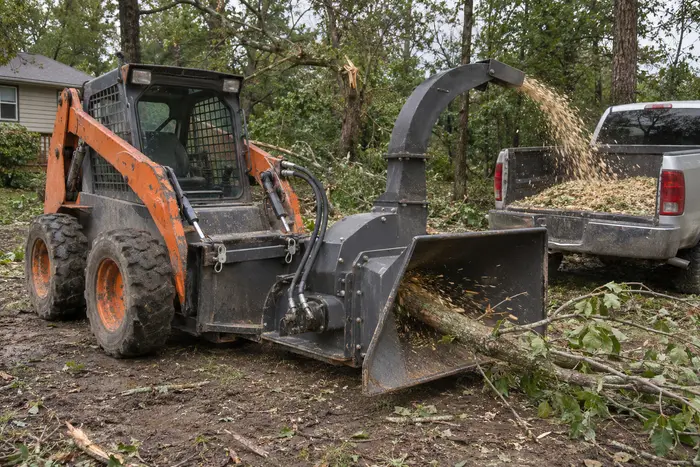
A standalone splitter has its own engine and pump, so it does not need your loader. It is portable and can sit in the woodlot. But you still need a way to move logs. A skid steer attachment uses the machine you already own, handles logs at the same station, and can cost less than buying a standalone unit with its own engine. If you split a lot of wood from long logs, a firewood processor is a different class of tool. See our wood chipper guide if you also deal with brush and limbs from the same trees.
Maintenance tips
Keep the wedge and beam clean and lightly greased where the manual says. Check hoses and fittings for leaks. Keep hydraulic oil clean, because a splitter works a cylinder hard. Inspect welds on the beam and wedge after heavy seasons. Replace worn or chipped wedge edges so the splitter keeps cutting instead of crushing.
What jobs suit a skid steer log splitter?
The attachment earns its keep on property cleanup, storm cleanup, land clearing and personal firewood. After a tree comes down, you can cut it to length, load the rounds with a grapple or forks, and split them where they land. For landowners clearing acreage, the same machine can pile brush, haul logs and split wood without trailering a second tool. If you plan heavy clearing, read our skid steer mulcher guide too.
Questions to answer before you buy
- How many cords do you split in a season, and how fast does it need to go?
- What species do you burn, and are the rounds knotty?
- Does your loader have high-flow hydraulics, or standard flow only?
- Do you need to split in the field, or at one fixed station?
- Who else will operate it, and have they read both manuals?
Honest answers to these narrow the choice quickly. A small, standard-flow unit is fine for a home woodlot. A bigger, multi-way splitter with a saw suits a full-time wood business better.
Green wood, seasoned wood and splitting
Freshly cut wood is heavy and wet. Some species split more easily green, and others split better once they have dried and checked. Knotty or stringy wood can be hard either way. Whatever the state, the splitter does the same job. What changes is the force you need and how often you will meet a stubborn round. Firewood still needs time to dry before it burns well, so plan your splitting well ahead of the heating season and stack the wood off the ground with air flow around it.
When a round will not split, back the wedge out and rotate the log to a different grain line rather than forcing the cylinder. Forcing a stalled cut strains the beam, the hoses and the loader.
Get the right fit the first time
Send us your machine make, model and year and tell us the job. A person checks the attachment against the maker's specs, then you request a fit-checked quote with delivered pricing before you pay. The supplier ships direct, and warranty terms, if any, are written on your quote.
Questions buyers ask
Can you put a log splitter on a skid steer?
Yes. Hydraulic log splitter attachments mount on a skid steer's quick attach plate and run on its auxiliary hydraulics. Match the splitter's flow, pressure and coupler type to your loader, and confirm the mount and lift height before ordering.
What is a 6 way wedge on a log splitter?
A six-way wedge has six blades radiating from a center point. One stroke can split a round into as many as six pieces, which speeds up firewood production on larger rounds. Standard two-way wedges split a log into two. Wedge choice depends on log size and species.
How much hydraulic flow does a skid steer log splitter need?
It depends on the model. Flow sets cycle speed and pressure sets splitting force. Check the splitter maker's requirement against your loader's standard or high-flow circuit. We can match the splitter to your machine's make, model and year.
Is a skid steer log splitter good for firewood?
It works well for splitting cordwood and rounds when you already own a skid steer. For high-volume commercial firewood from long logs, a dedicated processor with a saw and conveyor is built for more throughput.
Can a mini skid steer run a log splitter attachment?
Some smaller log splitters are made for mini skid steers, but flow and lifting capacity are lower. Choose a unit sized for your machine's hydraulics and rated operating capacity, and confirm fit with a person before ordering.