Equipment basics guide
Backhoe Loader Parts and Functions Explained
Quick answer
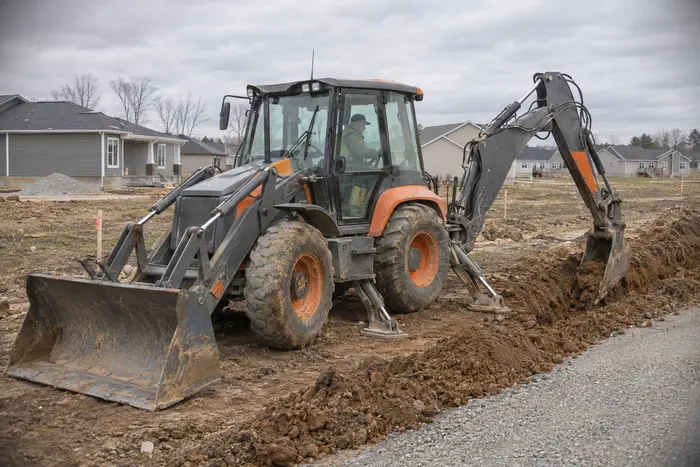
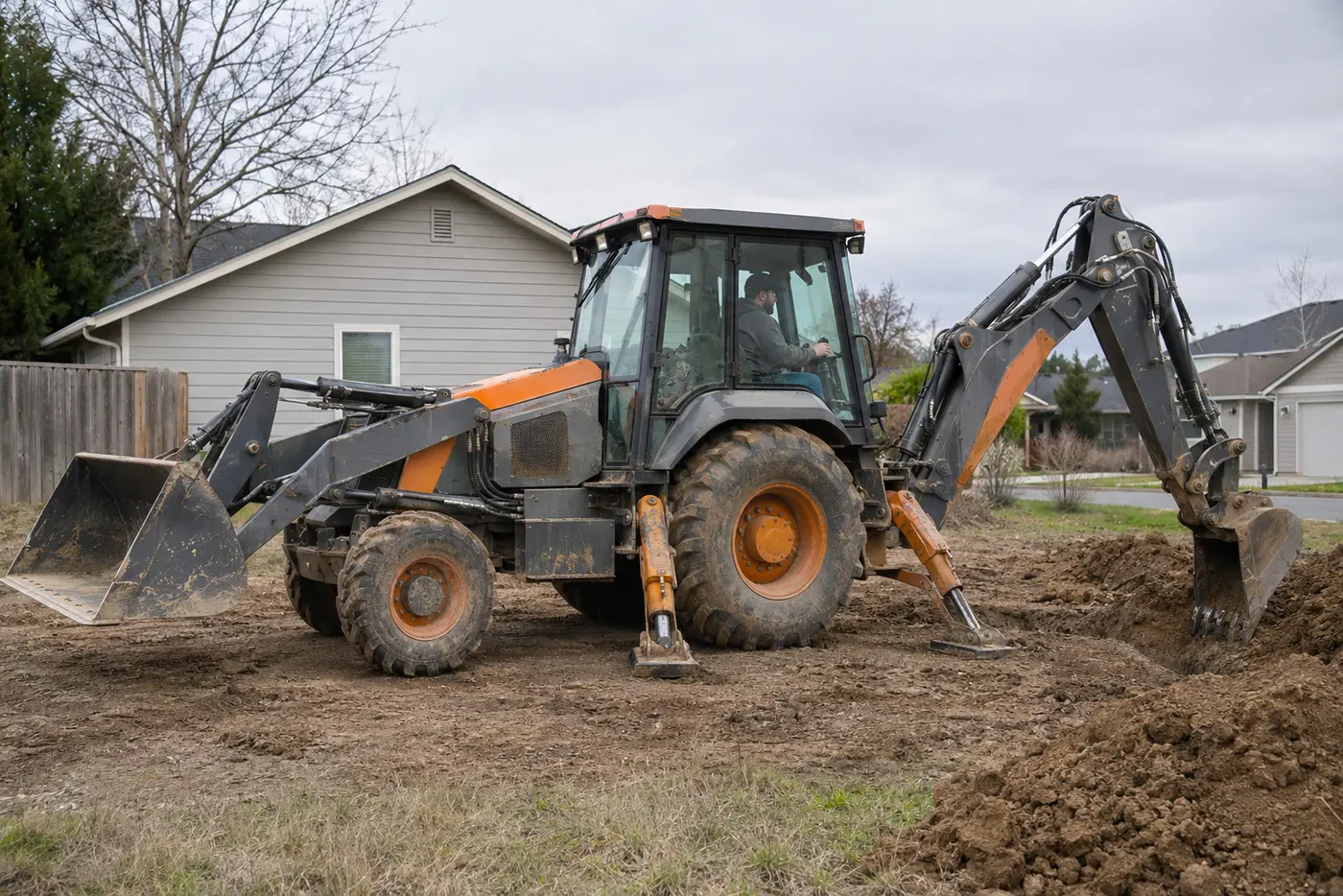
A backhoe loader has a front loader bucket, a rear digging arm called the backhoe, hydraulic stabilizers that steady the machine, an operator seat that swivels between controls, and a tractor-style chassis. Quick couplers and auxiliary hydraulic circuits let operators swap attachments such as breakers, augers and grapples.
Shopping for this now? Get a fit-checked, delivered quote.
Key takeaways
- A backhoe loader combines a front loader and a rear digging arm on one tractor-style chassis.
- Rear stabilizers (outriggers) lift and steady the machine while the backhoe digs.
- The operator seat swivels to face the rear controls on permanently attached backhoes.
- Quick couplers and auxiliary hydraulics let one machine run many attachments.
- Attachment fit depends on the coupler type and the hydraulic circuit.
A backhoe loader looks like a tractor with a bucket on each end. It digs behind and loads in front. Because it does two jobs, it has two sets of working parts. This guide names the major parts, explains what it does and shows how attachments connect.
What are the main parts of a backhoe loader?
Most backhoe loaders share the same basic layout. The names vary a little by region, but the parts are the same.
| Part | Where it is | What it does |
|---|---|---|
| Front loader bucket | Front of the machine | Loads, carries and spreads material. Some buckets have a retractable bottom ("clamshell") for faster emptying and for grading and scraping. |
| Loader arms and cylinders | Front | Lift and tilt the bucket |
| Backhoe | Rear | The digging arm. It is often slightly curved, like an excavator's, for better maneuverability. |
| Boom and dipper (stick) | Rear arm | The boom lifts and swings, and the dipper reaches in and out to dig |
| Backhoe bucket | End of the stick | Digs trenches and holes |
| Rear stabilizers (outriggers) | Rear corners | Hydraulic supports that steady the machine while digging |
| Operator seat | Cab | On permanently attached backhoes, it swivels to face the rear controls |
| Chassis | Machine body | Tractor-like base, often four-wheel drive |
| Quick coupler and auxiliary hydraulics | Loader or backhoe end | Allow faster attachment changes and power for hydraulic tools |
How does the front loader work?
The loader is the shovel-style bucket on the front. Two hydraulic arms lift it, and cylinders tilt it. Operators use it to scoop dirt or gravel, carry it a short distance and dump it into a truck or onto a pile. A clamshell bucket opens at the bottom, which speeds up dumping and makes grading and scraping easier. The front assembly may be removable or permanently mounted.
Many operators also use the front for backfilling a trench they just dug with the rear arm. That is the benefit of one machine doing both jobs.
How does the backhoe work?
The backhoe is the digging arm on the rear. It has three sections: the boom attached to the machine, the dipper (or stick) hinged to the boom, and the bucket on the end. Hydraulic cylinders move each section. The whole arm swings left and right on a pivot, and on some models it slides sideways on the frame to dig along a wall or fence.
The operator turns the seat to face rearward, plants the stabilizers and digs. Removable backhoe attachments usually have their own seat. The arm digs like an excavator, but with a shorter reach and a smaller swing. See backhoe vs excavator to compare them.
What do the stabilizers do?
When the backhoe digs, the machine needs a steady base. Rear stabilizers, also called outriggers, extend to the ground and lift the rear wheels, or at least take the load off them. They keep the machine level and stop it from rocking. Some European models use vertical stabilizers with a side-shift backhoe mount. Always set the stabilizers before you dig, and raise them before you drive.
What is the chassis and powertrain?
The base is a tractor-like chassis. Many models have four-wheel drive. Most do not offer a rear power take-off like a farm tractor. The engine drives a hydraulic pump that supplies oil to the loader, the backhoe and any attachments. This is why the hydraulic system matters so much on this class of machine.
How do quick couplers and auxiliary hydraulics work?
A quick coupler lets the operator change a bucket or tool without driving out pins by hand. An auxiliary hydraulic circuit supplies oil to powered attachments like breakers and augers. Together they turn a backhoe into a multi-tool. Common attachments include a breaker, a grapple, an auger, a stump grinder, a snow plow and, on some machines, a tiltrotator, which adds articulation.
If you are shopping for backhoe tools, check these points:
- The coupler type and pin spacing on the stick.
- The hydraulic flow and pressure the attachment needs.
- The weight against the machine's rated lifting capacity at reach.
- The hose routing and fittings.
Compare buckets, breaker hammers, thumbs and quick couplers. Some tools built for excavators in a similar size class can fit a backhoe stick, but pin sizes and hydraulics differ, so confirm the fit. A person can check it for you.
How do you read a backhoe loader parts diagram?
A parts diagram, also called an exploded view, lays out each assembly with part numbers. Start with the main assembly you need, such as the backhoe arm or the loader. Find the subassembly, such as the cylinder or the pivot pin. Then read the part number and the quantity. Use your machine's serial number when you order, because parts change between production years. Keep the operator manual and the parts manual together, and note the pin sizes and bushing types before you shop.
How do you learn to operate the controls?
The controls differ by model, so read the operator manual first. Take training from a qualified person before using the machine on a job. Basic habits include warming up the hydraulics, checking around the machine before starting, setting the stabilizers on firm ground, and never swinging a load over people. Our backhoe operation guide covers the steps, and parts of an excavator is a good companion if you work with both.
What should you check during a walk-around?
- Hydraulic hoses and cylinders for leaks or damage.
- Pins and bushings for wear or play.
- Stabilizer pads and cylinders.
- Bucket teeth and cutting edges.
- Coupler locks and safety pins.
- Tires, fluid levels and lights.
Catch small problems early. Worn pins and leaking seals cost more once they spread.
What do common backhoe terms mean?
- Dipper or stick: the middle section of the digging arm, between the boom and the bucket.
- Swing: the side-to-side rotation of the backhoe arm on its pivot.
- Breakout force: the force the bucket can apply to pull material loose.
- Auxiliary hydraulics: an extra oil circuit that powers an attachment.
- Side shift: a mount that slides the backhoe along the frame so you can dig close to a wall.
- Clamshell bucket: a front bucket with a bottom that opens for fast dumping, grading and scraping.
Learning these terms makes spec sheets and parts manuals much easier to read, and it helps when you describe a problem to a dealer or a technician.
Get the right fit the first time
Tools for a backhoe depend on the coupler and the hydraulic circuit. Send us the make, model and year of your machine. A person checks fit against the maker's specs, you see the delivered price on your quote before you pay. The supplier ships direct, and warranty terms, if any, are written on your quote. Get a fit-checked quote or call 1-888-245-1555.
Questions buyers ask
What are the main parts of a backhoe loader?
The main parts are the front loader bucket and arms, the rear backhoe with boom, dipper and bucket, hydraulic stabilizers, an operator seat that swivels to the rear controls, and a tractor-style chassis. Quick couplers and auxiliary hydraulics add attachment capability.
What do backhoe stabilizers do?
Stabilizers, also called outriggers, are hydraulic supports at the rear. They extend to the ground to steady the machine while the backhoe digs, keeping it level and preventing it from rocking. Set them before digging and raise them before driving.
What is the difference between a backhoe and a backhoe loader?
The backhoe is the rear digging arm. A backhoe loader is the whole machine, a tractor-style chassis with both a front loader and a rear backhoe. People often say backhoe when they mean the full machine.
Can you put attachments on a backhoe loader?
Yes. With a quick coupler and auxiliary hydraulics, a backhoe can run tools like breakers, grapples, augers and thumbs. Check the coupler type, hydraulic flow and weight against the machine's specs before you buy, and follow the operator manual.
Why does the seat swivel on a backhoe loader?
On backhoes that are permanently attached, the seat swivels so the operator can face the rear controls when digging and then turn forward to run the loader. This lets one operator use both ends without leaving the cab.