Excavator guide
Mini Excavator Quick Couplers: Pin-Grab vs Hydraulic
Quick answer
A mini excavator quick coupler lets you swap buckets and attachments without removing pins by hand. Pin-grab couplers are manual or semi-manual and simple, while hydraulic couplers let the operator change tools from the seat. Choose by how often you change tools, your machine's pin sizes and your safety setup.
Shopping for this now? Get a fit-checked, delivered quote.
Key takeaways
- A quick coupler saves time by replacing manual pin changes
- Pin-grab couplers are simple and cost less; hydraulic couplers add speed and operator comfort
- The coupler must match your machine's stick pin size and spacing
- Use the secondary safety lock every time, and test the lock before lifting
- Couplers cut breakout force and lift capacity slightly, since they add length and weight
Changing a bucket on a mini excavator with a hammer and drift pin is slow, awkward and a common source of pinched fingers. A quick coupler turns it into a short job. It is a common addition to a compact excavator. This guide explains the main types, how to match one to your machine and how to use one safely.
What is a quick coupler?
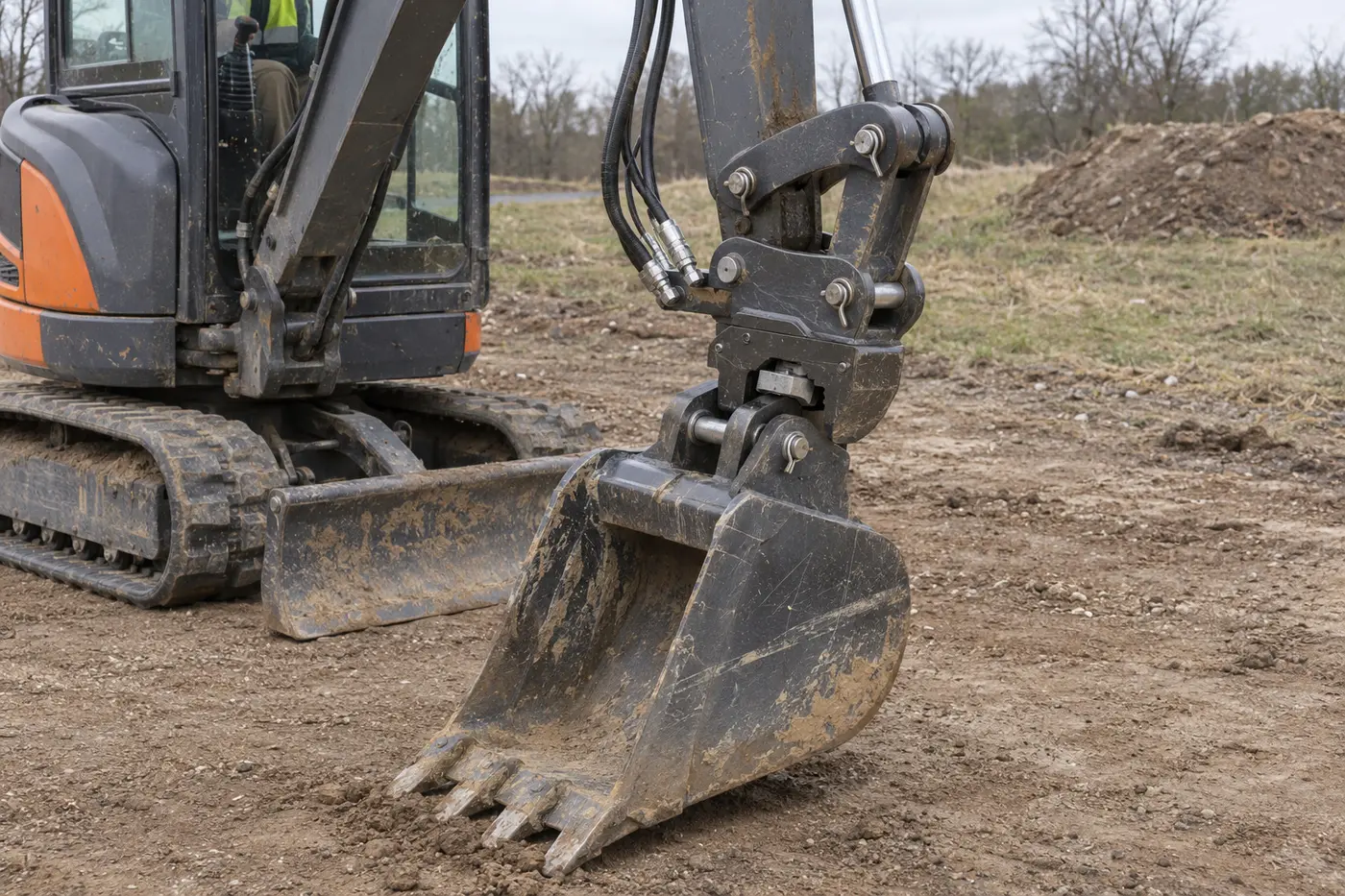
A quick coupler is a connector between the end of the arm (the stick) and the attachment. Many compact excavators have a quick coupler to simplify attachment mounting. It replaces the direct pin connection with a latching system so you can release one tool and pick up another quickly. A compact excavator is a tracked or wheeled machine with an operating weight up to about 8.5 tonnes, and the couplers made for it come in sizes that match the machine's pin dimensions.
Pin-grab vs hydraulic quick couplers
| Feature | Pin-grab (mechanical) | Hydraulic |
|---|---|---|
| How it locks | Wedge or manual lock; some use a bolt or lever | Hydraulic cylinder locks the pins |
| Operator effort | Usually leave the cab to lock or release | Change from the seat |
| Hydraulic needs | None | Needs a hydraulic line and a switch in the cab |
| Complexity | Simple | More parts to maintain |
| Speed | Fast | Fastest |
| Typical fit | Occasional changes, smaller budgets | Frequent changes, mixed work |
Naming is loose. Some sellers call any coupler that grabs the pins on the attachment a pin-grab, hydraulic ones included. What matters is how the coupler locks. A mechanical lock uses a manual wedge or screw, and a hydraulic one uses a cylinder. Ask the seller how the coupler locks and whether it has a second, independent lock.
Why add a quick coupler?
The case is time and safety. Driving pins by hand takes minutes per change and puts hands near pinch points. If you switch between a digging bucket, a grading bucket, a thumb and a breaker in the same day, those minutes add up fast. A coupler also makes it easier to share attachments across machines of the same size class and helps rental fleets and multi-machine crews. If you rarely change tools, the benefit is small and the pins you already have work fine.
Bucket and attachment pin patterns
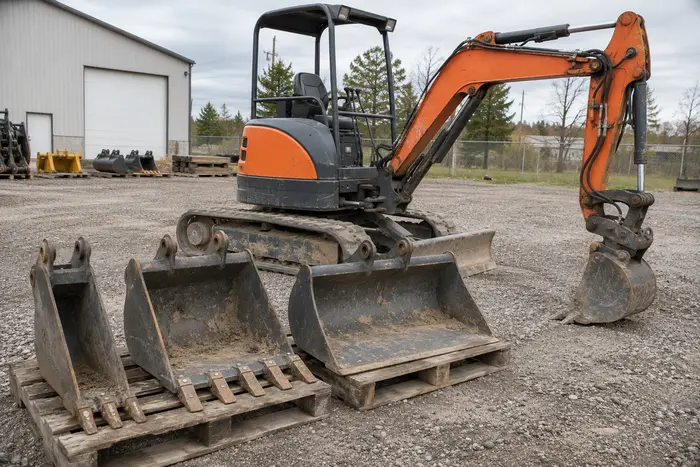
Each bucket or tool has two pins, a front pin and a rear pin, set a fixed distance apart. A coupler grabs those pins with a hook at the front and a latch at the rear. If you own several attachments with different pin spacing, a coupler may not fit all of them. Some buyers fit pin-on brackets or adapter plates, and others standardize on one pin pattern. Plan your attachment list first, then pick the coupler that covers the most of it.
How do you match a coupler to your machine?
- Stick pin diameter and spacing. The coupler connects at the stick and linkage pins. The pin size, width and spacing are on the machine spec sheet or measured with calipers and a tape. They must match.
- Attachment pin size and spacing. The attachments you own or will buy have their own pin sizes. The coupler grabs those pins. If the coupler's jaw opening or center distance does not match, it will not hold.
- Machine size class. Couplers are rated for a machine weight range. Do not put a coupler rated for a smaller machine on a larger one.
- Hydraulic line. A hydraulic coupler needs a hydraulic line from the machine and a control in the cab. Check that your machine has a free auxiliary circuit.
- Attachment fit. Some attachments are built for a specific coupler, and some tools such as a tiltrotator mount differently. Check before you buy.
See excavator quick couplers for options. We confirm the pin and linkage fit against the machine's specs, so send your machine make, model and year.
What do you give up with a coupler?
A coupler adds weight and length, which changes the machine's geometry. Breakout force falls slightly because the attachment sits farther from the stick pin, and the coupler's weight comes off what the machine can lift. On a small mini excavator that matters more than on a larger machine. Some couplers are built compact to limit the loss. If you mostly dig with one bucket, a direct pin connection is stronger and lighter. If you change tools several times a day, the time saved can quickly justify the cost.
Safety: do not skip the lock
Attachments that fall off a coupler injure people. A coupler holds the attachment by grabbing pins, and it depends on the lock to keep them there. Follow these practices:
- Learn the coupler's locking method and check it every time you change a tool.
- Use the secondary lock, if equipped. Many hydraulic couplers have a second safety lock, and some jurisdictions and safety standards call for one.
- After connecting, curl the attachment against the ground to confirm it is locked before lifting.
- Keep people out of the swing area during a change.
- Do not hold the coupler open and move the machine. Never rely on hydraulic pressure alone.
- Follow the coupler's and the machine's manuals, and check the rules in your region.
Which attachments are made for a coupler?
Most buckets, thumbs, hammers, augers and grapples can be fitted for a coupler through brackets or pins. Some tools, such as tiltrotators, have their own coupling systems and sit between the stick and the tool. Ask how the attachment mounts before you assume it is compatible. Look at excavator buckets, thumbs and tiltrotators for examples, and read our thumb guide.
Maintenance
A coupler is a wear part. Grease the pivot points as the manual says, and keep the jaws clean of mud and rock. Inspect the locking wedge or cylinder for wear and cracks. Check hydraulic hoses for rubbing and leaks. Replace worn pins and bushings before they let the attachment rattle. A loose coupler wears the attachment pins and can fail unpredictably. Check it before each shift.
Retrofit or buy new?
Many machines come with a coupler as an option. If yours does not, a retrofit coupler can usually be added, built to your machine's stick pin diameter and spacing, which vary by maker and model. The cost is mainly the coupler itself, any added hydraulic line and the labor to fit it. Ask whether your machine's linkage geometry works with the coupler. A badly matched coupler can interfere with curl range or cylinder travel.
Quick coupler checklist
- Machine make, model, year and operating weight.
- Stick pin diameter and spacing.
- Attachment pin sizes and spacing for the tools you use.
- Manual or hydraulic locking, and whether a second lock is included.
- Hydraulic line availability.
- Impact on breakout force and lift capacity.
Get the right fit the first time
Send us your machine make, model and year and what you plan to do with it. A person checks fit against the maker's specs, and you see the delivered price on your quote before you pay. The supplier ships direct, and warranty terms, if any, are written on your quote. Get a fit-checked quote.
Questions buyers ask
What is a quick coupler on a mini excavator?
It is a connector between the stick and the attachment that lets you swap buckets and tools quickly without driving out pins by hand. It locks onto the attachment's pins, either mechanically or with a hydraulic cylinder, and reduces change time.
What is the difference between a pin-grab and a hydraulic quick coupler?
A pin-grab coupler locks mechanically with a wedge or manual lock, and you leave the cab to change tools. A hydraulic coupler uses a cylinder, so you change from the seat. Hydraulic types need a hydraulic line and cab control.
How do I know which quick coupler fits my mini excavator?
Match the coupler to the machine's stick and linkage pin diameters and spacing, its size class, and the pin patterns of the attachments you use. A fit check against the maker's specs confirms it before you order.
Do quick couplers reduce digging power?
Slightly. A coupler adds weight and moves the attachment farther from the stick pin, which reduces breakout force and lift capacity. The effect is greater on small machines, and compact coupler designs are made to limit that loss.
Are quick couplers safe?
They are safe when used correctly. Always use the secondary lock if your coupler has one, confirm the attachment is locked before lifting, and follow the manuals and local rules. Never rely on hydraulic pressure alone.