Skid steer guide
How to Use a Skid Steer Trencher: Step-by-Step Guide
Quick answer
To use a trencher on a skid steer, call 811 first, mount the attachment, lower the boom chain into the ground at a slow auxiliary speed, then back the machine slowly to cut a straight trench while the chain throws spoil to the side. Match chain, depth and travel speed to the soil.
Shopping for this now? Get a fit-checked, delivered quote.
Key takeaways
- Locate underground utilities before the chain touches the ground.
- A trencher cuts while you drive backward in a straight line at a slow, steady pace.
- Chain type, depth and hydraulic flow must match soil and machine.
- Deep trenches need protective systems under OSHA or provincial rules, so plan depth before you start.
A trencher attachment turns a skid steer into a trench digger. A hydraulic motor spins a chain with teeth around a boom, and the chain cuts a narrow slot while the machine backs along the line. People use it for drain lines, irrigation, conduit and cable. This guide shows how to use a trencher on a skid steer, step by step, and how to avoid the mistakes that cause stalled chains and crooked trenches.
What a skid steer trencher does
A chain trencher cuts a continuous, narrow trench with a defined width and depth. That makes it faster than a bucket for utility and drain lines, and it leaves clean walls. Published guides say full-size chain trencher attachments commonly reach maximum digging depths of about 36, 48 or 60 inches, with narrower, shallower options for mini machines. Walk-behind trenchers are often quoted at 24 to 48 inches deep and 4 to 8 inches wide. The exact number depends on the model, so use your attachment's spec sheet. If you want a plain-language overview first, read what is a trencher.
Before you start: the checklist
- Call before you dig. In the United States dial 811. In Canada use your provincial one-call service. Wait for utilities to be marked, and keep the marks visible.
- Read the operator manuals. Both the skid steer and the trencher. Note the hydraulic flow range, pressure and any warnings about rock or frozen ground.
- Walk the line. Look for buried rocks, stumps, concrete, roots, septic fields and drainage tile. Move what you can.
- Pick the chain. Use the chain and teeth the manufacturer recommends for the soil: standard teeth for loam and clay, carbide or rock teeth for rocky or hard ground.
- Check hydraulics. Confirm your machine's auxiliary flow meets the trencher's requirement. See skid steer hydraulic flow explained if you are unsure.
- Inspect the chain. Check tension, missing teeth and worn pockets. A loose chain wears the boom and can throw teeth.
How to run a trencher, step by step
- Mark the line. Use paint or stakes. For drains, mark the slope direction and the outlet.
- Position the machine. Line the trencher up at the start of the trench with the boom raised. The chain should be clear of the ground.
- Start the chain. Engage the auxiliary hydraulics at the speed in the manual before the chain touches soil.
- Plunge in. Lower the boom slowly until the chain is at the planned depth. Let it cut in; do not slam it down.
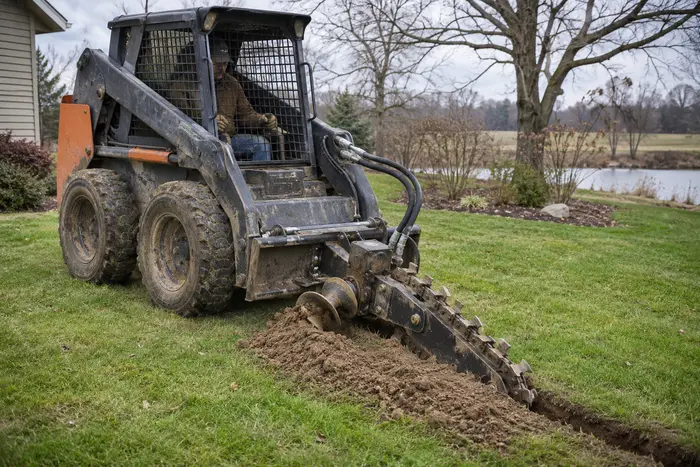
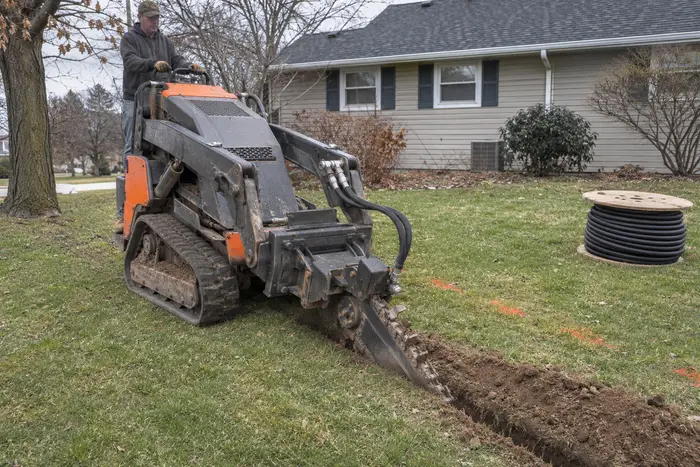
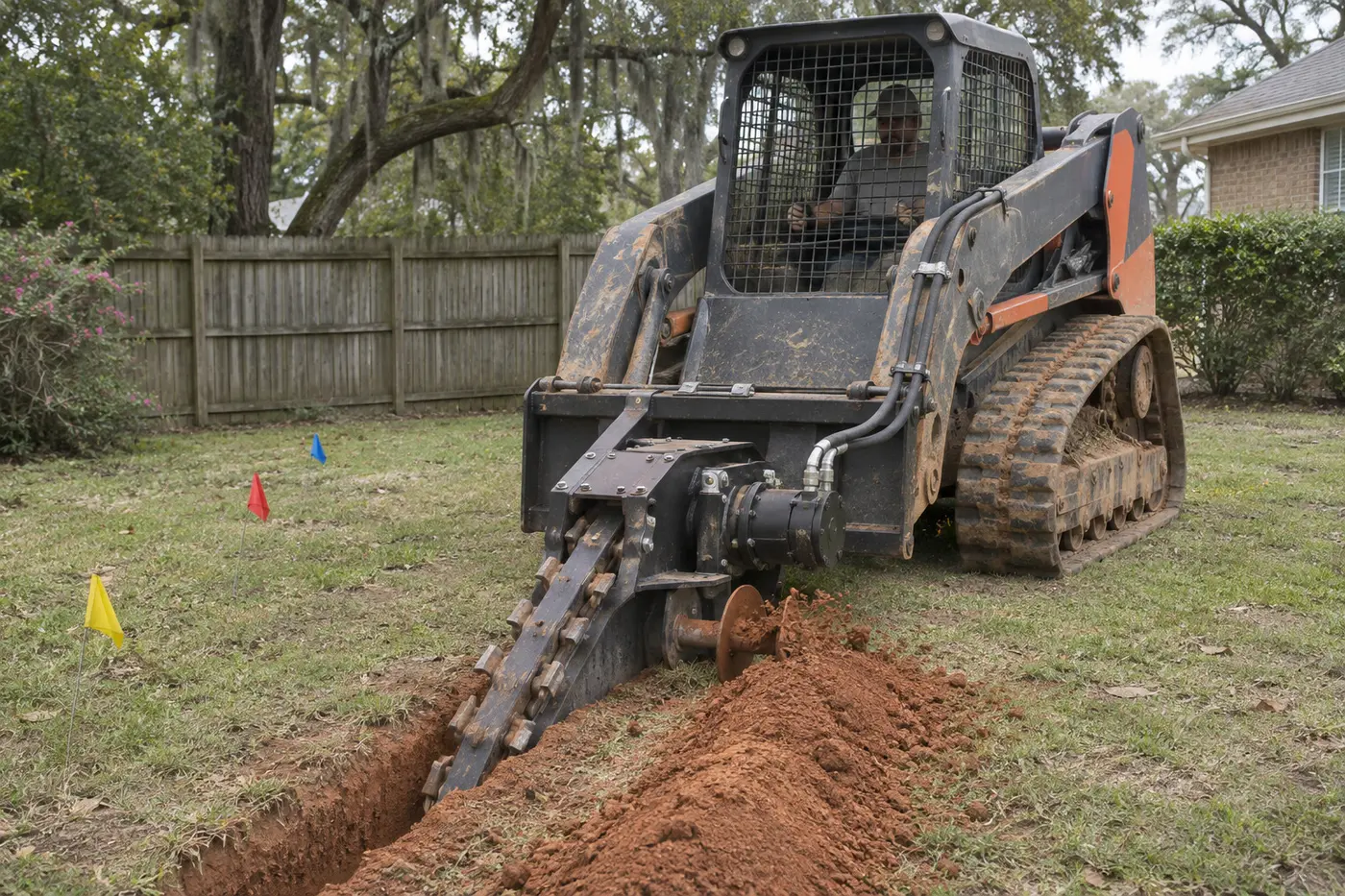
- Back up in a straight line. The chain cuts as the machine moves rearward, pulling spoil out and placing it to one side. Use slow, even travel.
- Watch the load. If the engine drops or the chain slows, ease off travel speed, not the hydraulics. Stalling means too much load for the soil.
- Keep the line. Steer in small corrections. A skid steer can twist the boom if you turn hard.
- Raise out at the end. Lift the boom while the chain is still turning so it clears the trench cleanly, then stop the chain.
Work in one direction. Trying to reverse the chain or push the machine forward through a cut stresses the boom and teeth.
Settings that matter: depth, speed and soil
| Soil | What to expect | Adjustment |
|---|---|---|
| Loose loam or sand | Fast cutting; walls may cave | Shallower cut or shoring; widen the safe zone |
| Clay | Sticky; chain can pack | Slow travel; clean the pockets often |
| Gravel or cobble | Hard on teeth | Carbide or rock teeth; expect wear |
| Rock or frozen ground | Chain may stall or skip | Use the right chain or choose another tool |
Travel speed is the control that matters most. Too fast and the chain packs and stalls. Too slow and the teeth polish rather than cut. Watch the spoil: a steady stream means the pace is right.
Trench depth and safety rules
Deep trenches can collapse. In the US, OSHA's excavation rules require protective systems such as sloping, shoring or a trench box once a trench reaches five feet in depth, unless it is dug entirely in stable rock, and a competent person must inspect excavations. In Canada, provincial rules apply, and some set the limit lower, at about 1.2 m (4 ft). A trencher may cut a narrow slot, but the same collapse risk applies. Plan the depth first, and do not enter a trench that is not protected. If the trench will be deeper than the rule allows without protection, talk to your local safety authority or a competent person before you start.
- Never reach into the chain area. Shut the hydraulics off and relieve the pressure before you clear debris.
- Keep bystanders well back. Spoil and rocks can fly.
- Follow the operator manual on slopes, and never trench across a slope that the machine cannot hold.
- Keep the restraint bar down and wear the protective gear the manual calls for.
Common uses: drains, sprinklers, conduit
For a French drain, cut the trench at a consistent grade toward the outlet, then place pipe and clean stone. Our guide to how deep a French drain should be covers depth. For sprinkler or irrigation lines, a narrow, shallow trench is enough. For conduit and cable, follow the depth in your local code.
If your machine is small, look at mini skid steer trenchers. For full-size machines, see our skid steer trenchers and the matching mini skid steer trenchers.
Troubleshooting common problems
- Chain keeps stalling. Slow the travel speed, check the flow, or switch to a chain that suits the soil.
- Trench wanders. Aim at a fixed point ahead, and avoid heavy steering input while cutting.
- Chain skips or throws teeth. Check tension and tooth condition. Replace worn teeth as a set.
- Spoil piles back into the trench. Check the auger or conveyor on the boom, and clean any packed clay.
- Cuts too shallow. Re-set the depth stop or the boom angle and recheck the ground for hard layers.
After the cut: finishing the trench
The trench is only half the job. Once the chain is out, look along the line and check the bottom for loose soil, rocks and stones that can damage pipe or cable. Set bedding if the product calls for it, lay the line, and backfill in thin layers. Compact each layer so the trench does not settle into a dip later. For drains, keep clean stone around the pipe so water can reach it.
Clean the chain at the end of the day. Packed clay and mud dry hard and wear the pockets. Grease the fittings listed in the manual, check the teeth, and store the boom off the ground so the chain stays clear of dirt.
Get the right fit the first time
A trencher only works if the flow, pressure and mount match your machine. Send us the make, model and year of your skid steer and we will confirm the fit against the maker's specs. You see a delivered price before you pay, and the supplier ships direct. Get a fit-checked quote.
Questions buyers ask
How do you use a trencher on a skid steer?
Call 811, mount and inspect the trencher, start the chain, lower it into the ground at the planned depth, and back the skid steer slowly in a straight line. The chain cuts as you move and throws spoil to one side. Adjust speed to the soil.
How deep can a skid steer trencher dig?
Published guides say full-size chain trenchers commonly reach about 36, 48 or 60 inches, while mini machines are shallower. Your attachment's spec sheet is the real limit. Soil, chain condition and machine hydraulics also affect how deep it will cut.
How do you use a trencher for a French drain?
Mark the line, check the grade toward the outlet, and cut the trench at a steady slope. Then lay perforated pipe and stone. Depth and slope depend on your site, so check local guidance and keep trench depth within safe limits.
Can a skid steer trencher dig through rock?
Rock tooth chains and carbide teeth can cut some rock and hard ground, but wear is high and a stall is likely in solid rock or frozen soil. For serious rock, other methods such as a breaker may be a better fit.
Do I need to call 811 before trenching?
Yes. In the United States, call 811 before any digging so utilities are marked. In Canada, use your provincial one-call service. Do not start until the marks are in place, and keep the marks visible while you work.