Landscaping guide
How Much Topsoil Do I Need? Cubic Yard Calculation
Quick answer
How much topsoil do I need? Multiply the area in square feet by the depth in inches, then divide by 324 to get cubic yards. A new lawn typically needs 3 to 4 inches of screened topsoil. For a 1,000 square foot lawn at 3 inches, that is about 9.3 cubic yards.
Shopping for this now? Get a fit-checked, delivered quote.
Key takeaways
- Cubic yards = length (ft) x width (ft) x depth (in) / 324.
- One cubic yard covers 324 square feet at 1 inch deep.
- New lawns typically need 3 to 4 inches of screened topsoil over graded ground.
- Measure irregular areas in sections, add them up and round up a little.
- Topsoil settles, so order a bit over and spread in a level layer.
Order too little topsoil and the crew stands around waiting for a second load. Order too much and you have a pile of dirt in the driveway. This guide answers "how much topsoil do I need" with a formula that takes a minute, a depth table you can scan, and tips for measuring odd-shaped areas.
How do you calculate how much topsoil you need?
Topsoil is sold by the cubic yard. A cubic yard is a cube that is 3 feet on each side, which is 27 cubic feet. Depth is usually measured in inches, so use the shortcut that bridges the two:
Cubic yards = length (ft) x width (ft) x depth (in) / 324
Where does 324 come from? One cubic yard is 27 cubic feet. Spread over one inch of depth, that is 27 x 12 = 324 square feet. So a cubic yard covers 324 square feet at 1 inch deep, and the coverage drops in step as the layer gets thicker.
Worked examples
- Lawn, 1,000 square feet at 3 inches. 1,000 x 3 / 324 = about 9.3 cubic yards.
- Garden bed, 10 ft by 20 ft at 6 inches. 10 x 20 x 6 / 324 = about 3.7 cubic yards.
- Low spot, 12 ft by 15 ft at 2 inches. 12 x 15 x 2 / 324 = about 1.1 cubic yards.
How much topsoil per square foot at different depths?
| Depth | Area covered by 1 cubic yard | Yards for 500 sq ft | Yards for 1,000 sq ft |
|---|---|---|---|
| 1 in | 324 sq ft | 1.5 | 3.1 |
| 2 in | 162 sq ft | 3.1 | 6.2 |
| 3 in | 108 sq ft | 4.6 | 9.3 |
| 4 in | 81 sq ft | 6.2 | 12.3 |
| 6 in | 54 sq ft | 9.3 | 18.5 |
| 8 in | 40.5 sq ft | 12.3 | 24.7 |
| 12 in | 27 sq ft | 18.5 | 37.0 |
How deep should topsoil be?
It depends on the job. A few common cases:
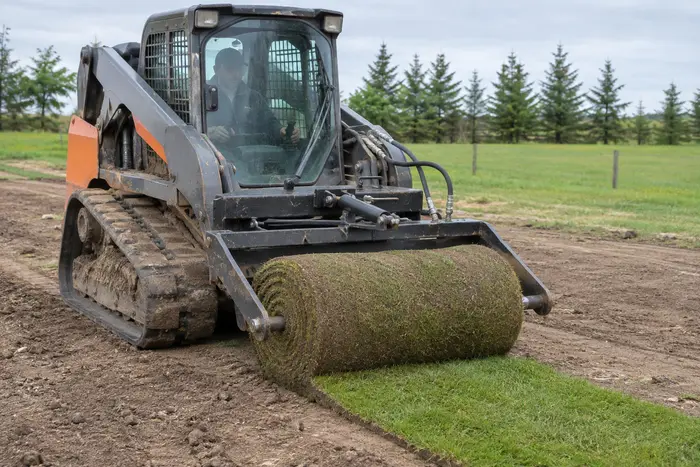
- New lawn from seed or sod. Spread about 3 to 4 inches of screened topsoil over graded ground, rake it level and let it settle before you sow or lay sod. If the existing soil is already decent, working about 2 inches into the surface does more good than laying 4 inches on top.
- Bare patches. Use a thin layer, just enough to give seed something to sit in.
- Topdressing a lawn. A light layer, much thinner than for a new lawn, to even out low spots. Adding too much can smother the grass.
- Garden beds. Deeper, often 6 inches or more, depending on the plants. Raised beds are a volume problem, not an area problem, so use the bed's length x width x height.
- Filling a low spot. Measure the depth of the dip at its deepest point, and use the average across the patch.
How do you measure irregular areas?
- Sketch the area and break it into simple shapes: rectangles, triangles and circles.
- Measure each shape in feet. For a rectangle, length x width. For a circle, 3.14 x radius x radius. For a triangle, half the base x height.
- Add the areas to get square feet.
- Pick a depth in inches and apply the formula.
- Round up. Orders are in half or whole yards, and soil settles after it is spread.
For sloped or lumpy ground, take depth measurements at several points and average them. A string line stretched across the area makes it easier to see how deep the fill must be.
How much does a cubic yard of topsoil weigh?
Weight depends on moisture and the mix. As a rough guide, a cubic yard of topsoil weighs about a ton or more, and wet soil is heavier. Ask your supplier for their figure. Weight matters if you are hauling it yourself, because a pickup bed has a payload limit that fills up fast. For more than a few yards, delivery is usually simpler. Bulk soil usually works out cheaper per yard than bags for anything beyond a small job. Three yards works out to about 108 bags, if each 40 lb bag holds 0.75 cubic feet, which is a lot to lift and carry.
What kind of topsoil should you buy?
- Screened topsoil. Sifted to remove rocks, roots and clumps. This is the best choice for lawns and beds.
- Topsoil and compost blends. Often sold as mostly topsoil with a smaller share of compost; ask the supplier for the ratio. These are usually a good choice for new lawns and beds.
- Fill dirt. Used to raise grade, not to grow plants.
Ask the supplier what is in the pile, and look at it before you buy.
What mistakes lead to ordering the wrong amount?
- Mixing units. Feet and inches in the same formula give nonsense. Convert everything to feet for length and width, and inches for depth, then divide by 324.
- Forgetting the area you will not cover. Subtract patios, walks and beds that already have soil. Otherwise you over-order.
- Using the loose pile depth. Freshly dumped soil is fluffy. It compacts after watering and rolling, so the finished depth is a bit less than the spread depth.
- Measuring the wrong depth. Measure from the finished grade down, not from where the current grass sits.
- Ordering to the exact number. Always add a little. Running short by half a yard is annoying and costs another delivery.
Do you need topsoil for sod or seed?
Both need a good bed. Sod comes with its own soil attached, but it still needs loose, level ground to root into, so rake the surface flat so the seams sit even. Seed needs fine, firm soil with good contact. Either way, skip the temptation to bury the old lawn under a thick layer of new soil. If the existing ground is hard clay or compacted fill, loosen it first, then add topsoil and mix it into the top few inches so roots do not stop at a sharp boundary.
How do you spread topsoil with a skid steer?
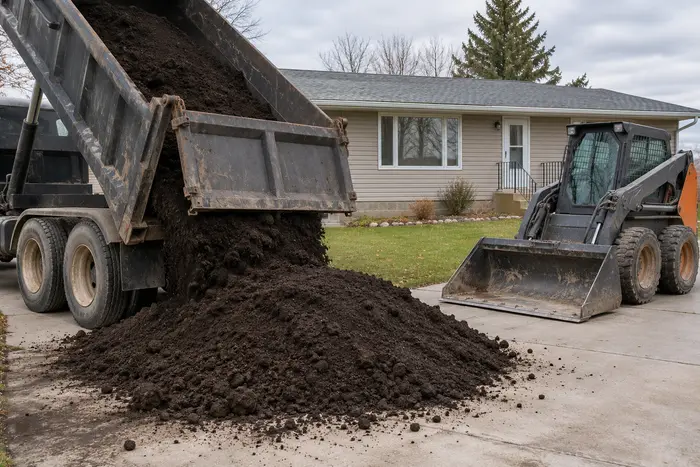
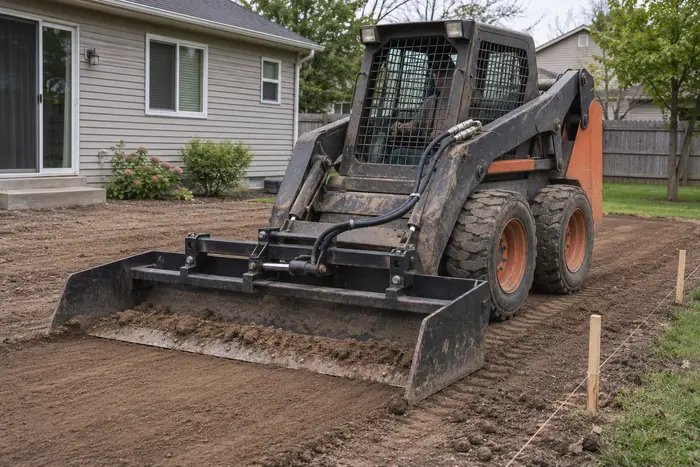
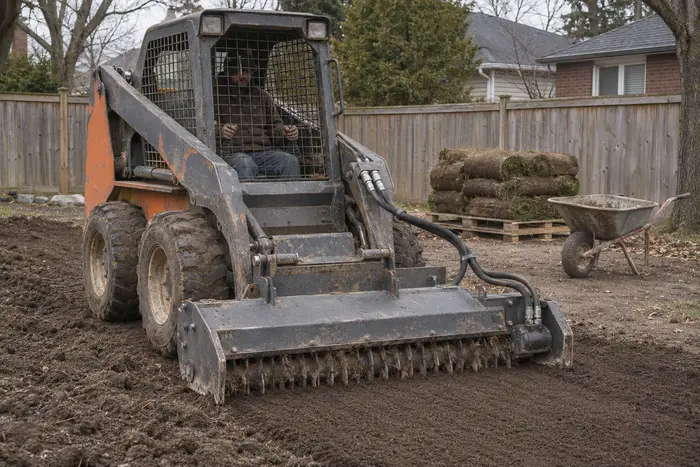
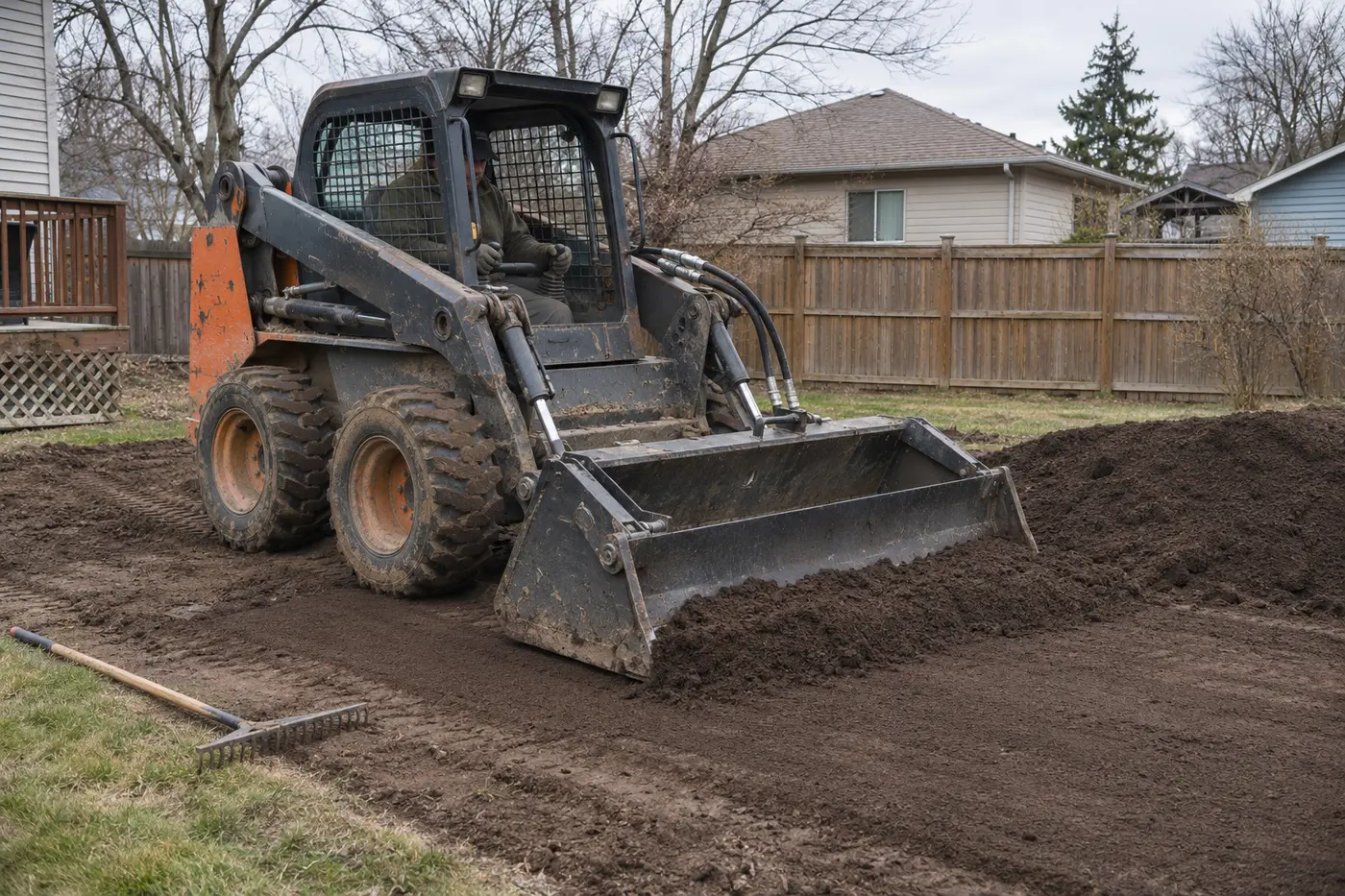
For loads of a few yards or more, a skid steer makes spreading much faster than a wheelbarrow. Dump the load, push it out with a bucket, and finish with a landscape rake, which pulls out rocks and roots and leaves a seedbed surface. See our landscape rakes and buckets. A tiller helps you mix topsoil into the existing ground. Rotary tillers do that job. For ideas on leveling first, read how to level ground with a skid steer.
What should you do after spreading?
- Rake it level and fill any low spots.
- Water it in lightly. Topsoil settles over a few days once it is spread and watered.
- Sow seed or lay sod after the soil stops moving. Sowing into soil that is still shifting gives you an uneven lawn.
- Keep the surface damp until the grass takes hold.
Get the right fit the first time
If you plan to spread topsoil with a loader or rake, the attachment has to fit your machine. Send us your make, model and year. We will confirm fit against the manufacturer's specs and give you a delivered price to approve before you pay. Start with a fit-checked quote.
Questions buyers ask
How much topsoil do I need for a new lawn?
A new lawn typically needs 3 to 4 inches of screened topsoil over graded ground. For 1,000 square feet, that is about 9.3 cubic yards at 3 inches and 12.3 at 4 inches. If your existing soil is decent, working in about 2 inches may do more good than a thick layer on top.
How do I calculate cubic yards of topsoil?
Multiply length in feet by width in feet by depth in inches, then divide by 324. For example, a 20 by 30 foot area at 4 inches is 20 x 30 x 4 / 324, or about 7.4 cubic yards. Round up a little because soil settles after you spread it.
How much topsoil do I need for grass seed?
Spread a layer of screened topsoil on graded ground and rake it level before sowing. A new lawn usually needs 3 to 4 inches. For overseeding or small bare patches, a thin layer is enough to give the seed contact with the soil. Do not bury seed deeply.
How much area does one cubic yard of topsoil cover?
One cubic yard covers 324 square feet at 1 inch deep, 162 square feet at 2 inches, 108 square feet at 3 inches and 81 square feet at 4 inches. Divide 324 by the depth in inches to get the coverage for any other depth.
Is it cheaper to buy topsoil in bulk or bags?
Bulk is usually cheaper for anything beyond a small job, and it saves a lot of handling. Three yards is about 108 bags, if each 40-pound bag holds 0.75 cubic feet. Bags make sense for small patches and raised beds, but a delivery of bulk soil is simpler for a lawn.