Skid steer guide
Skid Steer Backhoe Attachment: Buying Guide
Quick answer
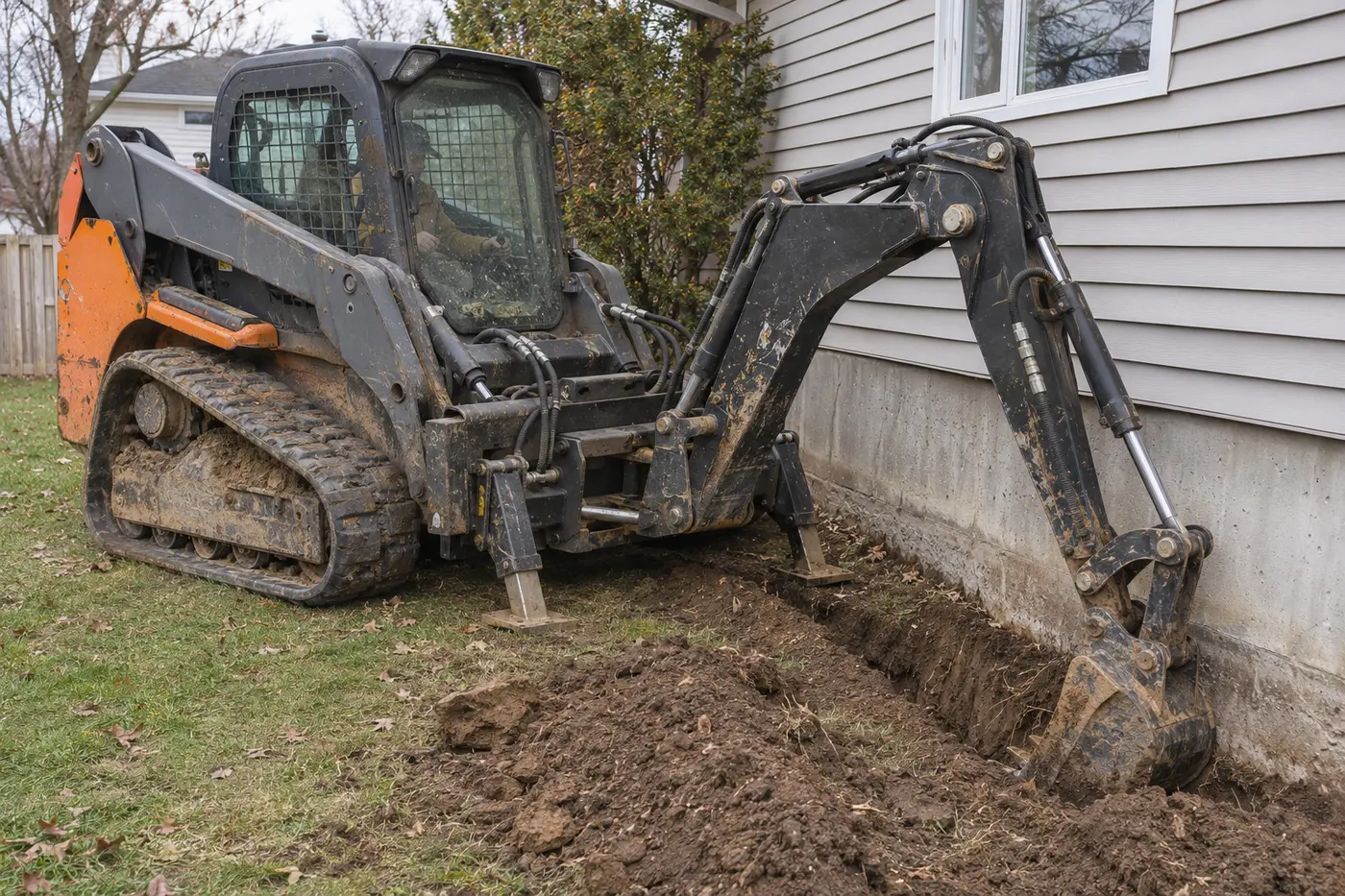
A skid steer backhoe attachment mounts on the quick-attach plate and gives a loader a digging arm for trenches, footings and utility work. It runs off the loader's auxiliary hydraulics, so flow, pressure and weight matter. It suits occasional digging; heavy daily excavation is better served by a dedicated excavator.
Shopping for this now? Get a fit-checked, delivered quote.
Key takeaways
- It adds digging depth and reach to a loader you already own.
- Check hydraulic flow, pressure and the loader's rated capacity first.
- Swing, thumb and bucket options change what the tool can do.
- For daily heavy digging, a mini excavator is often the better machine.
A skid steer backhoe attachment bolts to your loader's quick-attach plate. It gives you a boom, a stick and a bucket, so you can dig below grade without buying a second machine. For farms, small contractors and property owners, that can be a practical shortcut. It is not a full excavator, though, and knowing the difference saves money.
What is a skid steer backhoe attachment?
It is a self-contained digging arm. The attachment sits on the front of the loader. It plugs into the loader's auxiliary hydraulic couplers and is controlled either by the loader's own controls or by levers on the attachment, depending on design. Many use a stabilizer or pads that rest on the ground to keep the machine steady while you dig.
The loader supplies power and weight. The attachment supplies the digging geometry. If you want to see all the options, our skid steer backhoe category lists the type of units we can fit-check.
What jobs suit a backhoe attachment?
- Trenches for water, drainage, electrical conduit and irrigation.
- Footings and small foundations for sheds, decks and pads.
- Septic and drainage repair where you need controlled digging.
- Post holes and small excavations beside an existing building.
- Cleanup around buried pipes where a loader bucket cannot reach.
These tasks are short digging jobs. If you dig deep trenches or big holes every day, read the comparison below.
How does it compare with a mini excavator?
A mini excavator is built for digging. It has a rotating house, tracks, and a boom that sits low. A backhoe attachment borrows the loader's weight and hydraulics, and the digging reach and force are limited by that setup.
| Factor | Skid steer backhoe attachment | Mini excavator |
|---|---|---|
| Upfront cost | Lower if you own the loader | Higher, a separate machine |
| Digging reach and force | Moderate | Greater |
| Rotation | Limited, often swing arm | Full 360 degrees on most models |
| Stability | Depends on stabilizers and loader weight | Designed for digging loads |
| Best use | Occasional digging | Daily excavation |
If excavating is your main work, compare the machines in our mini excavator vs skid steer guide. For a general look at the older machine type, see backhoe vs excavator.
What should you check before you buy?
- Hydraulic flow and pressure. Compare the attachment's requirement with your loader's auxiliary output. Too little flow means slow, weak digging.
- Rated operating capacity. The attachment adds weight far forward on the loader. Check your operator manual so you do not exceed the machine's limits. Our guide on how much a skid steer can lift explains the basics.
- Mounting standard. A universal skid steer quick attach plate is common, but confirm the plate fit and hose routing.
- Digging depth and reach. Choose the depth you need for your usual trench, with margin.
- Swing arm. A swing arm lets you dig off-center without repositioning the loader. It helps in tight spaces.
- Thumb option. A thumb helps you pick up rocks, logs and debris that you dig out.
- Bucket sizes. Narrow buckets suit utility trenches. Wider ones move more material.
Does it work on a tractor?
Some units are built for tractor three-point hitches instead of skid steer plates. Those are a different product, and they use the tractor's hydraulics or a power take-off. If you are searching for a tractor backhoe, check the hitch category and power source before comparing it to a loader attachment. Our three-point hitch categories guide explains how to match one.
Setup and safety notes
Keep these basics in mind every time you dig:
- Call your local utility locating service before any digging.
- Set the stabilizers or ground pads on firm, level ground.
- Never dig under a bank that can collapse onto you or the machine.
- Keep people clear of the swing and dig area.
- Follow the attachment manual and the loader's rated operating capacity.
Trenches can cave in without warning. Excavation safety rules are strict for a reason, so shore or slope deeper trenches the way your local rules require.
Maintenance
Grease the pivot points on a schedule, inspect hoses and couplers for wear, and check the pins and bushings. Keep the bucket teeth sharp. Our guide on skid steer attachment maintenance gives a simple routine.
Is it worth it?
For light to moderate digging on a machine you already own, it can be. For daily excavation, a dedicated machine is usually more productive, more stable in deeper trenches and easier on the loader. Decide by how often you dig, how deep, and how much of your loader's capacity the attachment will use.
Questions to ask before you order
- What is the maker's stated hydraulic flow and pressure range, and does your loader fall inside it?
- How much does the attachment weigh, and how does that sit against your loader's rated operating capacity?
- Does it need a case drain or a dedicated hose set, and does your machine have the right ports?
- Which digging depth and reach does the maker publish, and is that enough for your deepest trench?
- What wear parts, such as pins, bushings and bucket teeth, will you replace first?
A fit check answers these against your exact machine, which is why we confirm fit before quoting.
Digging tips that save time
- Plan the trench line and mark it with paint before you start.
- Dig in passes. Take the top layer first, then go deeper.
- Keep spoil on one side so you have a clear path for backfill.
- Stay clear of power lines and buried utilities.
- Lift and re-set the stabilizers as you move along the trench so the loader stays stable.
When a different tool is better
If you only need post holes, an auger is faster. If you need to cut a long, narrow utility line, a trencher is neater and quicker. If you need to move loose material, a bucket does it with no extra gear. A backhoe attachment earns its place when you need a mix of digging tasks and you want to avoid buying a separate excavator. See augers for the post-hole alternative.
Finally, think about who will run it. Digging with a backhoe arm feels different from loader work, and a new operator needs practice on open ground before working near a foundation or a utility line. Start shallow, learn how the stabilizers and the swing behave, and build up to the real job.
Get the right fit the first time
Tell us the make, model and year of your machine and the job you want it to earn on. A person checks fit against the maker's specs, and you see a delivered price before you pay. Get a fit-checked quote.
Questions buyers ask
how does a skid steer backhoe attachment work
It mounts on the loader's quick-attach plate and connects to the auxiliary hydraulics. The loader supplies power and weight, and the attachment supplies a boom, stick and bucket. Stabilizers or ground pads keep it steady while you dig. Controls vary by model.
what size trench can a skid steer backhoe dig
It depends on the model's rated dig depth and reach, which the maker publishes. Choose an attachment with more depth than your usual trench needs. Also check your loader's rated capacity, since the arm adds weight forward on the machine.
is a skid steer backhoe attachment better than a mini excavator
For occasional digging on a loader you already own, it is a lower-cost option. For daily or deep excavation, a mini excavator has more reach, force and stability. Compare how often you dig and how deep before choosing.
what hydraulic flow does a skid steer backhoe need
It varies by model, so check the maker's flow and pressure range against your loader's auxiliary output. Too little flow makes the arm slow and weak. Send us your machine's make, model and year and a person will confirm fit.