Skid steer guide
Compact Track Loader Undercarriage Care Guide
Quick answer
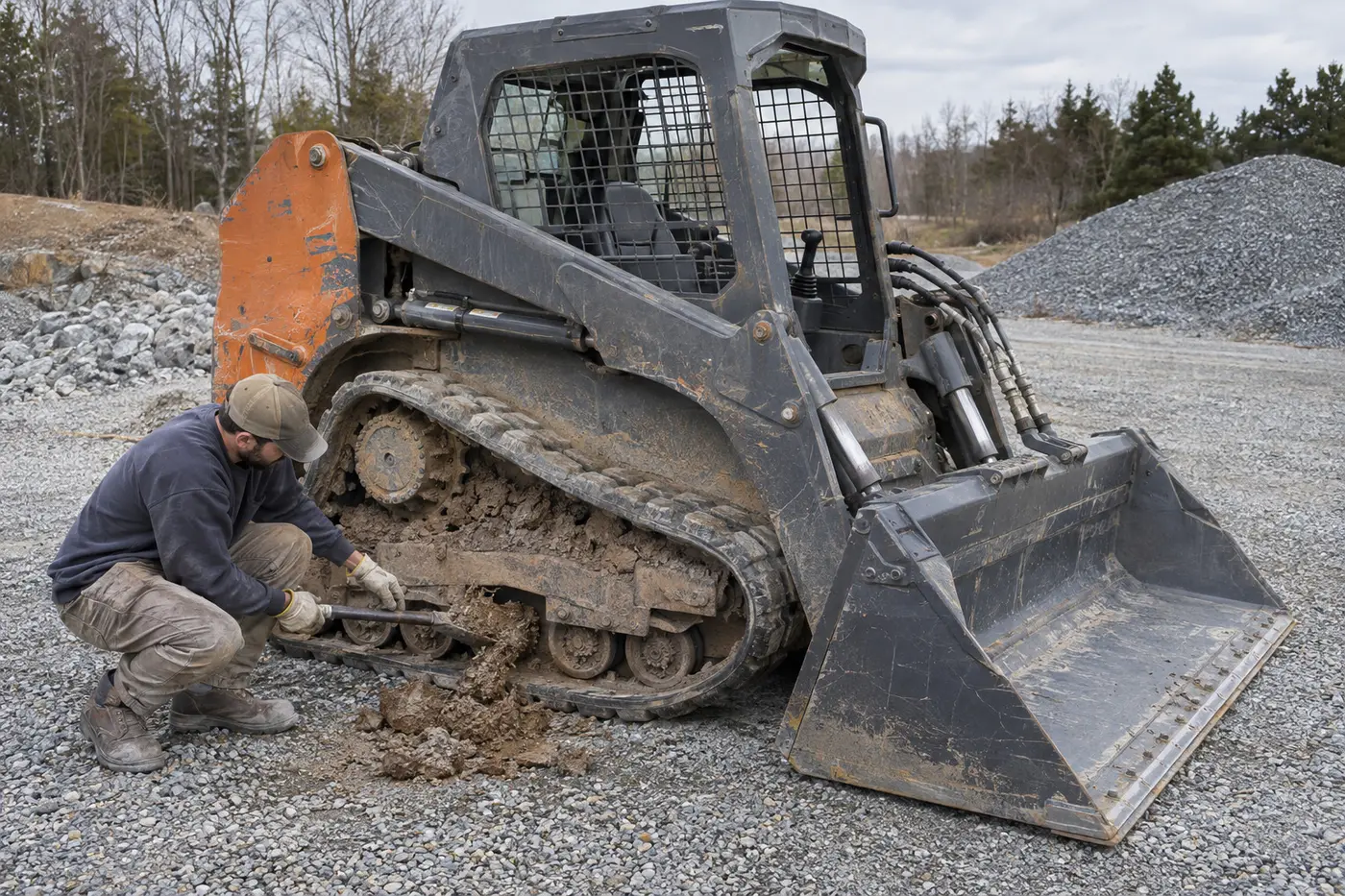
Compact track loader undercarriage care comes down to cleaning packed debris daily, keeping track tension to the maker's spec, inspecting rollers, idlers, sprockets and the track for wear and damage, and running smart: avoid hard spins, sharp turns on pavement and prolonged side slopes. Follow the operator manual for service intervals.
Shopping for this now? Get a fit-checked, delivered quote.
Key takeaways
- Clean debris from the undercarriage every day, especially in mud and snow.
- Track tension must match the manual; too loose or too tight both cause wear.
- Inspect rollers, idlers, sprockets and the track for wear, leaks and damage.
- Driving style is one of the biggest factors in undercarriage life.
The undercarriage is one of the most expensive wear systems on a compact track loader. It is also the one operators ignore until something fails. A small daily routine protects it, and a short list of checks catches trouble early. This guide covers what the undercarriage is, how to care for it and how to drive in ways that make it last. For service intervals and tension values, always use your operator manual.
What is the undercarriage on a compact track loader?
The undercarriage is everything below the machine frame that carries and drives the tracks. A general reference notes that compact track loaders are skid steer loaders fitted with tracks in place of wheels. The main parts are:
- Tracks. Rubber belts, often with embedded steel cords, with a tread pattern.
- Drive sprockets. They engage the track and pull it around.
- Rollers. They carry the machine's weight along the track's ground contact.
- Idlers. Wheels at the ends of the track frame that guide the track and hold tension.
- Tensioning system. Usually a grease cylinder or spring that sets track tension.
- Track frame. The structure that holds rollers and idlers.
If you are comparing machine types, read skid steer wheels vs tracks. The wheel versus track decision affects undercarriage costs for as long as you own the machine.
Why does undercarriage care matter?
Undercarriage parts wear steadily, and wear speeds up when debris, wrong tension or rough use are added. A worn sprocket chews a new track. A seized roller drags and damages the belt. A loose track can come off the rails. Each failure is expensive, and most are preventable with cheap, regular attention.
Daily care routine
- Clean it. Remove mud, clay, stones, snow and ice packed around sprockets, rollers and idlers. Packed material wears parts faster and can raise track tension.
- Look it over. Walk around the machine. Check for cuts and missing lugs in the track, leaking seals, loose bolts and objects caught in the undercarriage.
- Check tension. Measure track sag as the manual describes. Adjust only to the maker's spec.
- Listen. Squeaks, clicks and grinding noises point to dry or damaged parts.
- Grease. Follow the manual for grease points, especially on the tension system if it needs it.
How to check track tension
Track tension is easy to get wrong. Too loose, and the track can derail or slap and wear the sprocket. Too tight, and the belt, bearings and sprockets carry extra load and wear faster. The correct method is in your manual and usually involves measuring the sag between the roller and the idler with the track lifted or on level ground. Do not use a guess. Adjust it with the maker's tool and grease procedure, and recheck after a day of work, because new tracks can stretch and settle.
| Problem | Likely cause | What to do |
|---|---|---|
| Track comes off | Too loose, debris, hard turns | Clean, reset tension, review driving |
| Fast sprocket wear | Wrong tension or worn track | Check tension, replace parts together if worn |
| Cuts and missing lugs | Sharp objects, rough surfaces | Inspect, replace if cords are exposed |
| Roller leaks or noise | Failed seal or bearing | Replace the roller |
| Track feels too tight | Packed debris or over-greasing | Clean, release to spec |
What should you inspect for wear?
- Track. Look for exposed steel cords, deep cracking, torn or missing lugs and delamination.
- Sprockets. Look for hooked or pointed teeth, which signal wear.
- Rollers and idlers. Check for leaks, flat spots, wobble and uneven wear.
- Guide lugs and tread. Missing guide lugs let the track wander.
- Mounting bolts. Loose bolts on rollers and sprockets can cause damage quickly.
Replace parts that wear together as a set where the maker recommends it. A new track on a worn sprocket wears out early. Our used skid steer inspection checklist shows what to look at when evaluating a used track machine, including undercarriage wear.
How does driving style affect undercarriage life?
- Avoid spinning in place on hard surfaces. Counter-rotation grinds the track against the ground.
- Make wide turns when you can. Sharp pivots on pavement are hard on the belt.
- Limit travel on abrasive surfaces. Concrete, rough asphalt and sharp rock wear tracks quickly.
- Avoid curbs and hard edges. Climb them straight, not at an angle.
- Do not run side slopes for long. They load the track edge.
- Reduce speed. High-speed travel increases wear and heat.
- Use the right track for the ground. Tread patterns suit different conditions.
The wheel-versus-track tradeoff also shows here. Tracks give good traction and low ground pressure on soft ground but wear on pavement. If your work is mostly on hard surfaces, over-the-tire tracks or wheels may suit better. Read our over-the-tire tracks guide and look at over-the-tire tracks.
Cold weather and winter care
Ice and packed snow can freeze around rollers and sprockets overnight. Clear it before you start, and do not force a frozen track to move. Park on a surface that will not freeze the tracks to the ground when possible. If you use the machine for snow, see our snow removal guide.
Washing and storage
A pressure wash helps with caked mud, but keep the spray away from seals and bearings. After a wash, run the machine briefly and grease as needed so no water sits in joints. Store the machine under cover when possible. UV light and ozone age rubber tracks over time.
When to replace
Replace the track when cords are exposed, when lugs are missing in large sections, when the track will not hold tension, or when it has been damaged beyond repair. Do not wait for a failure in the field. Replace rollers with leaks or noise, and sprockets with hooked teeth, ideally alongside the track. Parts availability and cost vary, so get quotes and ask a service shop what else is near the end of its life when the track is off.
Keep a simple log with date, hours and what you checked or replaced. Over time, it shows you how your ground and driving habits affect wear, and it helps when you sell the machine.
Buying a used track machine
Undercarriage condition is a big part of a used track loader's value. Ask about hours, ask for photos of the tracks, sprockets and rollers, and inspect in person if you can. A machine with a nearly new undercarriage is worth more than the same machine needing a full replacement. Factor that cost into your offer.
Working in snow or mud with a wheeled machine instead? Compare snow pushers and other attachments sized for your loader.
Get the right fit the first time
Send us the make, model and year of your machine and the job you have in mind. A person checks fit against the maker's specs, and your quote shows one delivered price, freight to your address included. The order ships direct from the supplier. Start with a fit-checked quote request.
Questions buyers ask
how do you check track tension on a compact track loader
Follow your operator manual. It usually means measuring track sag between the roller and the idler under set conditions, then adjusting with the maker's grease procedure. Too loose can derail the track; too tight accelerates wear. Recheck after a day of work.
what is the undercarriage on a track loader
It is the system below the frame that carries and drives the tracks: the tracks, drive sprockets, rollers, idlers, tensioning system and track frame. It is one of the most expensive wear systems on a compact track loader and needs regular cleaning and inspection.
how long does a track loader undercarriage last
It varies widely with ground conditions, driving style and maintenance. Abrasive surfaces, hard pivots, wrong tension and packed debris shorten life. Daily cleaning, correct tension and gentle driving extend it. Your maker's service guidance gives replacement criteria.
what are the signs a track needs replacing
Exposed steel cords, large areas of missing lugs, deep cracks, repeated derailing or a track that will not hold tension all point to replacement. Check sprockets and rollers at the same time, because worn parts can ruin a new track.